 ENG
ENG
 INA
INA
Guest Lecture “Typology of Passive Analytical Constructions in Southeast Asian Languages: A Preliminary Study” with Associate Prof. Hiroki Nomoto from Tokyo University of Foreign Studies
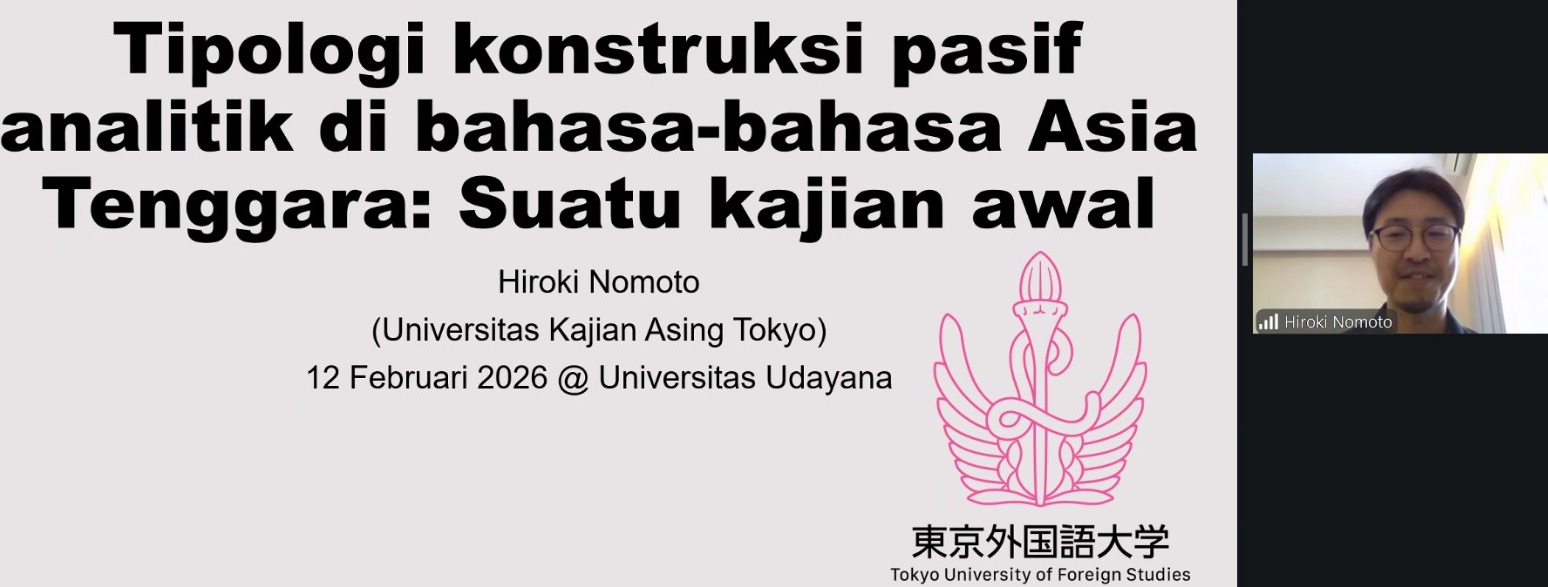
The Faculty of Humanities Udayana University held another international academic forum through a guest lecture on February 12, 2026. The event was opened by the Dean of the Faculty of Humanities Udayana University, Prof. I Nyoman Aryawibawa, S.S., M.A., Ph.D., while the moderator for the event was Gede Primahadi Wijaya Rajeg Ph.D. The public lecture was conducted online via the Zoom application and was attended by the Head of Research and Community Service Unit of the Faculty of Humanities, Dr. Ngurah Indra Pradhana, S.S., M.Hum., as well as students and lecturers from the Faculty of Humanities.
On this occasion, Associate Professor Hiroki Nomoto from Tokyo University of Foreign Studies presented a paper titled “Typology of Analytic Passive Constructions in Southeast Asian Languages: A Preliminary Study.” This guest lecture explored in depth the differences between synthetic and analytic passives, and offered a theoretical perspective on the definition and classification of passive constructions. This event served as a forum for scientific discussion that enriched linguistic studies, particularly in the field of syntax and language typology in Southeast Asia. In his presentation, Associate Prof. Hiroki Nomoto explained that there is no single universal definition of passive voice, but rather certain morphosyntactic features that characterize passive constructions. He emphasized the importance of viewing passive voice from the perspective of internal arguments, especially for languages in the archipelago that have different diathesis characteristics from European languages. Through a theoretical approach to three-layered verb phrase structures, Nomoto explained the role of voice makers and voice markers in forming active and passive constructions. This explanation shows how modern syntactic analysis can bridge the differences in the structures of Malay, Indonesian, Balinese, and other languages in Southeast Asia.
Furthermore, this research classifies analytical passives based on three main characteristics, namely the syntactic category of Aux, morphological independence, and the modal meaning of Aux. Various language examples such as Standard Malay (kena), Vietnamese (bị), Patani Malay (kenor), and languages in Sarawak are presented to show the typological variation of analytical passive constructions. Through this typological mapping, research on analytical passive constructions in Southeast Asia is expected to contribute significantly to the development of syntactic theory and comparative linguistics. This guest lecture also reaffirms Faculty of Humanities Udayana University's commitment to promote international research collaboration and strengthening linguistic studies at the global level.
UDAYANA UNIVERSITY