 ENG
ENG
 INA
INA
Faculty of Humanities Udayana University, Tsinghua Southeast Asia Center and ANU’s School of Cybernetics Organize International Conference “AI, Indigenous Knowledge, and Environmental Sustainability”
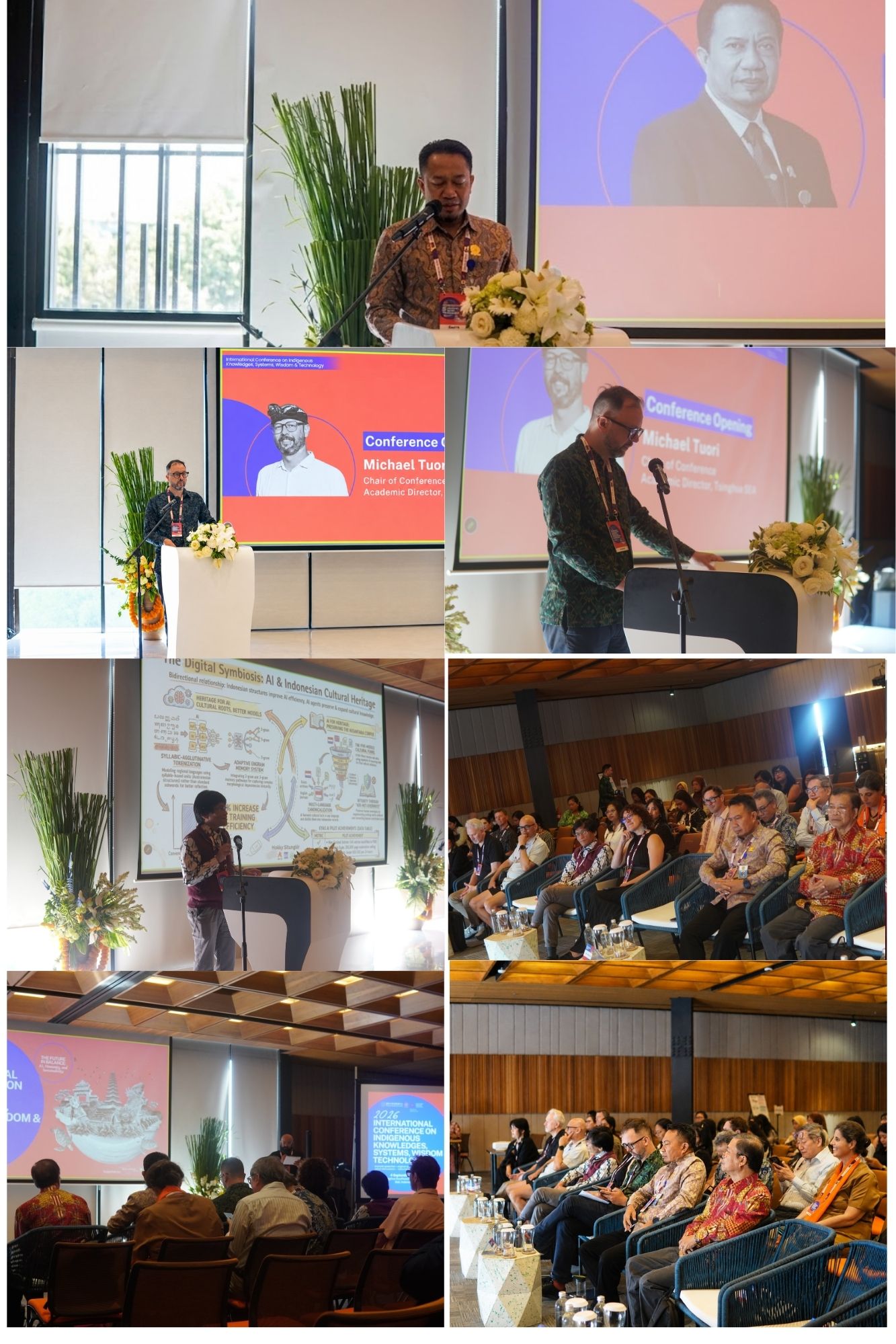
On Friday, 4 September 2026, the Faculty of Humanities of Universitas Udayana in collaboration with the Tsinghua Southeast Asia Center and the School of Cybernetics, The Australian National University, organized the International Conference on Indigenous Knowledges, Systems, Wisdom & Technology (CIKSWT) 2026 at the Tsinghua Southeast Asia Center – Kura Kura Bali SEZ as part of the Badan Kekeluargaan (BK) FIB Unud 2026 agenda. Themed “The Future in Balance: AI, Humanity, and Sustainability,” the conference brought together 23 researchers from 7 countries to discuss the interconnectedness of AI, Indigenous knowledge, knowledge systems, governance, and environmental sustainability.
The opening session of the conference was initiated by Michael Tuori, Chair of Conference and Academic Director of the Tsinghua Southeast Asia Center. He stated that this conference was an extension of the Conference on Indigenous Wisdom in the Contemporary World, with a broader focus on indigenous knowledge, systems, wisdom, and technology. He emphasized the importance of integrating various ways of understanding, experiencing, and applying local knowledge in addressing modern challenges, including AI development and sustainability.
Prof. Ir. I Ketut Sudarsana, S.T., Ph.D., Rector of Udayana University stated that the theme “The Future in Balance: AI, Humanity, and Sustainability” is highly relevant to current technological developments. He explained that AI provides significant opportunities to accelerate innovation, research, and solutions to global challenges; however, its implementation must remain based on ethics, responsibility, and human values. He also emphasized the importance of ensuring that AI development remains human-centered, culturally inclusive, and environmentally sustainable. Furthermore, he stated that innovation needs to progress alongside local wisdom, such as the Tri Hita Karana philosophy, which teaches balance between humans, nature, and spiritual dimensions. According to him, indigenous knowledge is not only a cultural heritage but also a source of knowledge that can inspire present-day solutions through collaboration between modern science and local wisdom.
The keynote speech was delivered by Hokky Situngkir, Founder of the Bandung Fe Institute, who discussed the relationship between artificial intelligence (AI) and the preservation of Indonesian culture. He introduced the concept of digital symbiosis, which refers to the reciprocal relationship between culture and AI, where culture can become a source of technological development, while AI can assist in documenting and expanding cultural knowledge. Hokky explained that AI development needs to consider local languages, data, and cultural values, including through the development of Toba.LM, which is designed to understand the structures of Indonesian and Austronesian languages. He emphasized that Indonesia’s linguistic and cultural diversity is not only a heritage that must be preserved but also an inspiration for developing more inclusive and sustainable AI technologies.
The next keynote speech was delivered by Prof. Angie Abdilla from the School of Cybernetics, The Australian National University, who discussed the relationship between artificial intelligence (AI), culture, and indigenous knowledge. In her presentation, she explained that technology and AI cannot be separated from culture because they emerge from particular stories, values, and perspectives. She highlighted that indigenous knowledge can provide important perspectives in addressing AI development, particularly through the principles of relationality, reciprocity, and regeneration. Prof. Angie also presented the Subak system in Bali as an example of a water management system based on the relationship between humans, nature, and spiritual values. She emphasized the importance of understanding the origins, values, and actors involved in shaping AI so that the technology can be developed while considering cultural diversity and its relationship with the living world.
Besides featuring researchers as speakers, the conference also involved FIB Unud lecturers as moderators in several discussion sessions. Dr. Sang Ayu Isnu Maharani, S.S., M.Hum., served as a moderator for the presentation session in the Saraswati Room, which discussed the topic “Relationality Between Living Systems and AI.” Meanwhile, Gede Primahadi Wijaya Rajeg, Ph.D., served as a moderator for the session “Plurality in AI” held in the Auditorium Room. Their involvement demonstrated the active role of FIB Unud academics in supporting discussions on the relationship between artificial intelligence, culture, and local knowledge during the conference.
The conference concluded with remarks from Prof. Dr. I Nyoman Darma Putra, M.Litt. who stated that the conference became a platform to discuss two different aspects: indigenous solidarity that has developed since the past and artificial intelligence (AI) as a modern technology. He explained that various interesting ideas emerged from the forum, such as how conventional learning systems could be applied to teach AI to children. In addition, he emphasized the importance of maintaining local identity in the use of technology, as well as exploring how culture can contribute to AI development and how AI can support the future of culture. He hoped that the ideas generated from this conference could serve as considerations for further exploring the use of AI in cultural development in the future.
UDAYANA UNIVERSITY