 ENG
ENG
 INA
INA
The Bachelor of English Literature at the Faculty of Humanities, Udayana University Held a Seminar on Language Documentation Guidelines with Expert from the Czech Republic
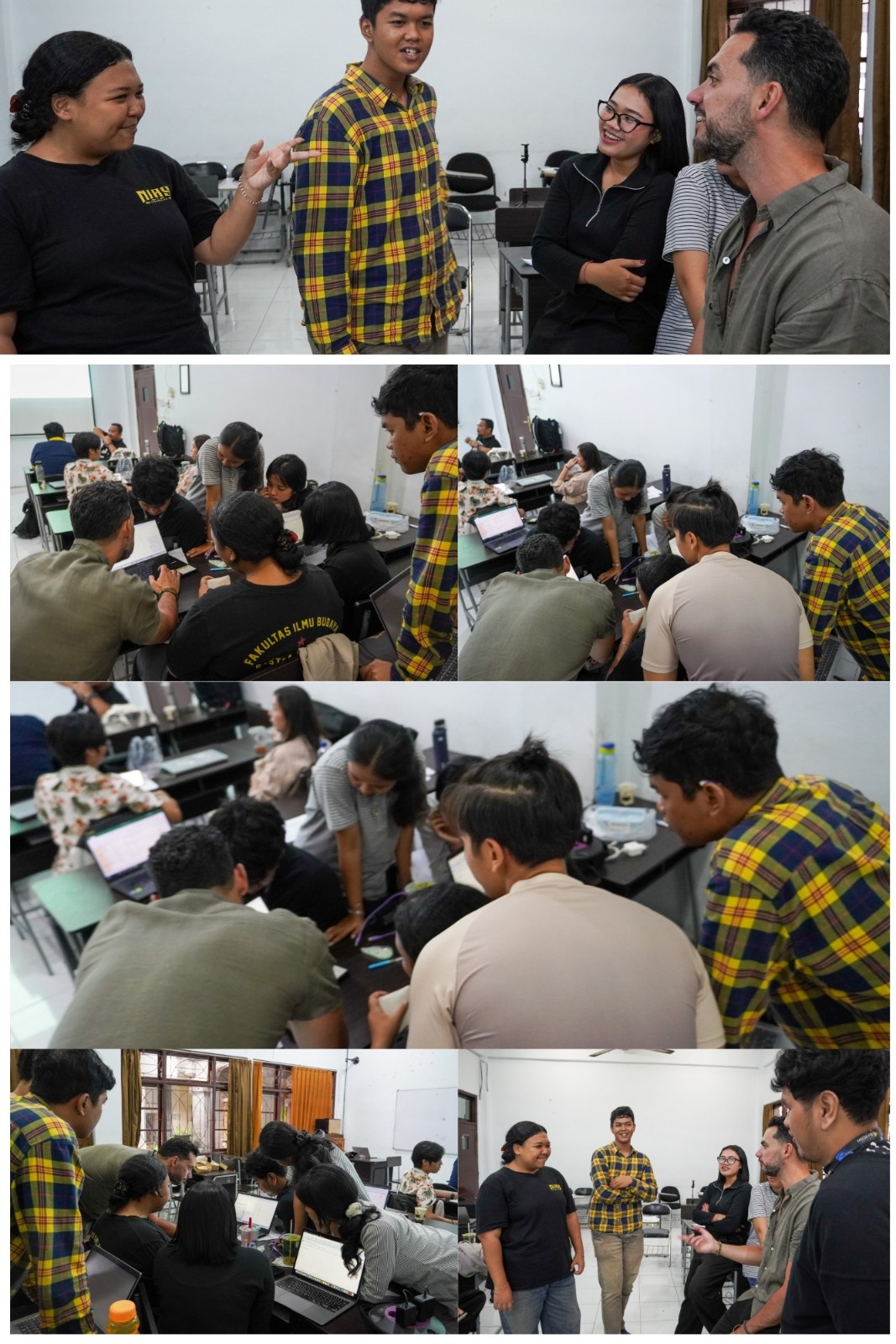
On Monday, March 16, 2026, the Bachelor of English Literature of the Faculty of Humanities (FIB), Udayana University, held a seminar titled “How to Conduct Language Documentation: From Start to Finish.” Located in Room 5, 1st Floor of the Dr. R. Goris Building, the event was attended by faculty members and students from the English Literature department. The workshop aimed to equip participants with technical skills in language documentation according to contemporary global standards.
The keynote speaker for the seminar was George Saad, a linguist from Palacky University Olomouc, Czech Republic. During the session, he explained that the primary motivation behind language documentation is to provide a tool for preserving and safeguarding endangered languages. He noted that language loss is often driven by factors such as: globalization, the lack of regional languages in educational curricula, and the social stigmatization of local dialects. Saad emphasized that conducting language documentation requires comprehensive linguistic data, which can include both oral and written language samples. To obtain this data, several critical stages must be observed, including meticulous planning, the selection of consultants (native speakers), and the implementation of formal consent. Research ethics were a central focus, ensuring that informants fully understand the research objectives, grant permission for data use, and retain the right to withdraw their consent at any time. Furthermore, participants were briefed on the importance of metadata, which is the supporting information regarding the speaker, the language, and the recording conditions that ensures the data remains intelligible and usable for future researchers.
In addition, lectures and participants had the opportunity to engage in simulations, alternating roles as researchers and native speakers to practice obtaining informed consent. The seminar also introduced various online linguistic resources and practical techniques, such as: systematic file naming, recording equipment operation, and transcription processes. Technical guidance was provided on how to record language data effectively using both mobile phones and professional equipment, with a strong emphasis on maintaining audio-visual quality and considering environmental conditions. Participants were also taught wordlist collection techniques, involving direct elicitation with speakers and re-pronunciation to ensure phonetic accuracy.
This activity is expected to empower participants to record linguistic data and compile comprehensive metadata independently. Beyond the technical aspects, the seminar highlighted that prioritizing research ethics through informed consent ensures that the results not only contribute to the advancement of linguistics but also serve as a tangible effort in preserving linguistic diversity across various regions.
UDAYANA UNIVERSITY