 ENG
 INA
Balinese Literature Study Program of FIB Unud Holds Practitioner Public Lecture, Examining Today's Media Landscape and Digital Journalism Challenges
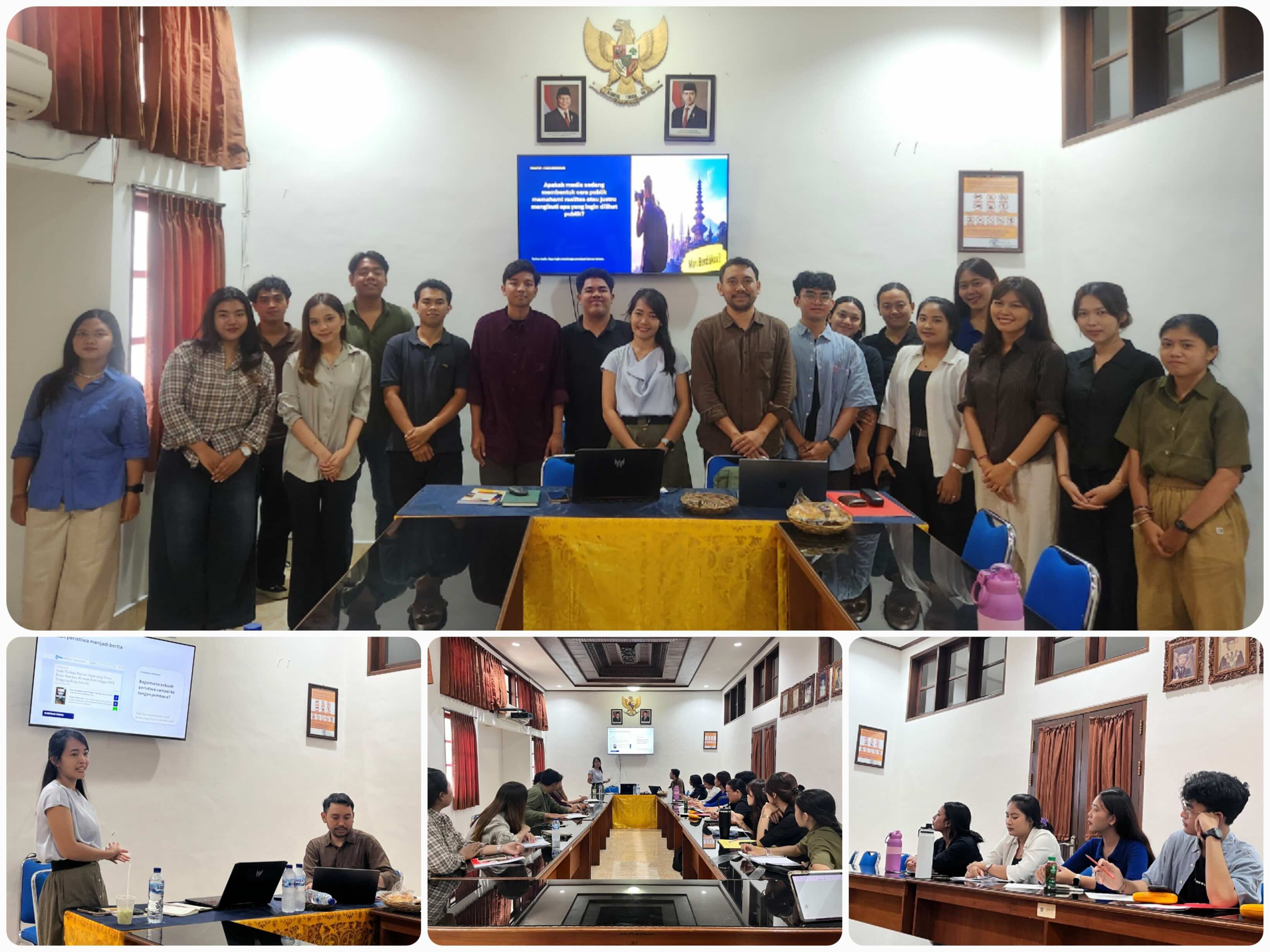
DENPASAR – The Balinese Literature Study Program, Faculty of Humanity, Udayana University (FIB Unud), organized a Practitioner Public Lecture titled "Digital Journalism: Today's Media and Its Challenges" ("Jurnalistik Digital: Media Kini dan Tantangannya") on Wednesday, November 11, 2026. Held from 09:40 to 11:20 WITA in the Professors' Room (Ruang Guru Besar), Faculty of Humanity, Udayana University, this event was attended by 7th-semester Balinese Literature students enrolled in the Journalism course.
The public lecture was moderated by the lecturer of the Journalism course at the Balinese Literature Study Program of FIB Unud, I Made Agus Atseriyawan Hadi Sutresna, S.S., M.Hum. The session featured Ida Ayu Suryantini Putri, S.S., M.Hum., a media practitioner with approximately nine years of experience in the digital journalism industry. An alumna of the Bachelor of Indonesian Literature and Master of Linguistics programs at Udayana University who was formerly active in the Akademika Student Press (Persma Akademika) of Unud, she began her career at Tribun Bali as a field reporter (2017–2018) and has served as an Online Editor since 2018.
In her presentation, the speaker—familiarly called Dayu—emphasized the fundamental stages of journalistic work: finding issues, conducting verification, confirming with credible sources, and publishing news clearly so as not to cause multiple interpretations among the public. She stressed that a news product must not only be technically accurate in journalistic terms, but must also be ethically accountable and prioritize human empathy.
Furthermore, she examined three primary challenges currently facing the online media industry: the proliferation of information-sharing accounts on social media that frequently cause public confusion, shifts in search engine algorithms toward greater personalization and segmentation, and the presence of artificial intelligence (AI). Amidst the flood of information from multiple sources, she reminded students that virality is not proof of truth, AI is not a tool for fact verification, and the number of clicks is not the sole measure of news quality; rather, public trust is what must be maintained.
Prior to entering the question-and-answer session, the speaker sparked a critical discussion with the students on whether today's media shapes how the public perceives reality or merely follows what the public wants to see. The discussion then developed interactively in response to various critical questions raised by the students, namely Gusti Ayu Dian, Elvina, and Dewa Guna.
Addressing Gusti Ayu Dian’s questions regarding the use of anonymous sources (initials), reporting boundaries on sensitive tragic cases, the application of slow journalism, and the widespread reposting of news by local information accounts on social media, the speaker explained that withholding a source's identity is permissible in specific cases for investigative safety, though source clarity remains crucial to maintaining news accountability. Regarding the coverage of sensitive tragic events, editorial teams must limit chronological details so that the news does not trigger psychological impacts or imitation in society. As for the phenomenon of reposting amidst the rapid flow of information production, she noted that it closely intersects with copyright ethics while requiring readers to distinguish between raw social media information and verified news products.
Subsequently, responding to Elvina’s question on packaging information through memes and chronological debates in comment sections, as well as Dewa Guna’s question regarding the phenomenon of uploading event videos without initial captions until they go viral, the speaker viewed these trends as forms of adaptation and strategies to capture attention in an era of digital competition. Nevertheless, the role of journalists and mainstream media remains irreplaceable as a reference for comprehensive verification and fact confirmation (5W+1H), including verifying the authenticity of visual documentation from the field.
Concluding the practitioner lecture, the moderator and speaker advised the students to remain wise and critical in responding to the rapid flow of information on social media. Students were encouraged not to hastily jump to conclusions or reshare unverified snippets of information, but instead build the habit of cross-verifying facts through credible news sources.
UDAYANA UNIVERSITY