 ENG
 INA
Bringing Alumni Perspective and Cultural Diplomacy, Vice Mayor of Uijeongbu Shares Insights on Bali’s Environment to Literacy Innovation at FIB Unud
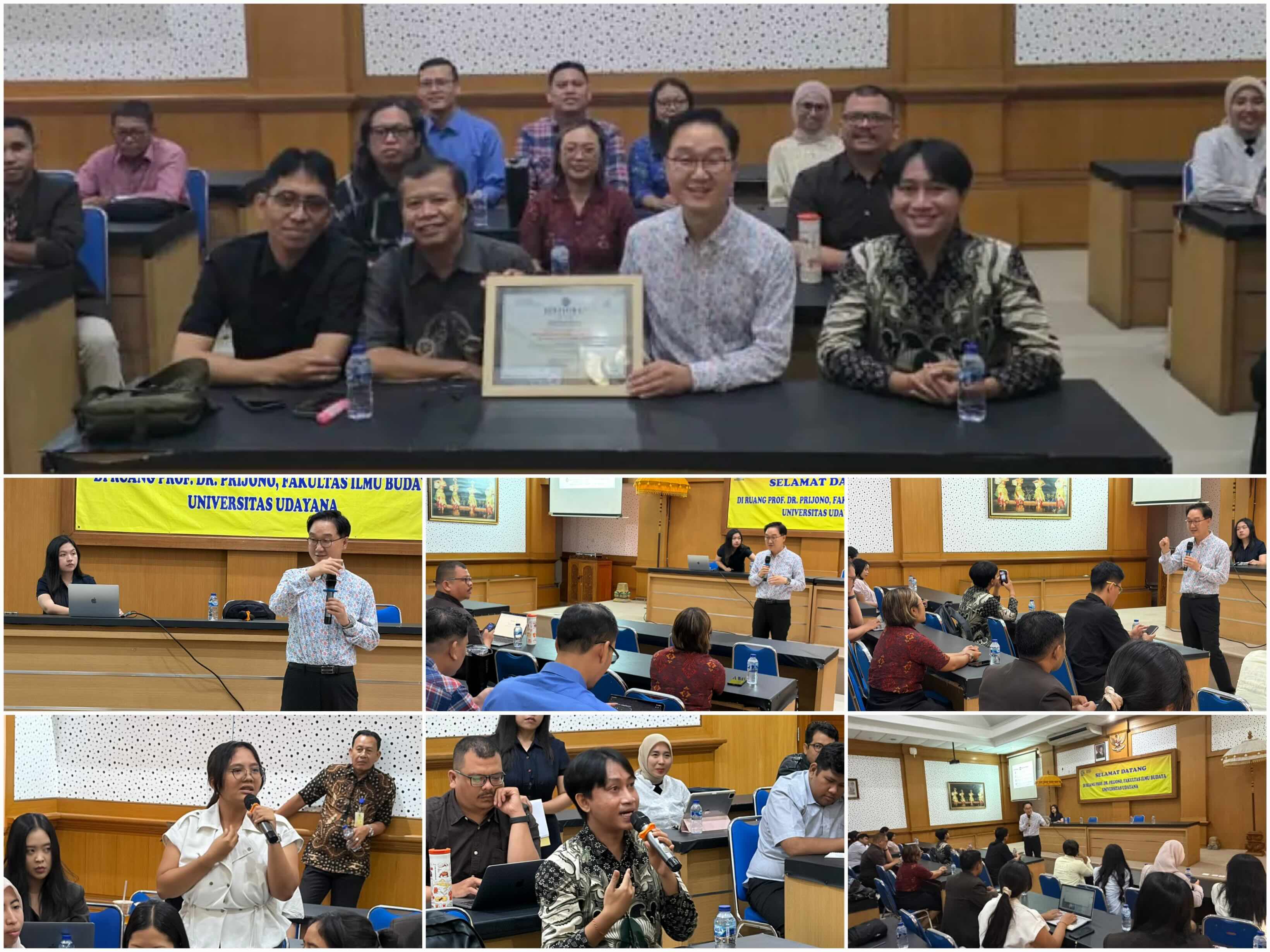
DENPASAR – Cultural closeness and an academic track record on the Island of the Gods bridged a cross-national dialogue during a Guest Lecture organized by the Doctoral Study Program (S-3) in Cultural Studies, Faculty of Humanity, Udayana University (FIB Unud), on Wednesday (25/11/2026). Held in the Prof. Dr. Prijono Room, Denpasar, this academic forum featured the Vice Mayor of Uijeongbu, Republic of South Korea, Kang Hyeon Seock—a regional leader as well as an alumnus of the Master’s Program (S-2) in Tourism at Udayana University—to examine the future of tourism, literacy space innovation, and the ethical challenges of artificial intelligence (AI).
Carrying the theme “Indonesia-Korea: Cross-Cultural Understanding and Future Collaboration Opportunities” (“Indonesia-Korea: Pemahaman Lintas Budaya dan Peluang Kolaborasi Masa Depan”), the guest lecture was officially opened by the Coordinator of the Doctoral Program in Cultural Studies of FIB Unud, Prof. Dr. I Nyoman Darma Putra, M.Litt. Kang’s presence was enthusiastically welcomed not only by Master’s and Doctoral students in Cultural Studies, but also by students from various study programs across Udayana University. Prof. Darma Putra encouraged participants to make the most of the 1.5-hour forum as an open discussion space to broaden their cross-cultural horizons.
Drawing from his experience studying in Bali and managing municipal governance in South Korea, Kang highlighted Bali’s privileged position on the global tourism stage. According to him, Bali is remarkably fortunate to possess natural richness and unique culture that are already world-renowned even without massive promotion. However, the 59-year-old leader offered a critical note that this appeal demands serious environmental governance readiness, particularly in addressing waste management issues.
“It is not easy to resolve, yet environmental policies must be formulated and enforced. I believe the most crucial matter in Bali is the environment. Bali must be truly prepared before even more foreign visitors arrive here,” he emphasized, while expressing appreciation for the development of the Sanur Special Economic Zone (KEK), which he viewed as highly promising for Indonesia’s future given the nation’s demographic advantage of a young population.
Beyond sustainable tourism, Kang shared a cultural breakthrough implemented in Uijeongbu—a city directly bordering the capital, Seoul—to address declining reading interest, a challenge faced by both South Korea and Indonesia. The local government established an aesthetic fine arts library designed like a gallery. This public space innovation successfully attracted public interest, transforming the library from merely a place to read into a tourist destination. He noted that the Korean government continues to encourage the younger generation to engage with books at libraries while balancing it with artistic appreciation, such as playing the piano.
In the interactive presentation session, Kang also unpacked the dynamics of artificial intelligence development, which is currently dominated by three nations: the United States, China, and South Korea. He reminded participants that AI technology is a double-edged sword: capable of accelerating human work, yet potentially posing a serious threat if misused without ethics. As an illustration, he recounted a bar exam case in which a participant achieved a near-perfect score deemed impossible for a human, before an investigation revealed that the examinee had used AI assistance.
Closing the lecture, Kang shared personal reflections to motivate students to have the courage to choose paths different from the mainstream. He recalled his 2014 decision to pursue his studies in Bali—bringing along his wife and two children, who later went on to study law at Universitas Gadjah Mada (UGM)—at a time when his peers opted to study in Australia and other countries. During his time at Unud, he even initiated a Korea–Bali tourism promotion program. That unconventional choice has now become a distinct advantage, frequently earning him invitations from various universities in South Korea as someone with deep insight into Indonesia.
“My message is, do not be afraid to choose a different path. I love Indonesia, I love Bali. I love the food, I love the culture, and I love Udayana University,” he concluded, immediately met with thunderous applause from the participants.
UDAYANA UNIVERSITY