 ENG
 INA
Featuring Uppsala University Researcher, FIB Unud Examines Muno Language Documentation Research
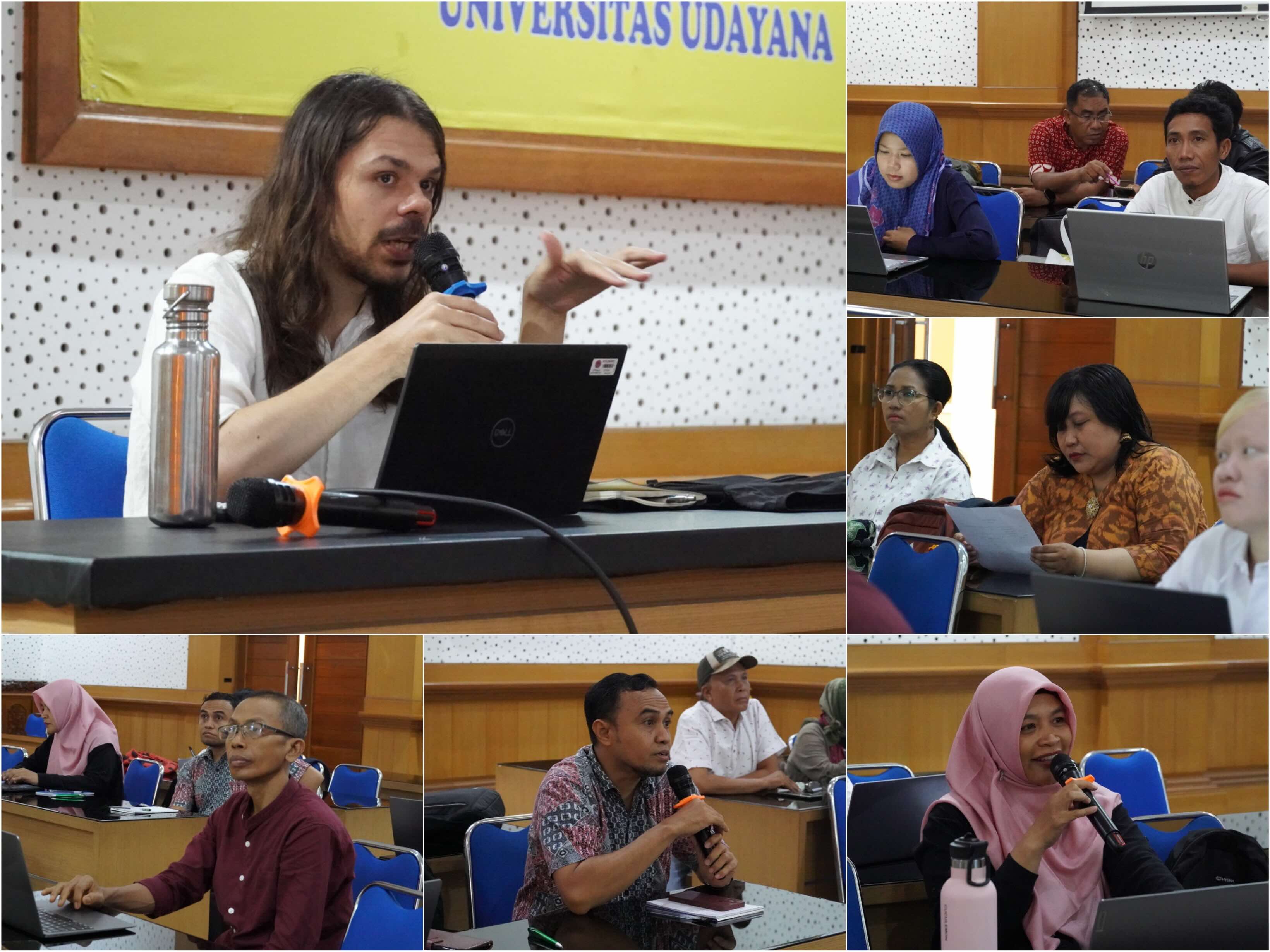
The Doctoral Program in Linguistics, Faculty of Humanities, Udayana University (FIB Unud), held a seminar titled “Documenting the Endangered Muno Language: Fieldwork, Linguistic Analysis, and Digital Resources” on Tuesday (25/11/2026) to examine the urgency of documenting and preserving endangered languages. Held in the Dr. Ir. Soekarno Meeting Room on the fourth floor of the Poerbatjaraka Building at FIB Unud, the forum, attended by the academic community of FIB Unud, featured Phillip Ronchen, a language researcher from the Department of Linguistics and Philology at Uppsala University, as the keynote speaker.
During the academic forum, Ronchen presented the findings of his 2022 fieldwork on the documentation and revitalization efforts of the Muno language in Papua New Guinea. He explained that Muno is a language isolate with no known genetic relationship to any other language family and is currently spoken by only around 1,500 people across six villages in the border region near Jayapura. The language is classified as endangered because younger generations and children no longer actively learn it, shifting instead to the regional language, Tok Pisin.
Drawing on linguistic data openly archived on the Paradisec platform, Ronchen outlined several unique structural features of the Muno language, such as a subject and object agreement system that drives complex verb inflection. In addition, the Muno community uses a traditional body-tally counting system starting from the fingers, as well as a spatial orientation concept based on river flow rather than conventional cardinal directions.
Nevertheless, he emphasized that compiling dictionaries and grammars through linguistic documentation does not automatically revitalize a language without the commitment of communities and families to pass it on to their children. As a practical form of support, he initiated the development of an offline mobile learning application designed to practice pronunciation and build younger generations' confidence in speaking Muno.
The presentation sparked an interactive discussion among participants, who highlighted parallels between the Muno language shift and the challenges of preserving regional languages in Indonesia, such as those in East Nusa Tenggara and the Sasak language in Lombok. Participants also underscored the importance of government policy support and local language instruction in schools to prevent regional languages from being eroded by the dominance of the national language. Concluding his session, Ronchen shared information on international grant opportunities for endangered language documentation research ranging from 5,000 to 10,000 euros, while encouraging young researchers to contribute to documenting local linguistic heritage before it disappears.
UDAYANA UNIVERSITY