 ENG
 INA
Faculty of Humanities and Lontar Unit of Udayana University Receive Courtesy Visit from ICAS India Chairman, Discussing Classical Lontar Manuscripts and Scientific Approaches to Wariga
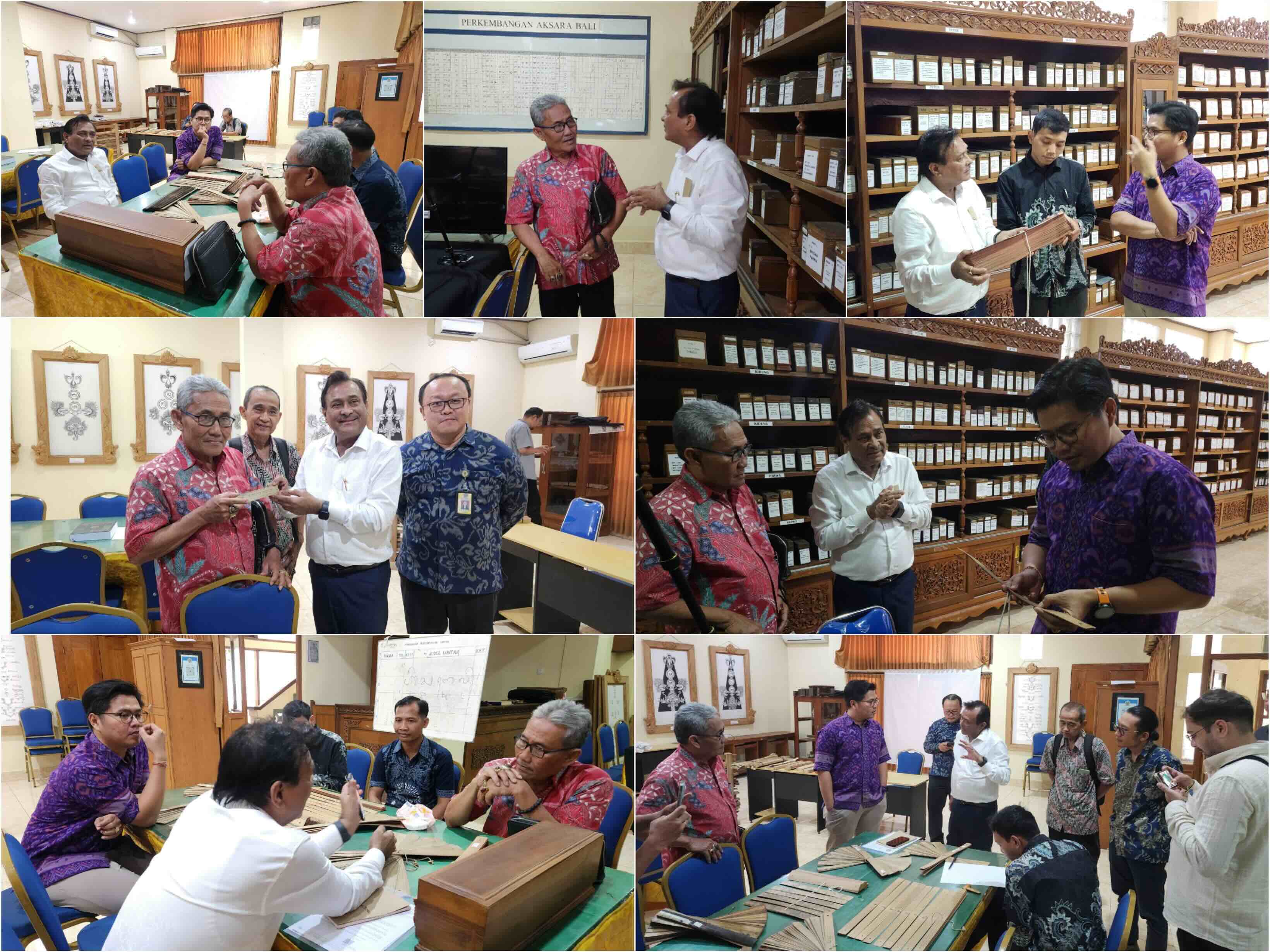
DENPASAR – The Faculty of Humanities (FIB) together with the Lontar Unit of Udayana University (ULU) welcomed a courtesy visit from the Chairman of the Indian Council of Astrological Sciences (ICAS) Lucknow, India, Shri Suryakant Mishra, IRS (Retd.), on Wednesday (November 25, 2026). The visit aimed to strengthen institutional ties while exchanging perspectives on the shared spiritual, cultural, and astronomical heritage connecting India and Bali.
The delegation from India was welcomed directly by the Vice Dean for Academic and Student Affairs of FIB Udayana University, Dr. I Gede Oeinada, S.S., M.Hum., accompanied by the Head of the Lontar Unit of Udayana University, Prof. Dr. Drs. Putu Sutama, M.S.; Coordinator of the Balinese Literature Study Program, Drs. I Ketut Ngurah Sulibra, M.Hum.; and Secretary of ULU, Dr. Putu Ari Suprapta Pratama, S.S., M.Hum. Also in attendance were lecturers from the Balinese Literature and Old Javanese Literature Study Programs, as well as ULU staff members.
Upon arriving at the Lontar Unit of Udayana University, Prof. Putu Sutama and Dr. Putu Ari Suprapta Pratama introduced the diverse collection of palm-leaf manuscripts (lontar) preserved and conserved at ULU. Among the various collections presented, the Lontar Parwa—specifically Adiparwa and Bhismaparwa—along with Kakawin Ramayana and Kakawin Sumanasantaka, became the focal points of discussion and drew numerous questions from Shri Suryakant Mishra.
This deep interest stemmed from the strong historical, literary, and cultural roots connecting these manuscripts with classical Indian literature. Adiparwa and Bhismaparwa form vital books of the great Mahabharata epic, Kakawin Ramayana derives from the Ramayana, while Kakawin Sumanasantaka was inspired by the classical Indian poet Kalidasa's Raghuvamsa. For the Indian guest, the survival of these classical narratives in the form of Balinese-script palm-leaf manuscripts serves as tangible proof of how Indian civilizational heritage has not only been preserved, but also creatively adapted into a living, enduring cultural tradition in Bali.
The discussion then progressed to ICAS’s core area of expertise: a comparative exploration of the Balinese Wariga system and India's Vedic astrology and calendrical traditions (Jyotish and Panchanga). As an institution dedicated to the promotion, preservation, teaching, and study of Vedic astrology and allied sciences, ICAS and the FIB Udayana University academics examined how traditional systems for determining days and time inherently rest on measurable astronomical foundations.
During the dialogue, both parties also discussed how the calculation of days linked to planetary movements and sunrise times is scientifically governed by geographical coordinates, namely latitude and longitude. These geographical variations account for differences in sunrise and sunset times across regions, even though general practice in Bali commonly adopts a standardized morning reference point to mark the start of the day.
Furthermore, the conversation emphasized the importance of advancing Wariga studies so that they can be understood more logically and scientifically, rather than being viewed merely as belief-based practices. Both sides highlighted the need to integrate principles of physics, astronomy, calendar evolution, the influence of lunar cycles on nature and human behavior, and natural energy management in traditional spatial planning—such as India’s Vastu concept, which shares philosophical resonance with traditional Balinese architecture. Through scientific and educational approaches, this traditional knowledge is expected to be continuously preserved, explained rationally, and made engaging for younger generations to research.
Concluding the visit, ULU Secretary Dr. Putu Ari Suprapta Pratama, S.S., M.Hum., expressed hope that the meeting would serve as an initial step toward exploring academic and cultural collaboration between FIB Udayana University, through its Lontar Unit, and the Indian Council of Astrological Sciences (ICAS). Such a partnership is expected to open avenues for cross-border knowledge exchange, joint research, and educational programs focused on ancient manuscript preservation, Wariga, and traditional astronomical studies.
UDAYANA UNIVERSITY