 ENG
 INA
Faculty of Humanities, Udayana University Holds Workshop on SDGs Implementation in Learning and Quality Assurance
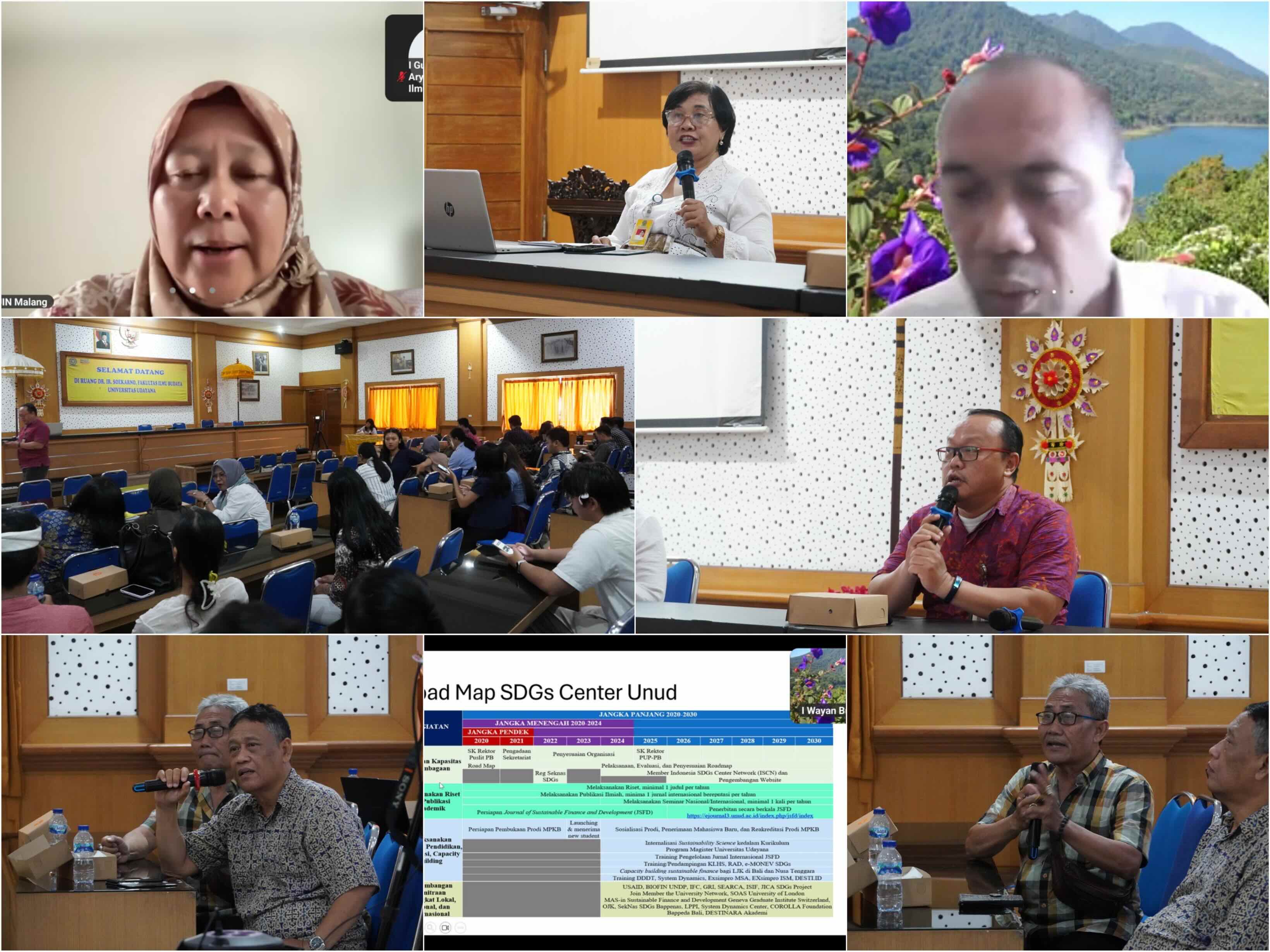
DENPASAR – The Faculty of Humanities (FIB), Udayana University (Unud), organized a Workshop on the Implementation of Sustainable Development Goals (SDGs) in Learning and Quality Assurance on Tuesday, November 24, 2026. The event was held in a hybrid format from the Soekarno Room, Poerbatjaraka Building, FIB Unud, with both speakers joining virtually via Zoom displayed on the room's projector screen. The workshop was attended by faculty leadership, coordinators from 12 study programs, lecturers, and student representatives within FIB Unud.
The event was officially opened by the Vice Dean for Academic and Student Affairs of FIB Unud, Dr. I Gede Oeinada, S.S., M.Hum., representing the Dean of FIB Unud. In his opening remarks, he emphasized that integrating the SDGs into teaching and quality assurance is a strategic step to ensure the humanities deliver tangible and measurable impacts for society. He expressed hope that the workshop would provide practical guidance for study programs and lecturers to systematically map, implement, and document SDGs contributions.
Moderated by the Head of the Quality Assurance Unit of FIB Unud, Dr. Ni Ketut Widhiarcani Matradewi, S.S., M.Hum., the first session featured Dr. Meinarni Susilowati, M.Ed., from UIN Maulana Malik Ibrahim Malang. She explained that five of the 17 SDGs, namely SDGs 1, 4, 8, 12, and 17, are closely aligned with humanities studies. According to her, Bali holds strong potential as an SDGs Living Laboratory through sustainable tourism, digital preservation of local culture, and MSME empowerment. Within Outcome-Based Education (OBE), she encouraged embedding SDGs into Program Learning Outcomes (PLOs), Course Learning Outcomes (CLOs), and active learning methods such as Project-Based Learning (PjBL) and Case Studies to foster critical and responsible graduates.
In the second session, the Chair of the Center of Excellence for Sustainable Development Research (SDGs Center) at Unud and Second President of the Indonesian SDGs Center Network (ISCN) for 2026–2028, Prof. Dr. Ir. I Wayan Budiasa, S.P., M.P., IPU, ASEAN Eng., discussed the urgency of Education for Sustainable Development (ESD) through multidisciplinary to transdisciplinary approaches. He explained that SDGs integration is closely linked to Higher Education Key Performance Indicator (IKU) 7. To ensure measurability within the Internal Quality Assurance System (SPMI), he stressed the need to explicitly articulate SDGs across policies, quality standards, and Semester Learning Plans (RPS) mapped to Bappenas SDGs metadata indicators.
The discussion session unfolded dynamically with feedback from participants, including Prof. Dr. Phil. I Ketut Ardhana, M.A., Prof. Dr. Putu Sutama, M.S., and Dr. Nanang Sutrisno, S.Ag., M.Si. The discussion highlighted two main points: the role of Balinese local wisdom in sustainability concepts and the technical aspects of integrating SDGs into the curriculum. In response, Prof. Budiasa affirmed that noble local values such as Tri Hita Karana encompass a broader dimension than the SDGs and should continue to be explicitly embedded in the learning process. Regarding the curriculum, both speakers agreed that study programs do not need to add new courses, but can instead integrate SDGs issues into existing ones so as not to overburden the curriculum.
Through this workshop, the Faculty of Humanities at Udayana University is expected to be increasingly prepared to align its curriculum, learning processes, and quality assurance system with the sustainable development agenda without losing its local wisdom roots.
UDAYANA UNIVERSITY