 ENG
ENG
 INA
INA
Doctoral Promotion at the Faculty of Humanities Udayana University Explores the Dynamics of Gender Identity in Contemporary Photography in Bali
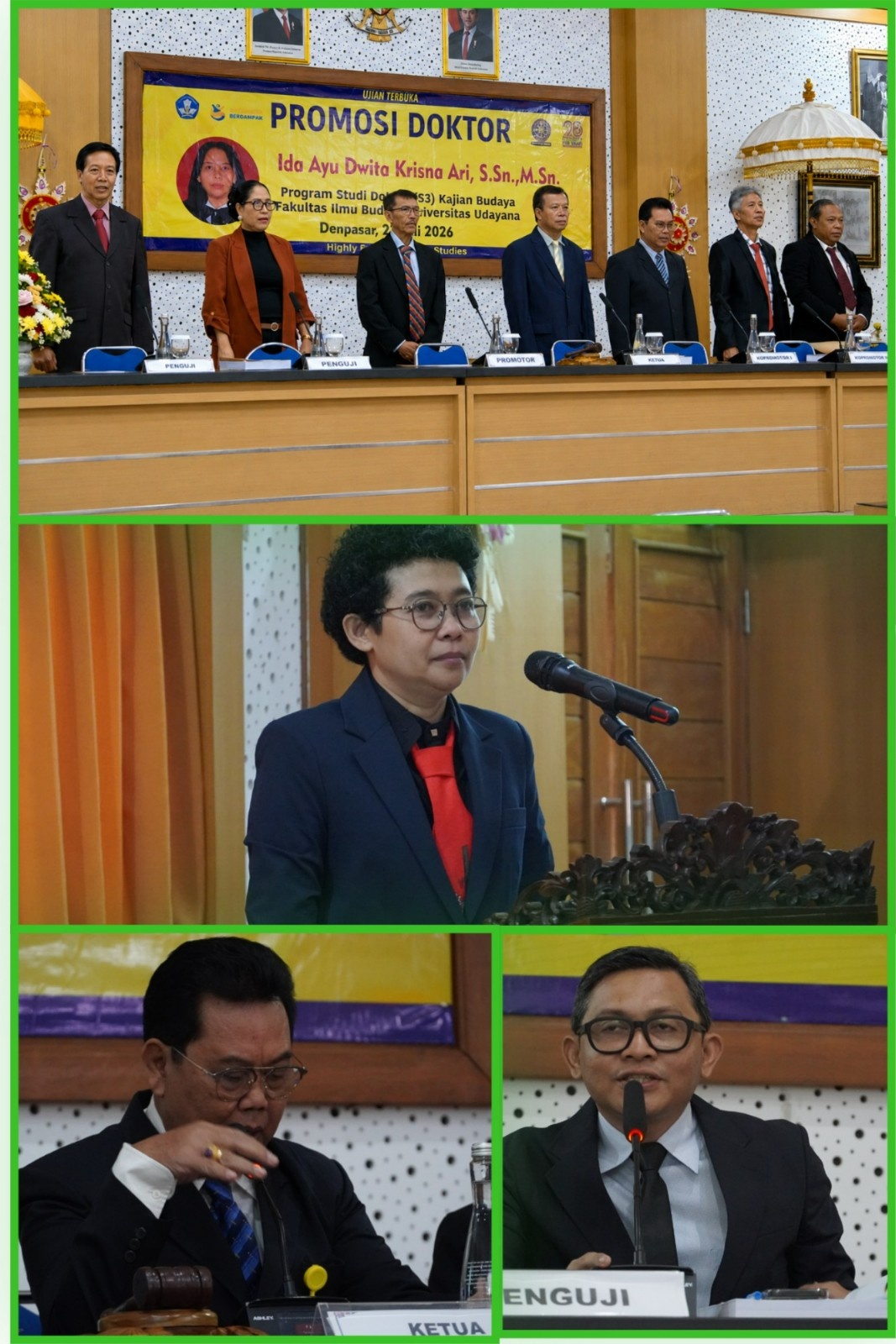
The Faculty of Humanities, Udayana University, announced its 288th doctor, who is also the 307th doctor from the Doctoral (S3) Cultural Studies Program, on July 24, 2026. Dr. Cokorda Istri Puspawati Nindhia, S.E., S.Sn., M.Sn., was granted the doctoral degree following an open examination held in the Dr. Ir. Soekarno Meeting Room, Poerbatjaraka Building. She successfully defended her dissertation titled "Manipulasi Identitas Gender dalam Dunia Fotografi Kontemporer di Bali (Gender Identity Manipulation in Contemporary Photography in Bali)".
Prof. Dr. I Nyoman Suarka, M.Hum., led the open examination, while Prof. Dr. I Nyoman Darma Putra, M.Litt., acted as the Promoter. They were accompanied by Prof. Dr. Anak Agung Ngurah Anom Kumbara, M.A., as Co-Promoter I, and Prof. Dr. Dra. Luh Putu Puspawati, M.Hum., as Co-Promoter II. The board of examiners and assessors included Dr. Ida Bagus Gde Pujaastawa, M.A., Dr. I Gusti Agung Ayu Mas Triadnyani, S.S., M.Hum., Dr. I Wayan Nuriarta, S.Pd., M.Sn., and Dr. I Made Marajaya, S.S.P., M.Si.
The promovenda defined gender identity manipulation not in the literal sense of manipulation, but rather as a process that alters gender codes within society. In contemporary photography, this is intentionally executed for artistic purposes and commercial commodities. Within this medium, gender has undergone a shift from a static display in front of the lens to something that the lens can actively rearrange.
Gender identity manipulation in photography extends beyond technical processes. It also involves symbolic manipulation, which refers to how gender identity is displayed and interpreted. The promovenda divided this manipulation into three aspects, starting with the construction of facial identity, which focuses on how the biological face can be shaped into a new visual image through masquerade techniques. The second aspect is the construction of pose identity, emphasizing feminine gestures displayed by the male body. The construction of fashion identity is the final aspect, where the male body is donned in clothing traditionally identical to women's. In her dissertation, the promovenda revealed that these three aspects provide an understanding that gender identity can be constructed and represented differently from prevailing norms.
In photographic works, gender identity manipulation is considered capable of attracting public attention and holds economic value, which subsequently becomes a driving factor for the practice. Another factor is heteronormative hegemony, where the boundaries of gender representation are questioned through visuals that break the normative relationship between the biological body and gender identity. Furthermore, cultural resistance acts as a third factor driving gender identity manipulation in contemporary photography in Bali.
Although regarded as commercially valuable and a form of resistance, this practice impacts the marginalization of women's existential space due to the replacement of women's roles in photography by male subjects. Additionally, the promovenda noted in her dissertation that repetitive visual reproduction continually contributes to the emergence of myths surrounding the ideal body and beauty standards, making these standards increasingly artificial. Given these contradictions, the promovenda deemed the practice of gender identity manipulation in contemporary photography in Bali to be highly ambivalent.
The promovenda revealed two primary findings in her study. First, gender identity manipulation in Bali did not emerge out of nowhere; rather, it is an intermedial, performative continuation of Bali's performance art traditions. Second, this manipulation occurs due to a habitus of cultural openness. Bali's continuous interaction with foreign cultures, the growth of the creative industry, and tourism development have fostered public acceptance of diversity as a legitimate art form.
As the Promoter, Prof. Dr. I Nyoman Darma Putra, M.Litt., stated that the topic of gender identity manipulation had never been explored in a dissertation within the Cultural Studies Program at the Faculty of Humanities. He expressed his immense joy and congratulations regarding the promovenda's success in completing her studies. Closing the open examination on Friday (24/7), the promovenda conveyed her gratitude to her family, the promoter team, the chairperson of the assembly, the board of examiners, and the colleagues in attendance.
.jpg)
UDAYANA UNIVERSITY