 ENG
ENG
 INA
INA
Preserving Balinese Script in the Digital Era, Bachelor of English Literature Research Team Holds FGD on Feasibility Study for Web Generative AI Nyastra
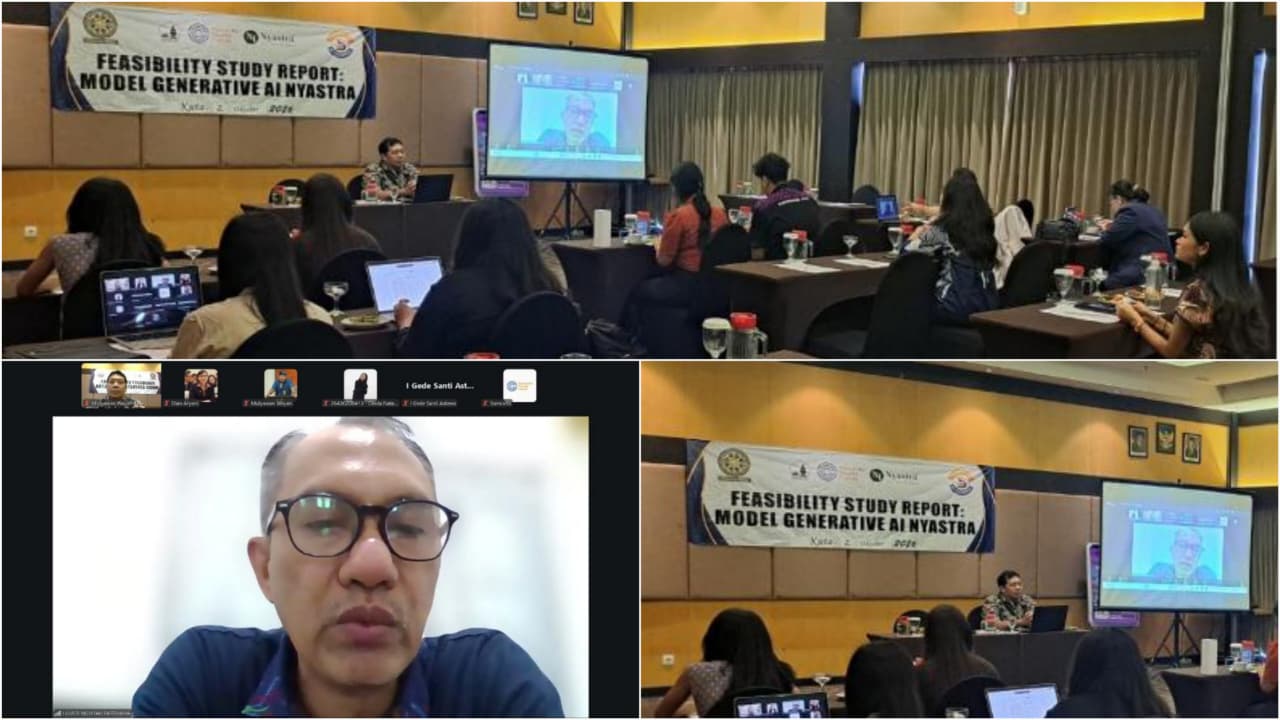
Kuta, October 2, 2026 – To preserve the Balinese language, script, and literature in the digital era, a research team from Udayana University held a Focus Group Discussion (FGD) on the feasibility study for developing the Web Generative AI Nyastra. The event took place on Friday, October 2, 2026, at Quest Hotel Kuta, Bali, and was attended by the research team, research partners, and various stakeholders.
The development of the Web AI Nyastra platform is backed by a strong legal framework regarding the use of Balinese script in public spaces under Bali Governor Regulation (Pergub) No. 80 of 2018. This regulation mandates the use of Balinese script on signage for government institutions, private sectors, and public facilities. However, limited public understanding of correct grammatical transliteration (pasang aksara) remains a key challenge. To bridge this gap, this artificial intelligence-based platform was designed to facilitate fast, accurate, and accessible transliteration from Latin script to Balinese script for students, government officials, and the private sector.
The FGD was officially opened by the Coordinator of the Bachelor of English Literature Study Program, Faculty of Humanities, Udayana University, Dr. I Gusti Ngurah Parthama, S.S., M.Hum. In his opening remarks, he emphasised the importance of integrating AI technology and interdisciplinary collaboration to sustain Balinese culture. The discussion was led by the Lead Researcher, Prof. Dr. I Wayan Mulyawan, S.S., M.Hum., who presented initial trial results, demonstrated the Web AI Nyastra features, and outlined the draft feasibility study.
Overall, the feasibility study results showed highly positive indicators, confirming that the Web Generative AI Nyastra platform is functional and ready for deployment. The FGD identified several potential user segments, including the education sector (students, academics, and educators), government institutions for official documentation, public signage, and private companies. The session also outlined a sustainable monetisation model, including a freemium option for general users and a subscription/B2B model for enterprise-level document transliteration.
In addition to its potential, the interactive session highlighted critical technical challenges that need optimisation prior to an open public release. A key concern is optimising AI API Key operational costs to prevent financial overhead during high traffic volume. As a solution, the research team agreed to implement a hybrid processing architecture using smart caching and rule-based parsing. Moreover, since cultural transliterations involve specific nuances and exceptions, the system incorporates a human-in-the-loop framework featuring validator dashboard verification by language experts for formal government documents.
As follow-up actions, the research team will focus on optimising system architecture, developing expert validator dashboards, drafting cooperation agreements (MoUs) with regional government bodies and tourism industry partners, and conducting system load testing. Through these enhancements, the Web AI Nyastra platform aims to launch officially as a premier digital solution supporting Bali Governor Regulation No. 80 of 2018 while preserving Balinese cultural heritage in the digital age.
UDAYANA UNIVERSITY