 ENG
ENG
 INA
INA
Examining Javanese Reciprocal Constructions, Bachelor of English Literature, Lecturer of Faculty of Humanities Udayana University Successfully Achieved Doctoral Degree
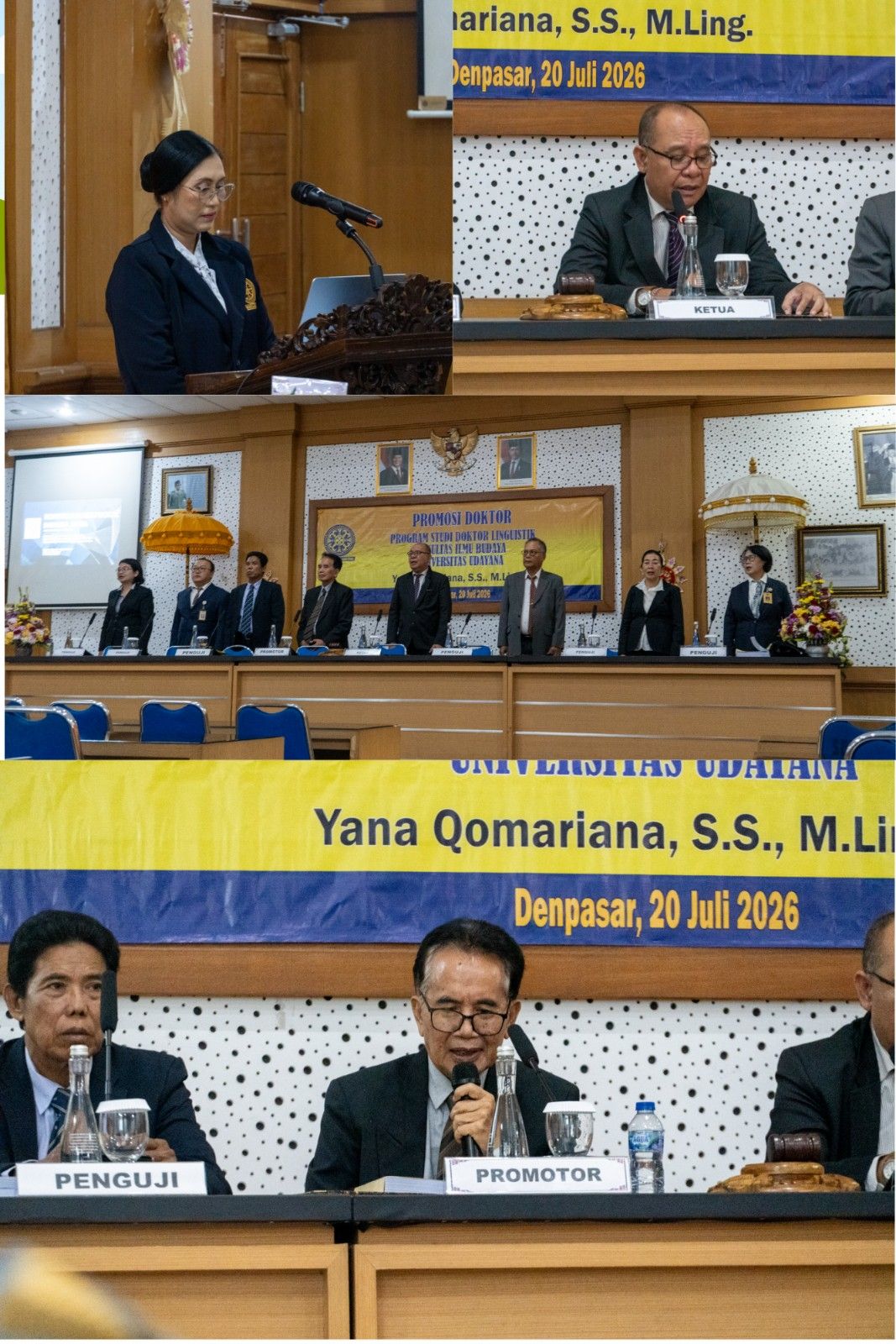
Denpasar, July 20, 2026 – The Faculty of Humanities, Udayana University (FIB Unud), has once again inaugurated a new doctoral graduate through an Open Doctoral Defense organized by the Doctoral (S3) Linguistics Study Program. The event was held in the Dr. Ir. Soekarno Meeting Room, 4th Floor of the Poerbatjaraka Building, FIB Unud, on Monday (20/7). The promovenda, Yana Qomariana, S.S., M.Ling., successfully defended her dissertation entitled "Javanese Reciprocal Constructions" and achieved a "Very Satisfactory" predicate, officially becoming the 285th doctor at FIB Unud and within the Doctoral Linguistics Study Program. This open defense was attended by the promovenda's family and her fellow lecturers from the English Literature Study Program of FIB Unud.
This Doctoral Promotion Examination was evaluated by a Board of Examiners consisting of 10 members, presided over directly by Prof. Dr. I Made Netra, S.S., M.Hum., acting as the Chairperson of the Assembly, alongside Prof. Dr. Ketut Artawa, M.A., as the Promoter. The other examiners included Prof. Dr. I Wayan Pastika, M.S., Prof. Dr. Ni Ketut Widya Purnawati, S.S., M.Hum., Dr. I Gede Oeinada, S.S., M.Hum., Prof. Dr. Drs. I Wayan Simpen, M.Hum., Prof. Dr. Dra. Ni Luh Ketut Mas Indrawati, Dip.TEFL., M.A., and Prof. Dr. Dra. Ni Ketut Ratna Erawati, M.Hum. Due to the absence of Co-promoter I, Drs. I Wayan Arka, M.S., M.Phil., Ph.D., and Co-promoter II, Prof. Dr. Drs. Agus Subiyanto, M.Hum., the examination rights and authorities of the supervisory team were delegated to Prof. Dr. I Made Netra, S.S., M.Hum., in his capacity as the Coordinator of the Doctoral Linguistics Study Program.
This dissertation research was motivated by the crucial essence of reciprocal constructions in syntactic and semantic studies, which reflect the mutual relationship between participants in a linguistic event. Although this relationship is generally marked by various strategies—such as the lexical marker saling, specific affixation, and verbal constructions conveying collective meaning—a comprehensive description of its argument structure and semantic nuances has not been widely discussed in Javanese linguistic literature. Therefore, this study aims to fill the theoretical gap by dissecting the morphological and syntactic marking systems, along with their implications for the typology of Austronesian languages.
In addressing these issues, this descriptive qualitative research applied an observation method supported by audiovisual recording techniques. Primary data collection was carried out through an elicitation technique utilizing stimulus videos to trigger linguistic responses from native speaker informants within a controlled situation. As a complement to ensure a more holistic analysis, this study also utilized field note-taking techniques and extracted written secondary data from Javanese-language magazines and literary works. This combination of approaches was designed so that the obtained data could reflect the grammatical intuition of the speakers while demonstrating the reciprocal functions within actual usage contexts.
The research findings indicate that the Javanese language expresses reciprocal meaning through three primary strategies: lexical, morphological, and syntactic. Lexically, Javanese possesses verbs that inherently carry a reciprocal meaning, while morphologically, this meaning is formed through reduplication and affixation processes, such as the use of the polysemic suffix -an. Syntactically, this construction exhibits a universal reciprocal characteristic in the form of valency reduction (from two-place to one-place arguments). Historical findings also revealed an intriguing dynamic: from Old to Middle Javanese, the language previously utilized the prefix ma-, a distinct characteristic of Austronesian languages; however, this exponent weakened and eventually disappeared in Modern Javanese due to changes in sentence structure and competition with reduplicated forms.
The Open Doctoral Defense proceeded to the Q&A session. Prof. Dr. Ketut Artawa, M.A., as the promoter, examined the promovenda regarding the determining factors behind the emergence of reciprocal meaning, to which the promovenda straightforwardly answered that this meaning arises from the interaction between morphological strategies and syntactic argument structures that merge the agent and patient. Furthermore, examiner Prof. Dr. Drs. I Wayan Simpen, M.Hum., provided technical input regarding spelling and scientific terminology, and subsequently requested clarification on the difference between iterative and reciprocal meanings in the reduplication of base forms. In response, the promovenda clarified that the distinctiveness of reciprocals strictly relies on mutual activities where two participants hold equal positions as both actors and targets, whereas iterative meaning can emerge within a reciprocal frame if there are multiple sub-events involved.
Concluding the assembly, Prof. Dr. Ketut Artawa, M.A., representing the supervisory board, expressed deep pride and appreciation for the hard work, perseverance, and high ambition of the promovenda in compiling a remarkably rich methodological data corpus. He praised the promovenda's extraordinary efforts in typologically dissecting the medial diathesis constructions of the Javanese language. The event closed with congratulations addressed to the new doctor and her family, accompanied by hopes that this academic achievement will continuously bring blessings and success in the future.
.jpg)
UDAYANA UNIVERSITY