 ENG
ENG
 INA
INA
Faculty of Humanities Held FReTalk: Promoting the Dissemination of Lecturer Research: Studies on Ethnicity in NTT and Conceptual Metaphors
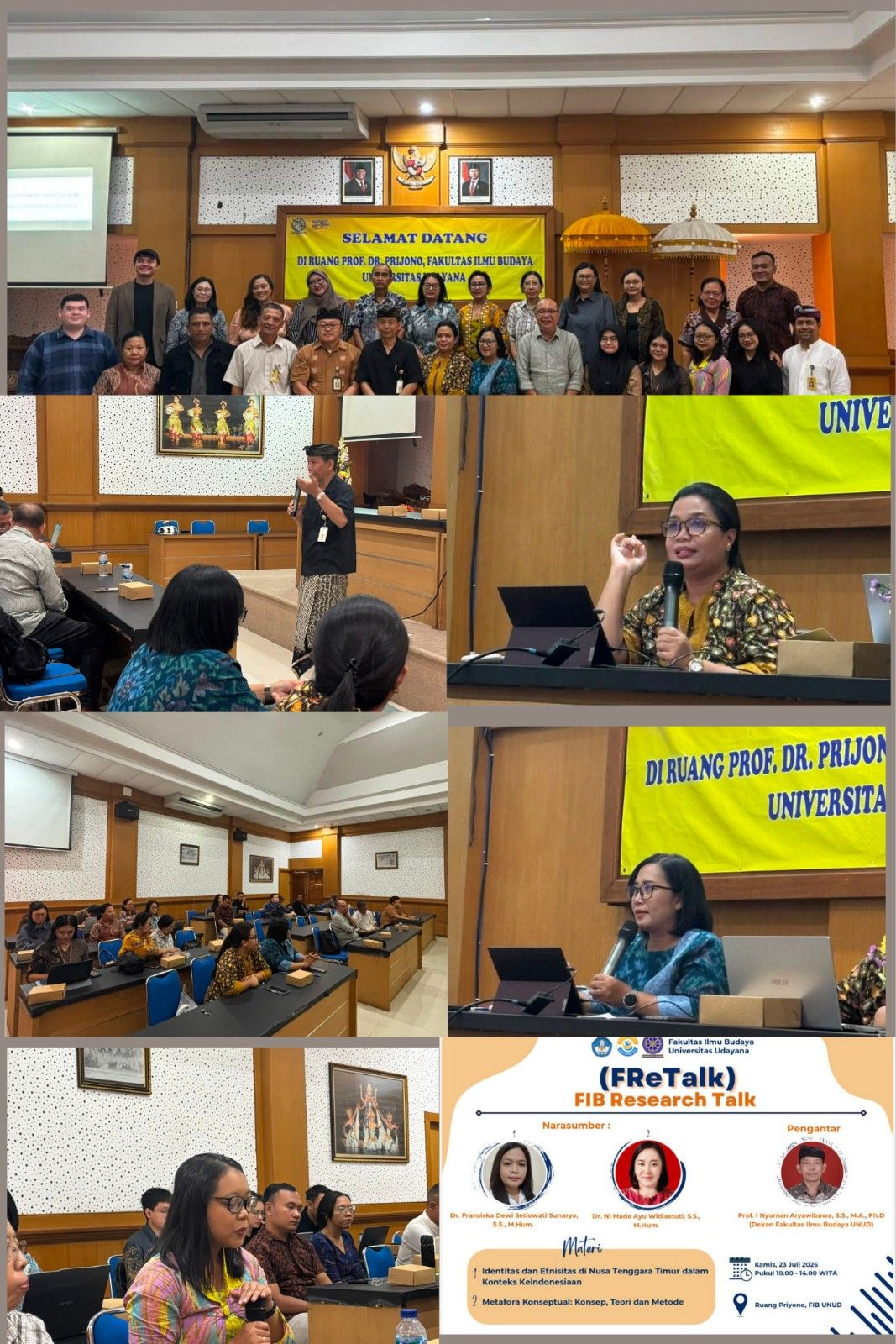
Denpasar, July 23, 2026 – The Faculty of Humanities (FIB), Udayana University (Unud), has once again demonstrated its commitment to consistently cultivating an academic climate by holding a scientific forum entitled FIB Research Talk (FReTalk). This forum aims to strengthen the academic culture, improve the quality of lecturers' research, and expand the space for cross-disciplinary discussions within the campus environment. The research dissemination event was held on Thursday, July 23, 2026, from 10:00 WITA until concluded, taking place in the Priyono Room, FIB Unud. The series of events was organized by the Research and Community Service Unit (UP2M) of FIB Unud, coordinated by Dr. Ngurah Indra Pradhana, S.S., M.A. The FReTalk event was officially opened by the Dean of FIB Unud, Prof. I Nyoman Aryawibawa, S.S., M.A., Ph.D., and was attended by faculty leaders, the Chair of the Senate, study program coordinators, professors, and lecturers.
In his opening remarks, Prof. I Nyoman Aryawibawa, S.S., M.A., Ph.D., emphasized the importance of the faculty's initiative in facilitating the accelerated dissemination of the doctoral (S3) research results of its teaching staff. He asserted that this event is specifically designed to be purely research-based. Furthermore, the Dean of FIB Unud strongly encouraged young academics to continuously and proactively participate in similar scientific spaces. According to him, forums like FReTalk serve as strategic platforms to build a productive academic atmosphere, strengthen interdisciplinary collaboration, and enhance the quality of research outputs that impact the development of science and the wider community.
Entering the core session, the first presentation was delivered by Dr. Fransiska Dewi Setiowati Sunaryo, S.S., M.Hum., carrying the topic "Identity and Ethnicity in East Nusa Tenggara within the Indonesian Context". Dr. Fransiska explained that the concept of identity among the people of NTT is highly dynamic, shaped by a long historical journey—starting from the era of local kingdoms, Portuguese and Dutch domination, to the Christian and Catholic missionary endeavors. One of the intriguing highlights of her research is the strong preservation of Sumba ethnic traditions when migrating to Bali. Unlike several other migrant ethnicities, the majority of Sumba people who pass away in Bali are not buried overseas; their remains are mandatorily brought back to their homeland in adherence to customary traditions. This interactive session also explored the history of the establishment of the Flobamora Extended Family Association (IKB) in Bali, an organization initially pioneered from a cross-ethnic rotating savings gathering (arisan), which has now transformed into a vital support system for the NTT diaspora.
The second session continued with a cognitive linguistic analysis presentation by Dr. Ni Made Ayu Widiastuti, S.S., M.Hum., entitled "Conceptual Metaphor: Concepts, Theories, and Methods". Dr. Ayu clarified common misconceptions by explaining that conceptual metaphors are not merely figures of speech. Adhering to the foundational theory of Lakoff and Johnson (1980), she elaborated that metaphor is a human cognitive mechanism used to comprehend abstract concepts (target domain) through more tangible and concrete elements (source domain). In presenting her research findings, Dr. Ayu utilized a large-scale mixed-methods approach (qualitative and quantitative) by extracting Indonesian corpus data. Assisted by statistical software and the package heavier, this research successfully mapped thousands of linguistic expression data points to analyze how speakers conceptualize various emotions, such as "fear," "panic," and "anxiety." The results of this statistical data processing subsequently generated a conceptual metaphor prototype regarding the stages of a person's emotions.
The presence of the FIB Research Talk forum proves that cross-disciplinary academic discourse can be presented in an engaging and substantial manner, simultaneously reinforcing Udayana University's stride as an excellent research institution. Through the implementation of FReTalk, the Dean of FIB Unud hopes this forum can become a sustainable academic agenda to encourage the creation of high-quality research, strengthen collaborative networks among researchers, and increase reputable scientific publications. This activity is also expected to culminate in the achievement of FIB Unud's vision as an outstanding higher education institution in the development of humanities, language, literature, and cultural studies at both the national and international levels.
.jpg)
UDAYANA UNIVERSITY