 ENG
ENG
 INA
INA
Jiwanmukti as Liberating Literature in Kakawin Panca Dharma, Discussed in the 290th Doctoral Examination at Faculty of Humanities
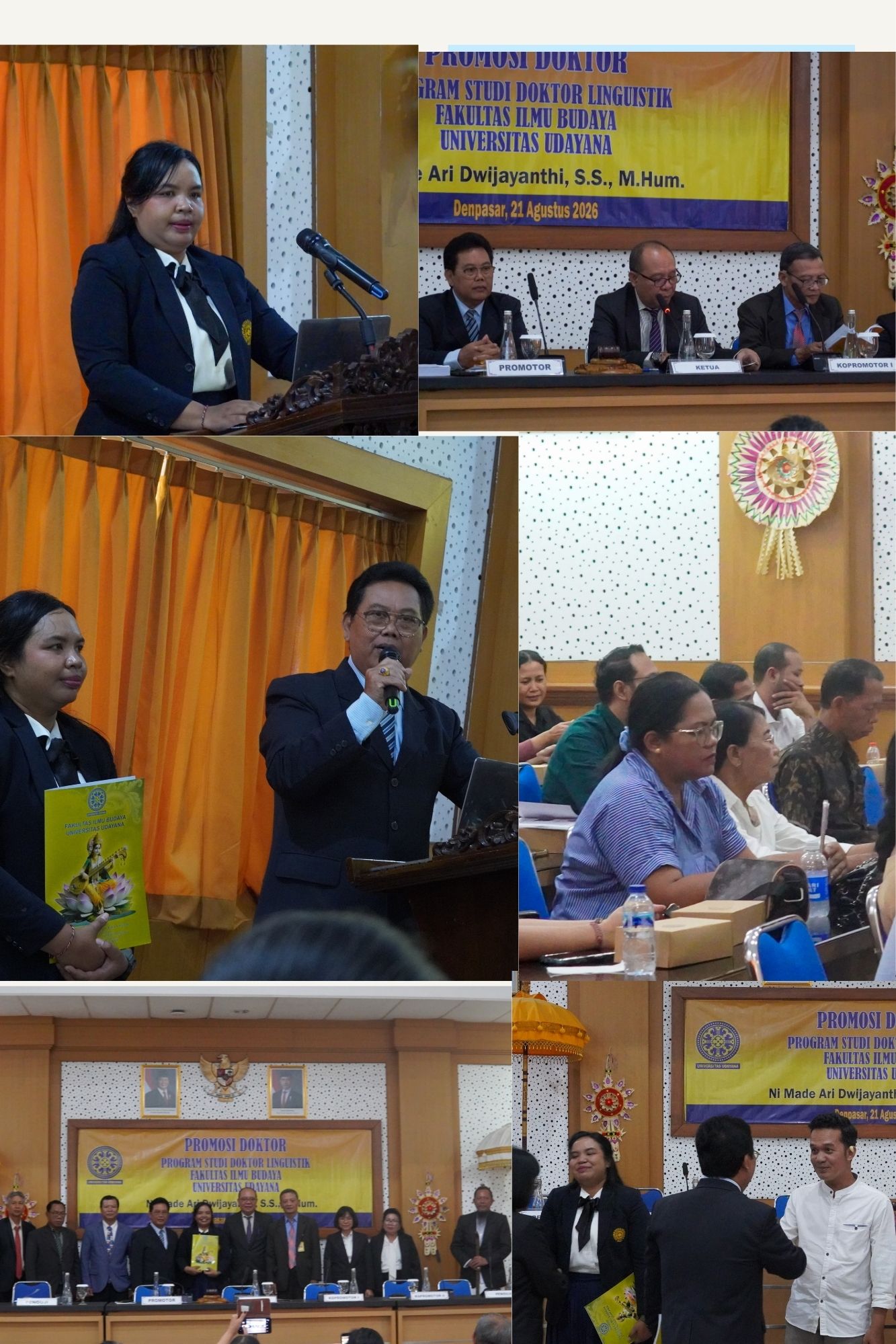
The Doctoral Study Program in Linguistics, Faculty of Humanities, Udayana University welcomed another new Doctor graduated through an Open Doctoral Examination held in the Dr. Ir. Soekarno Examination Room, R.M. Ng. Poerbatjaraka Building, 4th Floor, FIB Unud, on Friday, August 21, 2026. The doctoral candidate, Ni Made Ari Dwijayanthi, S.S., M.Hum., successfully defended her dissertation entitled “The Representation of Jiwanmukti as Liberating Literature in Kakawin Panca Dharma.” The examination was attended by the doctoral candidate’s family members and colleagues. With this achievement, she became the 290th doctoral graduate of the Doctoral Study Program in Linguistics, FIB Unud.
The doctoral candidate’s success in defending her research was supported by the guidance, feedback, and evaluation provided by the examining committee. The open doctoral examination was chaired by Prof. Dr. I Made Netra, S.S., M.Hum., accompanied by Prof. Dr. Drs. I Nyoman Suarka, M.Hum. as Promoter, Prof. Dr. Drs. I Ketut Sudewa, M.Hum. as Co-Promoter I, and Dr. I Gusti Ayu Agung Mas Triadnyani, S.S., M.Hum. as Co-Promoter II. Meanwhile, the examining committee consisted of Prof. Dr. Dra. Luh Putu Puspawati, M.Hum., Prof. Dr. I Nyoman Darma Putra, M.Litt., Dr. Drs. Ida Bagus Rai Putra, M.Hum., Dr. I Wayan Suardiana, M.Hum., and Dr. Drs. Ketut Yarsama, M.Hum.
Before the examining committee, the doctoral candidate explained that her research was motivated by the crisis of self-awareness experienced by modern human beings, who tend to seek happiness through external means and symbolic spiritual practices. Using a qualitative approach and critical discourse analysis, the study demonstrates that Kakawin Panca Dharma constitutes an integrated body of teachings that portrays the human journey toward inner liberation.
This journey unfolds progressively through kalepasan, kamoksan, kasunyatan, and kaputusan. Kalepasan concerns self-control, the regulation of the senses and speech, and the release of various attachments. Kamoksan refers to the process of uniting the soul with a higher state of consciousness. Kasunyatan describes a state of stillness and freedom from worldly dualities. Meanwhile, kaputusan represents the highest stage, in which human beings become free from attachment and attain the highest level of consciousness. These teachings are not merely understood as mystical concepts, but also as psychological processes involving self-acceptance, control of the mind, sincerity, and contemplation.
The study also identifies parallels between the teachings of liberation in Kakawin Panca Dharma and Carl Gustav Jung’s analytical psychology, particularly through the concepts of individuation, the shadow, anima-animus, and the Self. Thus, Kakawin Panca Dharma can be viewed not only as a literary heritage of Old Javanese literature, but also as a spiritual and psychological map that remains relevant to modern human beings. Values such as self-acceptance, inner awareness, ego control, sincerity, and dialogue with oneself can serve as materials for reflection in developing a more holistic understanding of mental well-being.
The presentation of the research findings subsequently led to an in-depth discussion during the question-and-answer session, focusing on two main points. First, the doctoral candidate explained that Kakawin Dharma Sawita, Kakawin Dharma Wimala, Kakawin Dharma Niskala, Kakawin Dharma Sunya, and Kakawin Dharma Putus are interconnected, forming a common thread that represents progressive stages from the foundational to the advanced level of achieving self-liberation. The liberation referred to involves the ability to understand and control oneself, enabling individuals to observe and evaluate themselves.
Second, the doctoral candidate expressed her hope that the findings of her research could be read and utilized more broadly by various stakeholders, particularly those working in the field of nutrition. Kakawin Dharma Sawita, for instance, discusses the process of managing one’s senses and feelings, including the regulation of food intake. Furthermore, from a psychological perspective, the ability to understand and control what enters the body can also support the process of self-control. By maintaining a healthy body, individuals are also expected to maintain their mental well-being.
As the closing message, Prof. Dr. Drs. I Nyoman Suarka, M.Hum., as the Promoter, conveyed his hopes and advice to the doctoral candidate. As both an activist and a lecturer, the doctoral degree she has earned should be demonstrated through meaningful contributions to society and the academic community. More than simply serving as a dissertation, the study of Kakawin Panca Dharma is expected to continue to be brought to life as a philosophical reminder for everyone to continually reflect on the values of life, self-awareness, and liberation contained within it. In this way, the work will not merely remain an academic achievement, but may also provide meaning and benefit to everyone present as well as to the wider community.
UDAYANA UNIVERSITY