 ENG
 INA
Synergizing Ceremonial Plant Conservation and Cultural Discussion, Doctoral Program in Cultural Studies of FIB Unud Holds "Living Heritage Museum Bali" Community Service
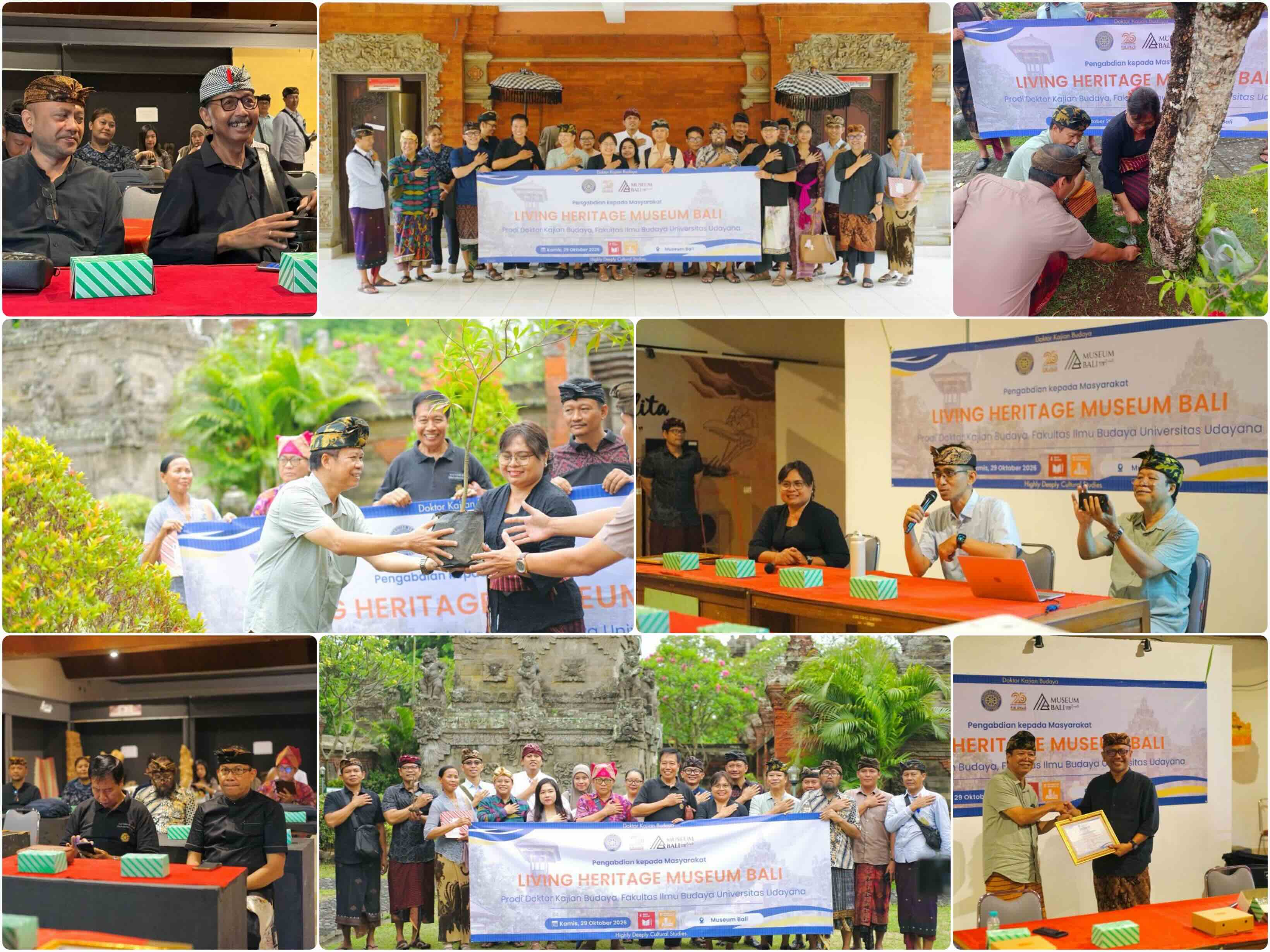
DENPASAR – The Doctoral (S3) Study Program in Cultural Studies, Faculty of Humanity, Udayana University (FIB Unud), organized a Community Service (Pengabdian kepada Masyarakat / PkM) activity themed "Living Heritage Museum Bali" at the Bali Museum, Denpasar, on Thursday, October 29, 2026. The half-day event combined the conservation of rare Balinese ceremonial (upakara) plants with a discussion session, involving 50 participants consisting of lecturers, students, staff, alumni, and representatives from the Bali Museum.
The community service series commenced in the morning with the symbolic handover of approximately 10 rare plants used for Balinese rituals (upakara). The donated plant species included nagasari, majegau, cempaka (magnolia), aren (sugar palm), rijasa, green betel (sirih hijau), red betel (sirih merah), starfruit (belimbing), and cemara gesang.
The activity continued with a symbolic planting of red betel/areca palm (sirih/pinang merah) in the courtyard of the Bali Museum by the Head of the Bali Museum, Ida Ayu Sutariani, S.S., M.Si., accompanied by the Coordinator of the Doctoral Study Program in Cultural Studies of FIB Unud, Prof. Dr. I Nyoman Darma Putra, M.Litt.. The red betel/areca palm was planted near an old frangipani (kamboja) tree, which will serve as the support where the plant will climb. The planting ceremony proceeded smoothly under clear skies after the rain that had fallen prior to the planting stopped.
The Head of UPTD Bali Museum, Ida Ayu Sutariani, S.S., M.Si., noted that while green betel was already available at the museum, red betel had not yet been planted there. According to her, a considerable number of plants are already growing in the museum's courtyard, and their numbers will continue to be increased in accordance with space availability. Most importantly, the public will know that the Bali Museum provides plants that may be needed for ritual purposes (sarana upakara) and are difficult to find elsewhere.
“Museum guests and visitors can also be introduced to the existing unique plants that are related to Balinese culture,” said the Head of the Museum.
Following the planting of rare ceremonial plants, the activity continued with a discussion on the living museum concept, featuring speakers Ida Ayu Sutariani (Head of the Bali Museum), Ida Bagus Agung Gunarthawa (Director of Samsara Living Museum), and Prof. Dr. I Wayan Windia, S.H., M.Si. (an alumnus as well as the author of the book Taman Gumi Banten).
In her presentation, the Head of the Bali Museum highlighted that she and her team are working hard to realize the vision and mission of the Bali Museum in preserving Balinese culture and establishing the Bali Museum as a living museum. As part of these efforts, the museum organizes various activities involving school students, such as cultural quiz competitions, museum video clip competitions, storytelling, and traditional Balinese games.
“We hold various activities for students so that they get to know the collections of the Bali Museum and learn about their culture. We also use social media to introduce the museum to the public so that they are interested in visiting the museum to learn about Balinese culture,” explained Dayu Sutariani.
With numerous activities taking place at the museum and visitors able to participate actively in its programs, the Bali Museum is directing its management toward becoming a living museum.
UDAYANA UNIVERSITY