 ENG
ENG
 INA
INA
The Highway Paradox: ISI Bali's Lecturer Successfully Promote Doctorate in Cultural Studies Faculty of Humanities Udayana University
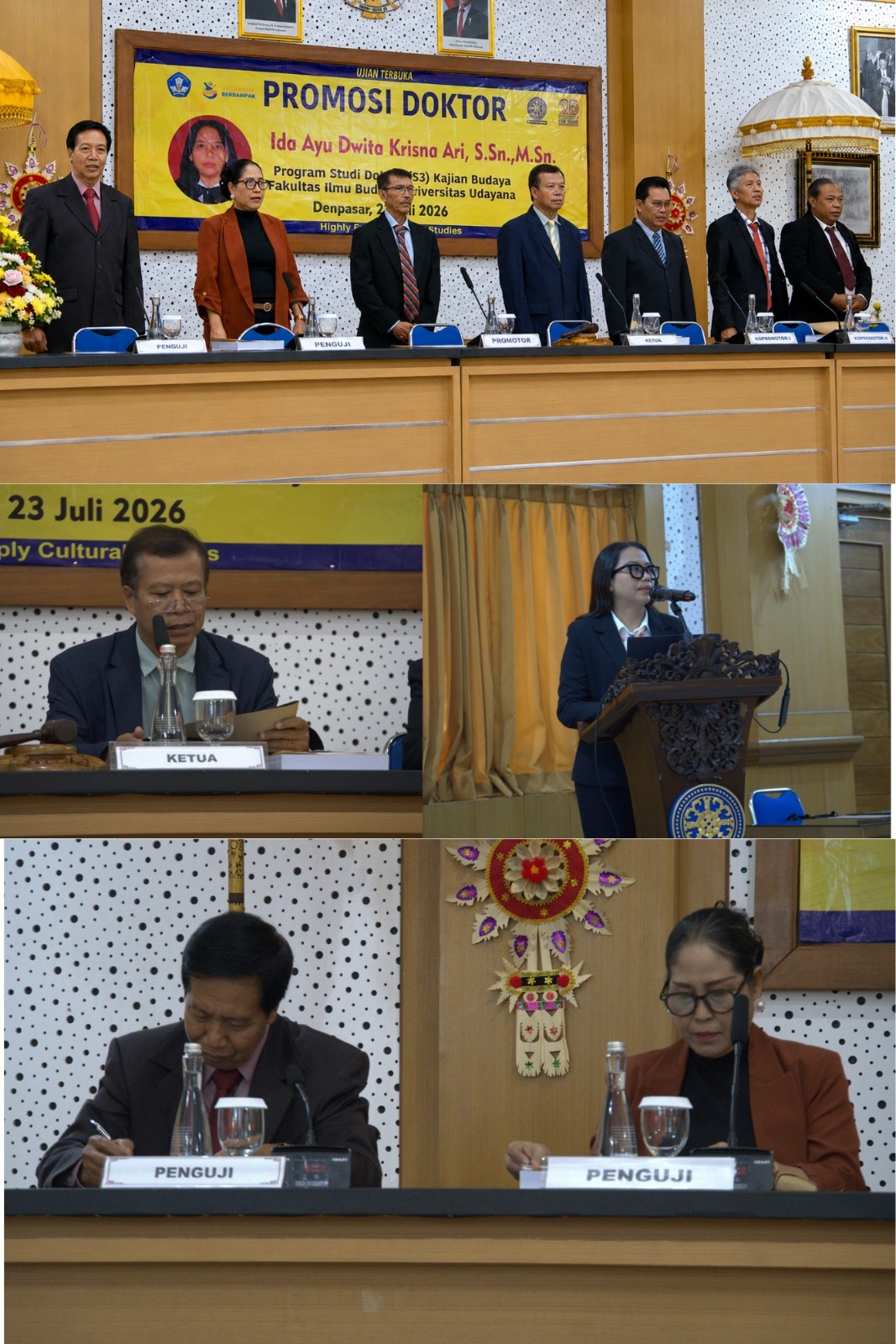
The Doctoral (S3) Cultural Studies Program of the Faculty of Humanities, Udayana University, once again produced a new doctor through an Open Doctoral Defense held on Thursday, July 23, 2026, in the Dr. Ir. Soekarno Meeting Room, 4th Floor of the Poerbatjaraka Building. This solemn academic celebration was witnessed firsthand by family members, colleagues from the Indonesian Institute of the Arts (ISI) Bali, and fellow doctoral students who attended to provide their full support. The promovenda, Ida Ayu Dwita Krisna Ari, S.Sn., M.Sn., who is also a lecturer in the Visual Communication Design (DKV) Study Program at ISI Bali, successfully defended her dissertation entitled "Representation of Women in the Discourse of Truck Tailgate Paintings in Bali" (Representasi Perempuan dalam Wacana Lukisan Bak Truk di Bali). She achieved a "Very Satisfactory" predicate, officially becoming the 287th doctor at the Faculty of Humanities, Udayana University, and the 306th doctor in the Doctoral Cultural Studies Program.
The Open Defense was chaired by Prof. Dr. I Nyoman Darma Putra, M.Litt. He was accompanied by Prof. Dr. Anak Agung Ngurah Anom Kumbara, M.A., as the Promoter, Prof. Dr. I Nyoman Suarka, M.Hum., as Co-Promoter I, and Dr. I Wayan Suardiana, M.Hum., as Co-Promoter II. The internal board of examiners for this session included Prof. Dr. I Nyoman Weda Kusuma, M.S., and Dr. Ni Luh Putu Ari Sulatri, S.S., M.Hum. To objectively assess the research's novelty, the open examination also featured two external examiners from ISI Bali: Dr. Tjokorda Udiana Nindhia Pemayun, S.Sn., S.H., M.Hum., and Dr. Ida Ayu Kade Sri Sukmadewi, S.Sn., M.Erg.
The background of this dissertation is rooted in the phenomenon of truck tailgate paintings in Bali, which the general public tends to view merely as spontaneous and humorous street entertainment. In reality, beneath its seemingly simple visual forms, this cultural discourse practice harbors profound meanings regarding the negotiation of identity representation, social class, humor, and ideology. Academically, there is a research gap that has frequently overlooked the ideological dimensions and power relations behind these street aesthetic practices. The verbal and visual texts displayed on trucks are essentially never neutral; rather, they actively operate as a mobile discursive space that produces, naturalizes, and disseminates gender-biased discourses concerning the female body.
The research applied a qualitative approach by eclectically integrating the theoretical foundations of cultural studies. The applied theoretical framework encompasses Stuart Hall's theory of representation, Roland Barthes's semiotics, Julia Kristeva's feminism, Norman Fairclough's critical discourse analysis, and Pierre Bourdieu's theory of social practice. Data collection was conducted through field observations, document studies, and in-depth interviews with purposively selected key informants, consisting of truck drivers, truck owners, and painters operating in the Bali region from 2021 to 2025.
The analytical results demonstrate that the representation of women in the discourse of truck art emerges through an intertwined combination of verbal texts, visual texts, and narratives that reproduce body objectification, stereotyping, and the domination of patriarchal ideology. This construction of meaning is heavily influenced by paradoxical parody mechanisms that mock masculinity crises, the normalization of sexual violence discourse through sexist jokes, and pseudo-appreciation where the authority of meaning remains under male control. The sociocultural implications of this practice indicate that truck mobility has transformed highways into a circulation of patriarchal ideology that potentially provokes the public's critical reasoning regarding gender inequality.
The open examination proceeded dynamically with various inquiries from the board of examiners. The main spotlight was directed at the external examiners' questions, which pierced the core of the dissertation's cultural argumentation. Dr. Ida Ayu Kade Sri Sukmadewi, S.Sn., M.Erg., highlighted the concept of "gender-biased psychosocial catharsis" and its future relevance. Addressing this, the promovenda explained that the working class often channels their economic pressure onto women through the reproduction of sexist humor—a finding she asserted as crucial for the discipline of visual communication design. On the other hand, Dr. Tjokorda Udiana Nindhia Pemayun, S.Sn., S.H., M.Hum., questioned the moral paradox in the text "Lihat jalanmu, jangan lihat celana dalamku" (Look at your road, don't look at my panties) and challenged the promovenda on whether she had ever empirically climbed onto the back of a truck to directly experience the public's gaze. The promovenda straightforwardly elaborated that the text creates a paradox: the female visual is deliberately displayed erotically to provoke stares, yet women are scapegoated for men's inability to avert their gaze, while also admitting she had never conducted direct observations atop a truck tailgate.
Closing the open examination, Prof. Dr. Anak Agung Ngurah Anom Kumbara, M.A., as the promoter, emphasized that every academic work inevitably has limitations, yet this is by no means a negatively construed weakness. On the contrary, within those gaps or boundaries lies a positive space that challenges other scholars to delve into the field and produce new studies. He stressed that from the perspective of the philosophy of science, an outstanding dissertation is not a work that claims absolute perfection and shuts down debate. A good work is one capable of sparking dialectics and providing room for the creation of subsequent dissertations in the future to continuously dissect untouched discourses.
.jpg)
UDAYANA UNIVERSITY