 ENG
ENG
 INA
INA
A Harmonious Prelude for Mahadayana: 2026 FIB PKKMB Integrates Campus Ecosystem and Safe Spaces
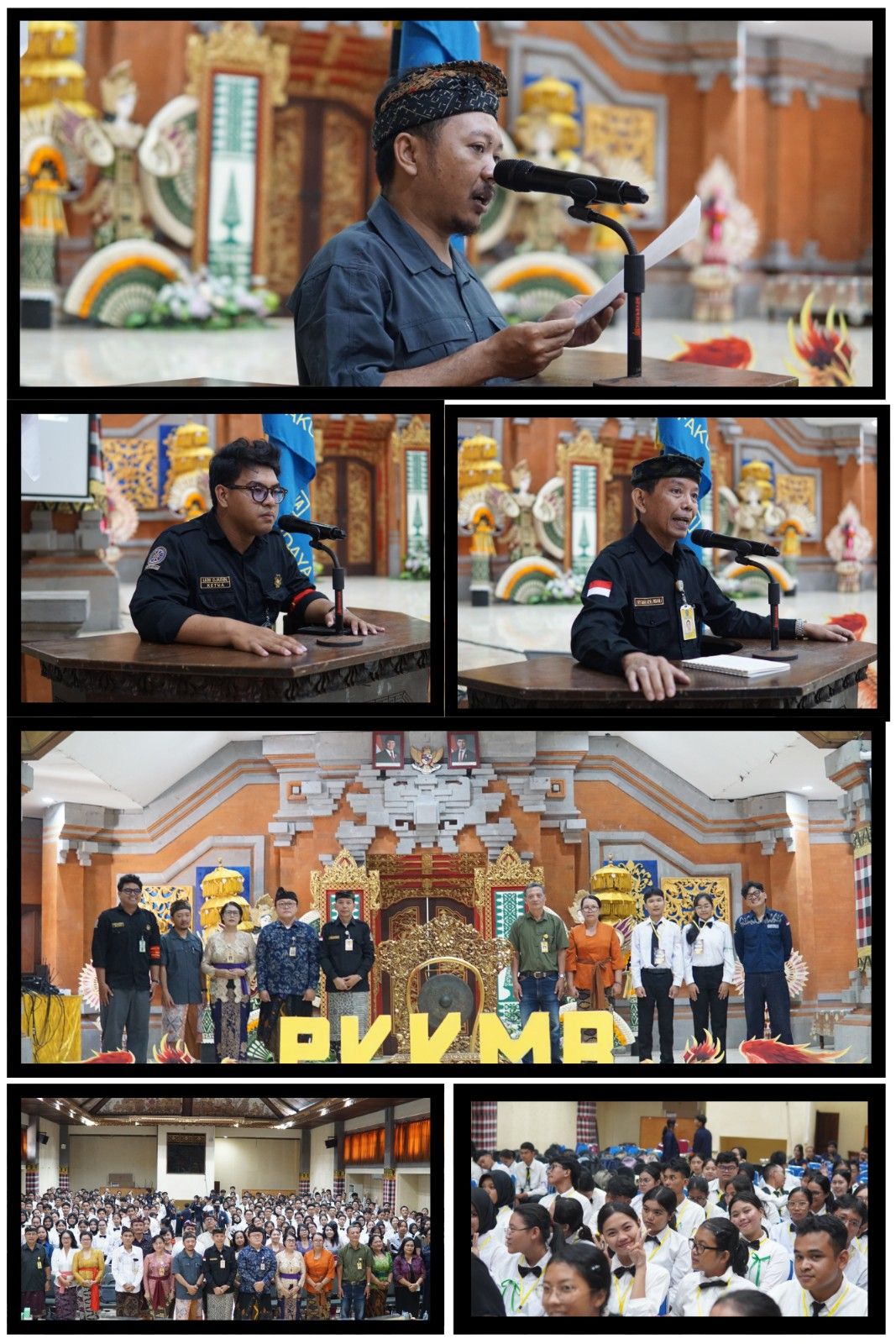
Denpasar, August 6, 2026 – A new chapter for the Mahadayana (Udayana Faculty of Humanities Students) has officially begun through the 2026 FIB PKKMB (Introduction to Campus Life for New Students of the Faculty of Humanities). The first day of the orientation series aimed to accelerate the adaptation of new students to the faculty ecosystem, encompassing an understanding of the academic system, introductions to the leadership and student organizations, and education on violence prevention in higher education. The event took place at the Widya Sabha Mandala Auditorium and the Reading Room, 3rd Floor of the Ida Bagus Mantra Building. It was attended by 460 new students and 16 continuing students. This orientation was attended by all executive leaders of Faculty of Humanities..
Initiating the event, Taufik Agus Purnomo, S.Pd., M.A., as the general chair of the 2026 FIB PKKMB committee, reported that this year's orientation was attended by 460 new students and 16 continuing students, carrying a commitment to a positive environment. "This activity prioritizes educational, humanistic, inclusive, and safe values, free from all forms of violence, discrimination, and hazing," he stated.
This spirit was welcomed and forwarded by the Chairperson of the Student Senate of the Faculty of Humanities, Udayana University (SMFIB Unud), I Putu Gede Lion Ojasvin Putra Barata, who urged the 2026 Mahadayana to maximize this orientation period as a transitional space to understand the campus ecosystem and build their character as academic individuals.
The faculty's commitment to nurturing new students was further reinforced by the directive from the Dean of Faculty of Humanities, Prof. I Nyoman Aryawibawa, S.S., M.A., Ph.D. In his remarks, he issued an absolute warning that participation in PKKMB is a non-negotiable obligation for every student, serving as a crucial administrative prerequisite up to the thesis completion stage. He also encouraged students to balance their academic responsibilities with involvement in student organizations to hone their leadership skills. Regarding the safety of the learning environment, he delivered an absolute assertion.
"The Faculty of Humanities is bound by a commitment to build an integrity zone. We are committed to zero bullying," he emphasized. After the introductory session for the deanery leaders, study programs, units, and sub-coordinators, he officially opened the event symbolically by striking the gong, accompanied by the placing of name tags on the 2026 Mahadayana representatives, which was then followed by all the new students.
Following the inauguration, the students' focus was immediately directed toward the dissection of various operational and academic aspects of the faculty. The comprehensive session, guided by Putu Gede Suarya Natha, S.S., M.Hum. as the moderator, featured the three Vice Deans as the main speakers.
The first presentation was delivered by the Vice Dean for Academic Affairs and Planning, Dr. I Gede Oeinada, S.S., M.Hum., who thoroughly examined the academic rules and policies at FIB Unud. The material was then continued by the Vice Dean for General and Financial Affairs, Prof. Dr. Dra. Ni Ketut Ratna Erawati, M.Hum. She detailed the readiness of facilities and infrastructure at both the Jimbaran and Nias campuses, in line with the faculty's commitment to the Integrity Zone towards a Corruption-Free Area (ZI-WBK). Concluding the session, the Vice Dean for Student Affairs and Information, Dr. Ni Ketut Puji Astiti Laksmi, S.S., M.Si., dissected the student affairs ecosystem, providing insights into the student executive and legislative bodies, study program associations, various Student Activity Units (UKM), and the Impactful Campus (Kampus Berdampak) program.
Moving from faculty-level policies, the orientation was then narrowed down to a more specific academic scope. The new students received an in-depth explanation regarding the profile of each Study Program (Prodi) under FIB Unud, along with an introduction to the Study Program Student Associations (HMPS) as their first organizational home.
The dense academic atmosphere was subsequently lightened during the break session, where the committee screened interactive videos from groups 1-5 as a form of appreciation for the Mahadayana's creativity.
Entering the second half of the event, the tension of the activity was refocused on a crucial institutional issue through a material presentation on the prevention and handling of violence in higher education environments. Moderated by Putu Dyah Pradnya Paramitha, S.S., M.A., this session invited I Gusti Agung Ayu Yuliari, S.E.Ak., M.Si., the Secretary of the Violence Prevention and Handling Unit of Udayana University (UPPK Unud). She asserted that the latest legal framework via Permendikbudristek Number 55 of 2024 has expanded the scope of campus protection; it no longer solely focuses on sexual violence but also takes strict action against physical and psychological violence, bullying, intolerance, and policies that perpetuate violence.
Furthermore, she emphasized the importance of students' courage to report immediately if they witness, hear, or experience acts of violence, considering that the UPPK authority cannot process cases without official reports. As a manifestation of the commitment to maintaining a safe space, all 2026 new students were also required to agree to an integrity pact, accompanied by strict warnings regarding severe administrative sanctions, up to the threat of permanent dismissal as a student for anyone proven to be a perpetrator of violence.
The first day of the 2026 FIB PKKMB was then officially closed with an introduction to the faculty-level student organizations, including the Student Senate of the Faculty of Humanities (SMFIB) as the executive motor and the Student Representative Council of the Faculty of Humanities (BPMFIB) as the legislative pillar. In this final session, the functionary representatives comprehensively dissected the structural details of the organizations along with the various aspects governed by each institution, aiming to provide a complete overview for the Mahadayana to eventually channel their aspirational rights and movement directions within the campus environment.

UDAYANA UNIVERSITY