 ENG
ENG
 INA
INA
A Study of the Discursive on the Krama Bali Family Planning Program in the Multicultural Community of Sukasada Subdistrict, Buleleng Regency, Leading Dewa Nyoman Dalem to Achieve Doctoral Degree
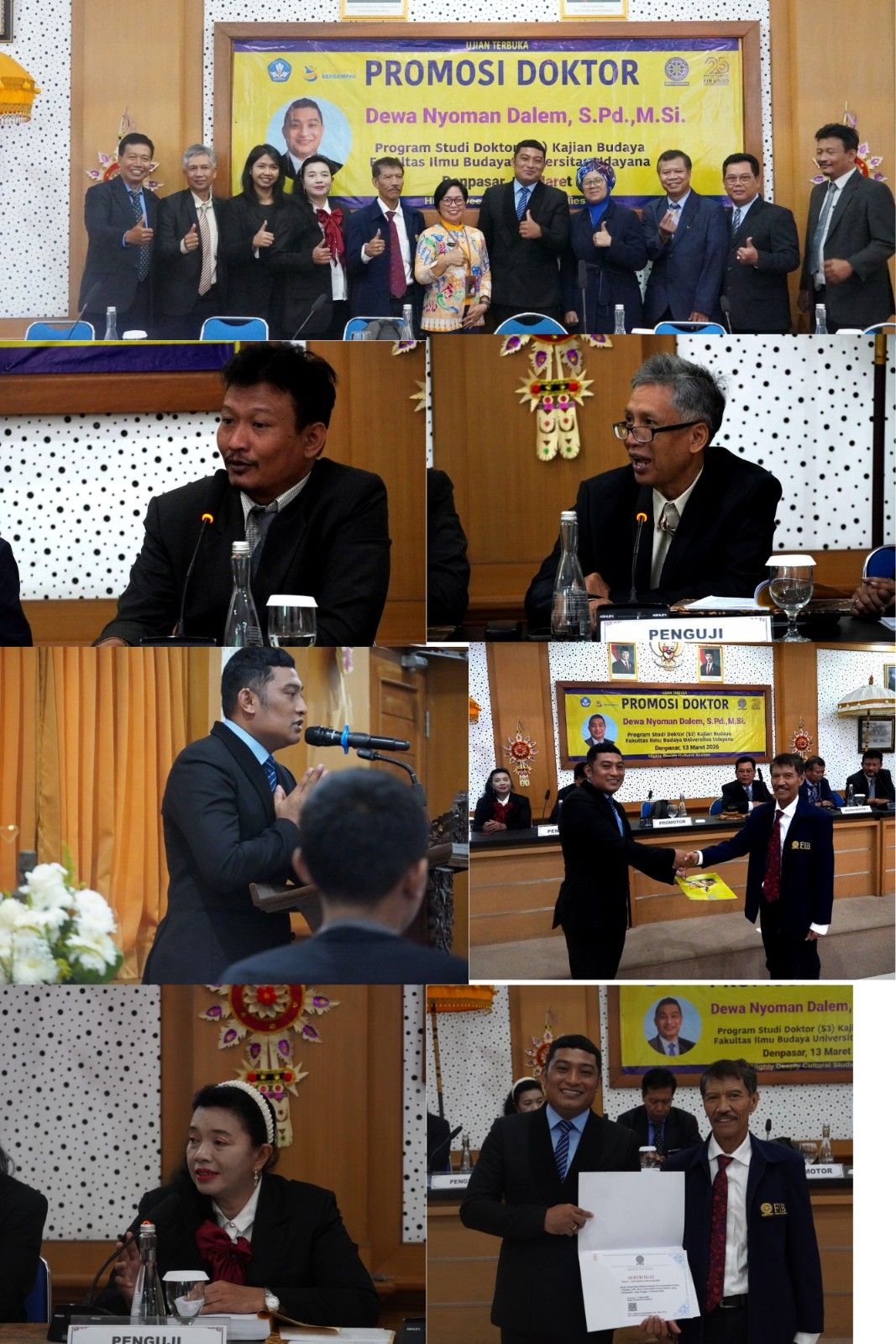
On Friday, March 13, 2026, the Faculty of Humanities at Udayana University once again held an Open Doctoral Defense for the Linguistics Program, Doctoral Program. The defense took place in the Ir. Soekarno Room, Poerbatjaraka Building, Faculty of Humanities, Udayana University. The doctoral candidate, Dewa Nyoman Dalem, S.Pd., M.Si., presented a dissertation entitled “The Struggle of Balinese Krama Discursive in a Multicultural Community in Sukasada Subdistrict, Buleleng Regency.” During the defense, the candidate successfully defended his dissertation and was declared to have passed with the grade “Cumlaude.” With this graduation, he is recorded as the 278th Doctoral graduate in the Faculty of Cultural Sciences and the 304th Doctoral graduate in the Doctoral Program in Cultural Studies, Faculty of Humanities, Udayana University.
At this Doctoral defense, the Chair of the Dissertation Examination Committee was Prof. Dr. I Nyoman Suarka, M.Hum., accompanied by members of the Examination Committee: Prof. Dr. A.A.Ngh. Anom Kumbara, M.A., Prof. Dr. I Nyoman Darma Putra, M.Litt., Dr. Nanang Sutrisno, S.Ag., M.Si., Prof. Dr. I Nyoman Weda Kusuma, M.S., Dr. I Wayan Suardiana, M.Hum., Dr. Ni Nyoman Dewi Pascarani, S.S., M.Si., Dr. Pande Wayan Renawati, S.H., M.Si., C.Ed., Dr. Retno Dwimarwati, S.Sen., M.Hum.
This dissertation is motivated by the author’s observations of the discourse on family planning (KB) among the Balinese community in Sukasada, Buleleng, which reveals social dynamics within a multicultural society. Acceptance and rejection of family planning emerge amidst ethnic and religious diversity, such as among the Balinese, Bugis, and Javanese or Blambangan communities living side by side. These attitudes are influenced not only by health and economic factors but also by cultural values, religious teachings, and the social positions of each group. This study aims to trace, uncover, and analyze the power-knowledge relations operating behind the processes of acceptance and rejection of the Balinese KB discourse by the multicultural community in Sukasada District.
The causes of the discursive struggles surrounding family planning among the Balinese elite stem from ideological pluralism, rational dispositions, cultural hybridity, identity negotiations, and structural dynamics. The forms of this discursive struggle over the KB Krama Bali framework include tensions between traditional and modern values, the paradox of symbolic authority among institutions, the negotiation of religion and social identity, and the contestation of intergenerational reproductive discourse. Implications arising from these struggles in the discourse of the KB Krama Bali include the fragmentation of the meaning of the ideal family in a multicultural context, the political dynamics of women’s bodies and silent resistance, the dislocation of traditional meanings and the formation of new, simulated traditions, as well as reproductive politics and the positioning of children as representations of cultural projects within a multicultural society.
The research findings reveal shifting public attitudes toward the Family Planning program. Empirically, some informants expressed opposition to Family Planning at the level of their views or beliefs, yet in practice they continued to regulate births through natural birth spacing or the covert use of contraception. Conversely, there are also people who verbally express acceptance of the Family Planning program, but in their daily lives continue to maintain the pattern of having many children due to cultural, religious, or social pressures from extended families. Theoretically, these findings indicate the existence of symbolic acceptance that is not always followed by actual practice. Therefore, this study proposes the development of Stuart Hall’s Encoding–Decoding framework by incorporating elements of ambivalence and paradox into the process of meaning-making—specifically, the condition where symbolic acceptance coexists with practical rejection, as well as pragmatic acceptance even when it is not fully endorsed ideologically.
In this study, the author recognizes that research on the discursive struggle surrounding the Balinese krama family planning discourse within the multicultural community of Sukasada, Buleleng Regency, remains limited to specific social spaces and temporal contexts and focuses primarily on discourse production, symbolic authority, and identity negotiations at the local level. Therefore, the author suggests that future research adopt a more genealogical and cross-institutional approach to trace the relationships between the state, population policies, customary institutions, and religious authorities in the processes of production, legitimization, and normalization of the Balinese krama family planning discourse within a broader network of power.
.jpg)
UDAYANA UNIVERSITY