 ENG
ENG
 INA
INA
Collaboration Between the Faculty of Humanities Udayana University and Sebelas Maret University: National Seminar on Cultural Studies, Series 11: Analyzing Post Modernism in Literature and the Dynamics of the Sumba Diaspora
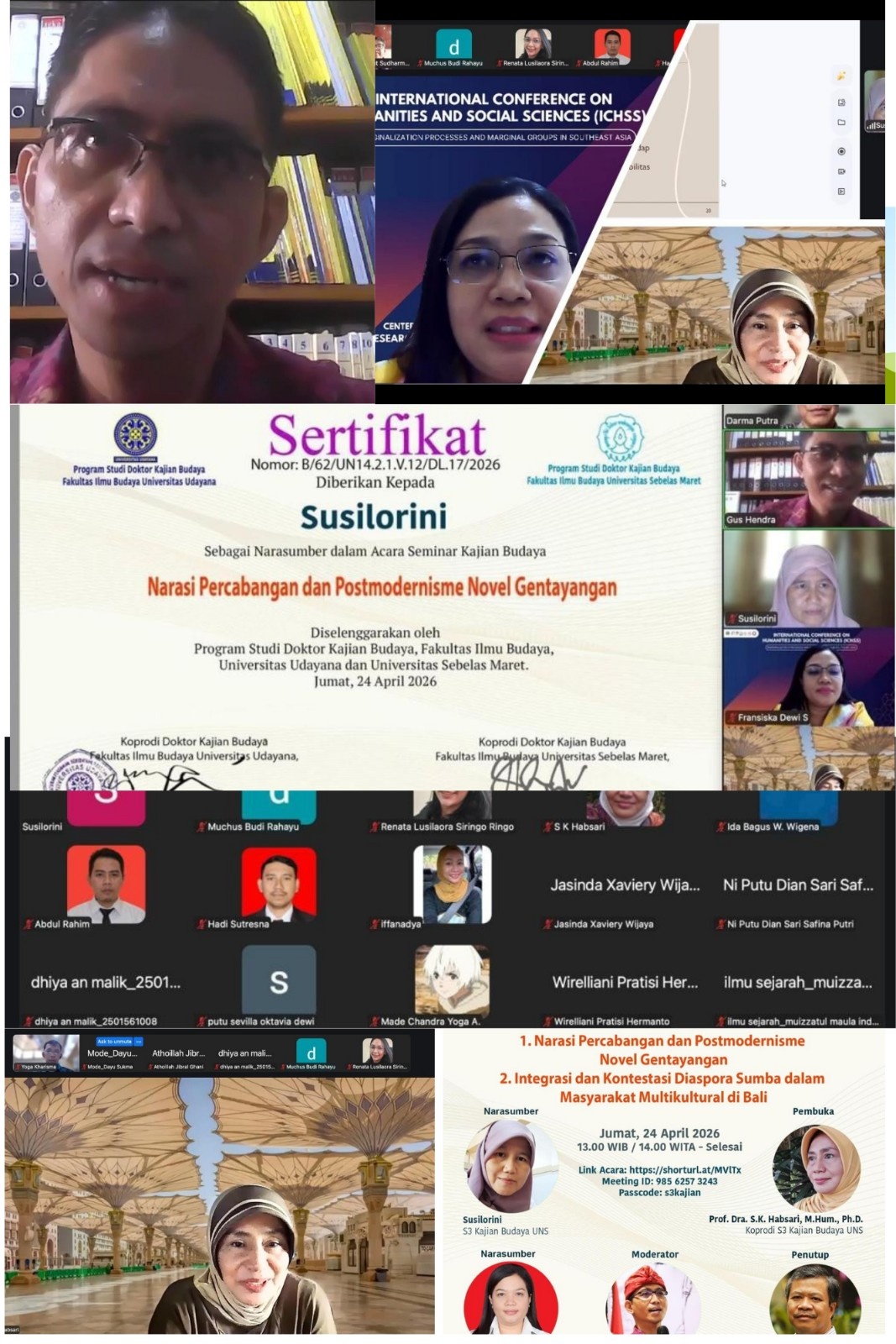
Denpasar, April 24, 2026 – The Doctoral Program in Cultural Studies, Faculty of Humanities, Udayana University once again collaborated with the Doctoral Program in Cultural Studies, Faculty of Humanities, Sebelas Maret University conducted the National Seminar for Cultural Studies Students: Cultural Narratives Series 11. The seminar, held online via Zoom Meeting, was attended by over 80 participants and discussed two relevant cultural issues, namely the complexity of postmodernism in contemporary literature and the dynamics of internal diaspora in Indonesia.
The seminar was officially opened by the Coordinator of the Doctoral Program in Cultural Studies Udayana University, Prof. I Nyoman Darma Putra, M.Litt., Ph.D. He expressed his appreciation for the high enthusiasm of the participants and highlighted an interesting correlation between the two topics discussed, which is the shared theme of 'adventure'. This theme is represented through the imaginative journey of a fictional character created by an author, as well as the real-life experience of the migration of the Sumba sub-ethnic community to Bali.
The event was moderated by Agus Putra Mahendra, a Doctoral student in Cultural Studies at Faculty of Humanities, Udayana University. The presentation for the first session was delivered by Dra. Susilorini, M.A., a representative of the Doctoral Program of Cultural Studies at Faculty of Humanities, Sebelas Maret University examined the novel Gentayangan: Pilih Sendiri Petualangan Sepatu Merahmu by Intan Paramadita. This work responds to post modernism by deconstructing the linear plot into ergodic literature with a branching narrative, granting full autonomy to the reader as the character "You" to navigate the course of the story. Furthermore, she emphasized the transnational dimension of the novel. Through an intertextual approach, the fairy tales of Rumpelstiltskin and Faust are utilized as critical allegories for the exploitation of female workers amidst global capitalism. The text also illustrates the transition from the epistemological to the ontological realm, where the existence of postmodern women occupies a dynamic liminal space and continuously transforms in a rhizomatic manner (spreading without hierarchy).
Dr. Fransiska Dewi Setiowati Sunaryo, S.S., M.Hum., representing the Doctoral Program in Cultural Studies of Faculty of Humanities Udayana University, examined the dynamics of integration and contestation of the Sumba Diaspora in Bali, highlighting their existence as active subjects who continuously negotiate their identities in a multicultural space. The manifestation of this cultural fluidity is evident in the phenomenon of "Modern Marapu", namely the adaptation of ancestral values to align with Balinese spirituality, as well as the strengthening of social cohesion through associations such as the Ikatan Warga Sumba and Flobamora. Responding to the escalation of social media stigmatization exacerbated by conflict-capitalizing algorithms, Fransiska explained that the "Nak Sumba" labeling actually triggers cultural resistance. The negative stigma is now reclaimed and utilized by the diaspora community as a form of identity representation to attain equal social recognition.
The seminar series was concluded by the Coordinator of the Doctoral Program in Cultural Studies of Sebelas Maret University, Prof. Dra. S.K. Habsari, M.Hum., Ph.D., through the high appreciation given to the sharp analytical approach applied in both presentations. It was also affirmed by her that the capacity of Cultural Studies in reading changes, identity negotiations, and power dynamics had been proven through the novelty of the digital fiction and ethnic diaspora topics examined. Ultimately, the continuation of the collaboration between Faculty of Humanities Udayana University and Sebelas Maret University, which has been established for two years. It is highly anticipated, so that the critical reasoning of researchers in responding to the dynamic cultural landscape can continuously be nurtured through this academic platform.
.jpg)
UDAYANA UNIVERSITY