 ENG
ENG
 INA
INA
Boosting Global Research Visibility, FIB Unud Officially Launches "DUMILAH" Digital Humanities Ecosystem
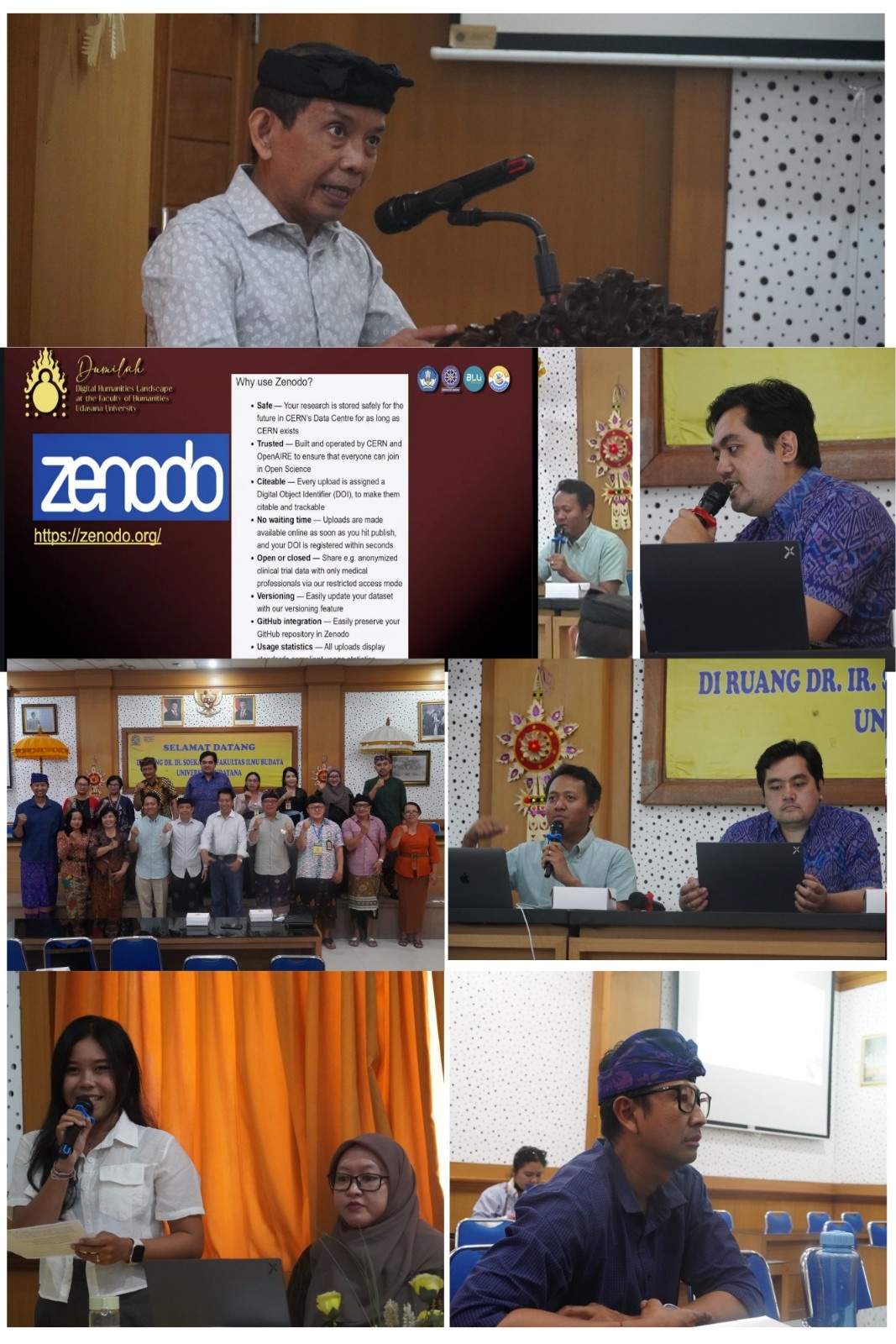
Denpasar, April 23, 2026 - The Faculty of Humanities, Udayana University officially launched DUMILAH (Digital Humanities Landscape at the Faculty of Humanities Udayana University). Held in the Dr. Ir. Soekarno Room, 4th Floor of the Poerbatjaraka Building, Faculty of Humanities Udayana University, the event was attended by the decanate ranks, the Chair of the Faculty of Humanities Udayana University’s Senate, study program coordinators and Unit Coordinators, the leadership of CIRHSS (Centre for Interdisciplinary Research on the Humanities and Social Sciences), and the Head of FIB Unud Media.
Commencing the event, Prof. I Nyoman Aryawibawa, S.S., M.A., Ph.D., as the Dean of Faculty of Humanities Udayana University emphasized that the launch of DUMILAH is a strategic step to increase the faculty's visibility at the national and international levels. This innovation, which manifests the mandate of the founders of the Faculty of Letters as well as the elaboration of the FIB Strategic Plan, has been developed since 2025 by involving global digital humanities experts, such as from Oxford, UK and Australia (i.e., from Queensland, Sydney, Melbourne, and Canberra). The presence of DUMILAH is projected to serve as an interactive platform for researchers and students to manage research data to boost academic productivity, in line with the leadership's commitment to raising Udayana University's global ranking.
Proceeding with the event, Gede Primahadi Wijaya Rajeg, S.S., M.Hum., Ph.D., as the Head of the DUMILAH launch team, explained that the initiation of this platform's development was motivated by the fact that fellow researchers within FIB Unud have actually conducted a considerable amount of research related to Digital Humanities. This series of research includes the compilation of databases in the fields of archaeology and anthropology, up to efforts in mapping and preserving lontar texts. Therefore, DUMILAH is specifically present to facilitate the visibility and dissemination of open science-oriented research, ensuring proper recognition for researchers through work citation (citeability), and guaranteeing the long-term preservation of digital research archives.
Technically, DUMILAH utilizes Zenodo, a free, globally scaled open research repository. This platform was chosen due to its integrity, having been trusted by various world research institutions and managed directly by CERN. The main advantage of archiving through Zenodo is that every uploaded material will automatically receive a Digital Object Identifier (DOI), allowing it to be globally recorded and easily cited, and the material possesses the capability to be continuously updated to its subsequent versions (versioning).
Accompanying the Head of the DUMILAH team, I Made Sena Darmasetiyawan, S.S., M.Hum., Ph.D., demonstrated in detail how to use DUMILAH, including how to access DUMILAH via Zenodo, which can be done through various browser options. After successfully logging in, users can directly search for the community by typing "DUMILAH" in the search bar under the Communities menu. Within the community page, users will find a New Upload button, which functions to upload various raw research data, such as databases or datasets. Users are required to fill in several essential metadata, primarily checking the request option for a Digital Object Identifier (DOI) to ensure the visibility and ease of citation of the work globally. In addition, an important feature like Save Draft is highly recommended to be clicked periodically to prevent data loss while the uploading process is underway. Once all mandatory metadata marked with a red asterisk and public visibility settings are completed, users can press the Submit for Review button. The uploaded work will undergo a curation process by the management team (reviewers) first before it is finally approved, officially published on the DUMILAH page, and given a DOI as well as an adjustable citation format (e.g., Vancouver format).
During the Q&A session, crucial issues regarding the protection of intellectual property copyrights and data curation policies became the main spotlight. Addressing concerns related to copyright, the DUMILAH team explained that the Zenodo platform is equipped with flexible license option features. Researchers can apply full copyright, limit data access (restricted), or simply display the metadata record along with external links without having to upload the raw data openly. Meanwhile, regarding the uploading policy, it was affirmed that the DUMILAH community is prioritized to accommodate the works of the Faculty of Humanities Udayana University’s academic community. External parties or external collaborators are only allowed to contribute data to the repository if they include an FIB academic community member as a co-author or collaboration partner in their work. To ensure the quality and relevance of the published content, the DUMILAH management will also empower representatives from each study program's research group to act as curators tasked with selecting and verifying incoming works according to their scientific disciplines.
Sharing his appreciation for this launch, the Chair of the Faculty of Humanities Udayana University ‘s Senate, Prof. Dr. I Nyoman Weda Kusuma, M.S., placed high hopes on the younger generation to become the driving force in utilizing DUMILAH. He emphasized the importance of continuous socialization so that this innovation can be maximized by the entire academic community. Prof. Weda is optimistic that this program will continue to grow and contribute significantly to the progress and reputation of Faculty of Humanities Udayana University.
.jpg)
UDAYANA UNIVERSITY