 ENG
ENG
 INA
INA
Affirming Commitment to Clean Governance Faculty of Humanities Udayana University Participated in the Integrity Zone Evaluation towards WBK
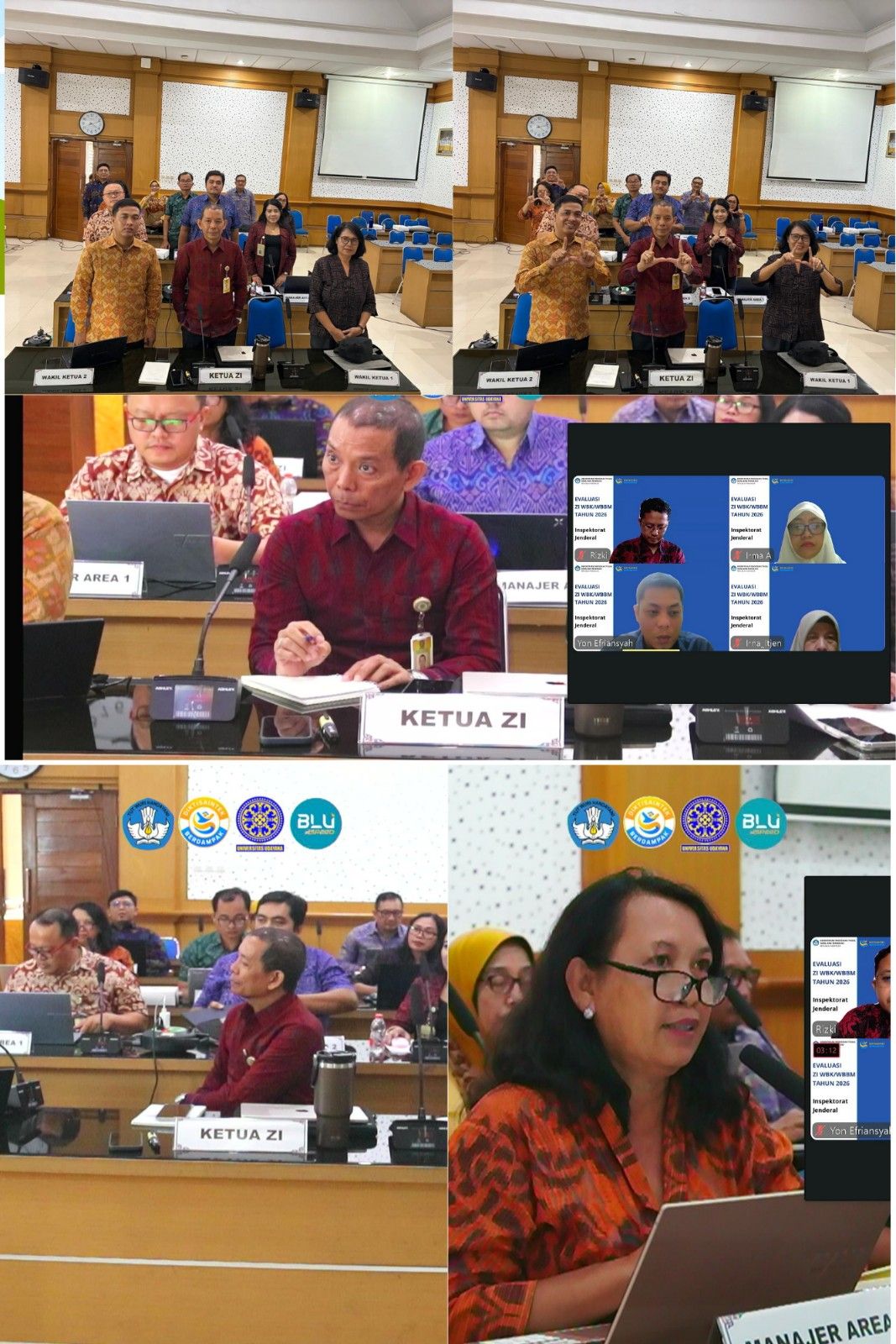
Denpasar, June 23, 2026 – The Faculty of Humanities, Udayana University participated in the Evaluation of the Integrity Zone towards a Corruption-Free Area (ZI WBK) organized by the Inspectorate General of the Ministry of Higher Education, Science, and Technology (Itjen Kemdiktisaintek) last Friday (19/06) in a hybrid format. Located in the Dr. Ir. Soekarno Meeting Room, 4th Floor of the Poerbatjaraka Building, the evaluation agenda was attended by the Faculty of Humanities Udayana University's ZI WBK development team.
In his presentation, the Dean of Faculty of Humanities Udayana University who also serves as the Chairman of the ZI Core Development Team, Prof. I Nyoman Aryawibawa, S.S., M.A., Ph.D., affirmed the faculty's commitment to its slogan, "Faculty of Humanities Udayana University with Integrity and Culture" (FIB Berintegritas dan Berbudaya). He explained that the featured innovations were rooted in real challenges on the ground, particularly regarding the management of class and exam schedules. Therefore, Faculty of Humanities Udayana University introduces the Class Schedule Planning System (SIPERJAKA) and the Room Reservation System (SIRERU) to resolve overlapping schedules for lecturers and students, as well as to optimize the social service of ancient manuscript preservation through the Udayana Lontar Unit.
During the Q&A session regarding performance achievements and the Government Internal Control System (SPIP), the Faculty of Humanities Udayana University ZI WBK team explained that the performance monitoring process is conducted periodically every quarter, involving all unit leaders. Although the faculty faced performance achievement challenges in 2025 due to budget adjustments and low alumni response rates in filling out the tracer study, it has formulated a corrective action plan and a more intensive communication strategy. Faculty of Humanities Udayana University also continues to improve its performance reporting through integration with the university's SILAKIN system and is designing the Performance Achievement System (SICAKI) application at the faculty level in 2026.
Regarding the aspects of supervision and integrity, the leadership of Faculty of Humanities Udayana University demonstrated a high commitment to compliance, evidenced by obedience in filling out the State Officials' Wealth Report (LHKPN) and the State Civil Apparatus Wealth Report (LHKASN) within the faculty. The faculty has also implemented a whistleblowing system and opened public complaint access through various massively socialized channels, such as the SP4N Lapor website, email, Instagram, and a dedicated electronic form. Up to the time of the evaluation, no crucial integrity violations or gratification reports were found, while incoming administrative complaints, such as requests for technical information on scholarships, were handled swiftly.
To maintain and improve the Community Satisfaction Index (IKM), which reached a "Very Good" rating (91.91) in the Fourth Quarter, Faculty of Humanities Udayana University is focusing on tangibly improving the quality of public services. One concrete step is the establishment of the Integrated Service Unit (ULT), which facilitates academic, student, and general administration in a single window. Given that the administrative center was relocated to the Bukit Jimbaran Campus in early 2024, the currently semi-manual ULT operations will soon be digitalized to ease the mobility of students studying at the Nias Campus.
Concluding the evaluation activity, the Dean of Faculty of Humanities Udayana University reaffirmed the primary essence of the Integrity Zone Development within Faculty of Humanities Udayana University. He stated that this endeavor is not solely for fulfilling assessment indicators or merely completing the Evaluation Worksheet (LKE) documents, but rather a sustainable commitment. The ultimate goal is to realize clean and accountable faculty governance, as well as to provide tangible services oriented towards the speed, convenience, and satisfaction of all service users.
Gallery
.jpg)
UDAYANA UNIVERSITY