 ENG
ENG
 INA
INA
AI Innovation for Balinese Script: Bachelor of English Literature conducted Workshop to Prepare "Nyastra AI" Web Development
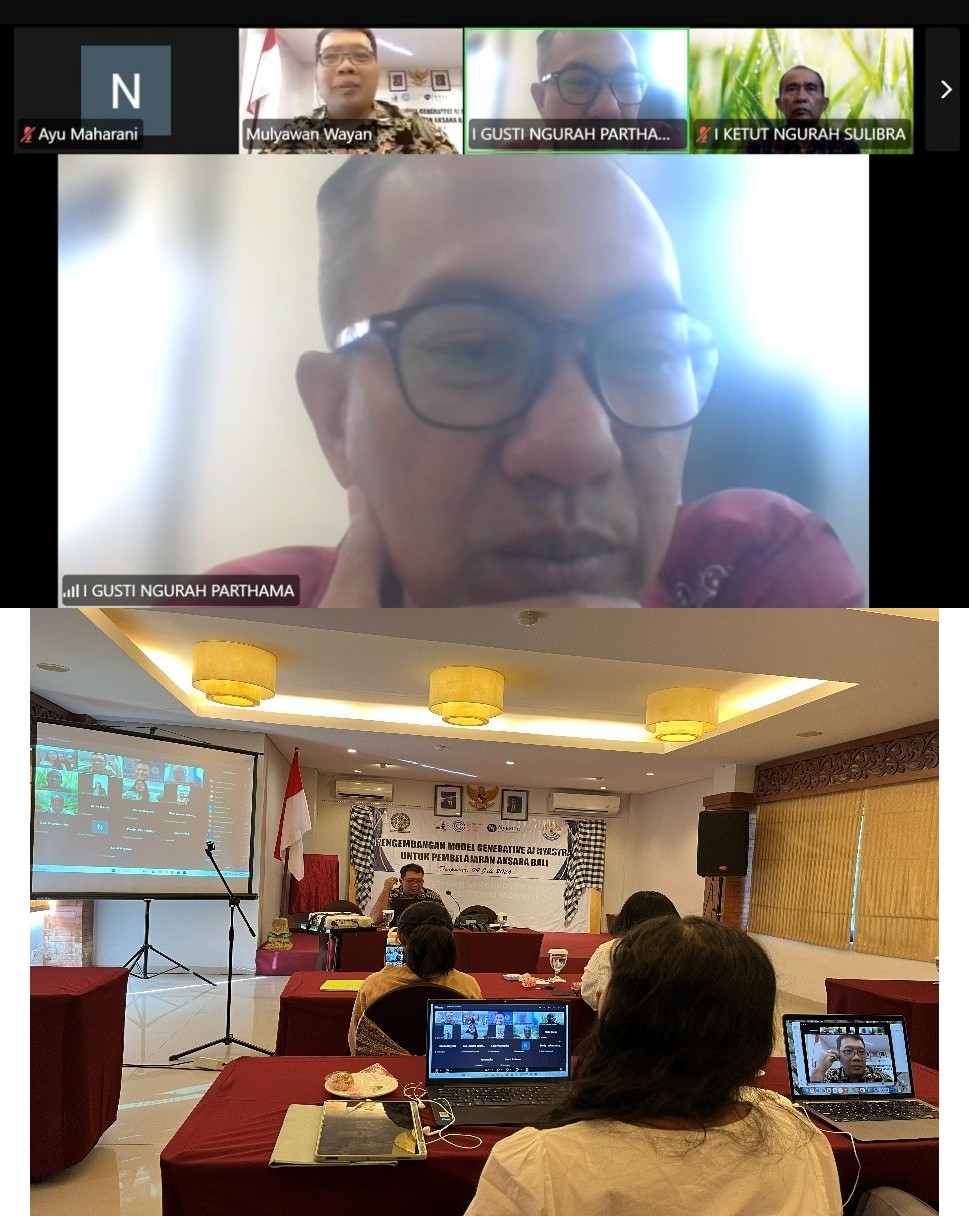
Denpasar, July 9, 2026 – As a concrete effort to support the Impactful Campus program, the English Literature Study Program of the Faculty of Humanities (FIB), Udayana University (Unud), held a Focus Group Discussion (FGD) themed "Development of the Nyastra Generative AI Web" at the Grand Mirah Hotel, Denpasar, in a hybrid format. This event marks a strategic step for the study program in delivering technological innovations that can be directly utilized by partner schools to strengthen the learning of the Balinese language, specifically the Balinese script.
The event was officially opened by the Coordinator of the English Literature Study Program, Dr. I Gusti Ngurah Parthama, S.S., M.Hum. In his welcoming remarks, he emphasized that this initiative aligns with the study program's strategic research plan, which is oriented toward socio-cultural impacts. "The development of the Nyastra Generative AI is a breakthrough that combines technological sophistication with efforts to preserve local cultural wisdom. This is a form of our commitment to producing research that is not only academic but also applicable and directly touches upon the educational needs of the community," he stated.
The FGD intensively discussed the core aspects of development, including designing an intuitive system workflow and preparing reliable technical infrastructure. The discussion resulted in an agreement to design a platform with a dual-mode interface: a "Fast Mode" for instant transliteration and an "Expert Mode" for deeper contextual adjustments, as well as special features such as a "Worksheet Generator" designed directly based on input from partner teachers. Furthermore, technical requirements were also discussed, such as server specifications, data security, and hosting strategies to support the AI model's performance.
In his presentation, the Head of the Research Team outlined a clear roadmap. "Our ultimate target this year is to complete the development of a stable AI model ready to be implemented within a restricted development environment. This will be an intensive validation phase. If the model proves to be accurate and robust, next year we will plan the downstreaming process or public launch for wider distribution," he explained. This statement underscores a phased approach oriented toward product quality and readiness.
The concrete outcomes of this FGD included the establishment of a comprehensive workflow for the Nyastra AI model, from text input and context analysis processes to the output of Balinese script equipped with various utility options. Moreover, the forum successfully formulated a strategic development plan that encompasses task delegation, project timelines, and an ongoing evaluation mechanism involving feedback from all stakeholders.
By involving multi-party collaboration—ranging from the research team, Business and Industry (DUDI) partners, to school partners and teachers—this activity not only finalized technical plans but also strengthened the synergy between academics and end-users. This step further solidifies the role of the English Literature Study Program as a pioneer in the utilization of cutting-edge technology for cultural preservation, as well as a tangible contributor in realizing the Impactful Campus vision championed by the ministry.
.jpg)
UDAYANA UNIVERSITY