 ENG
 INA
Balinese Literature Study Program FIB Unud Holds OBE-Based Curriculum Refinement Workshop, Produces 31 RPS Drafts
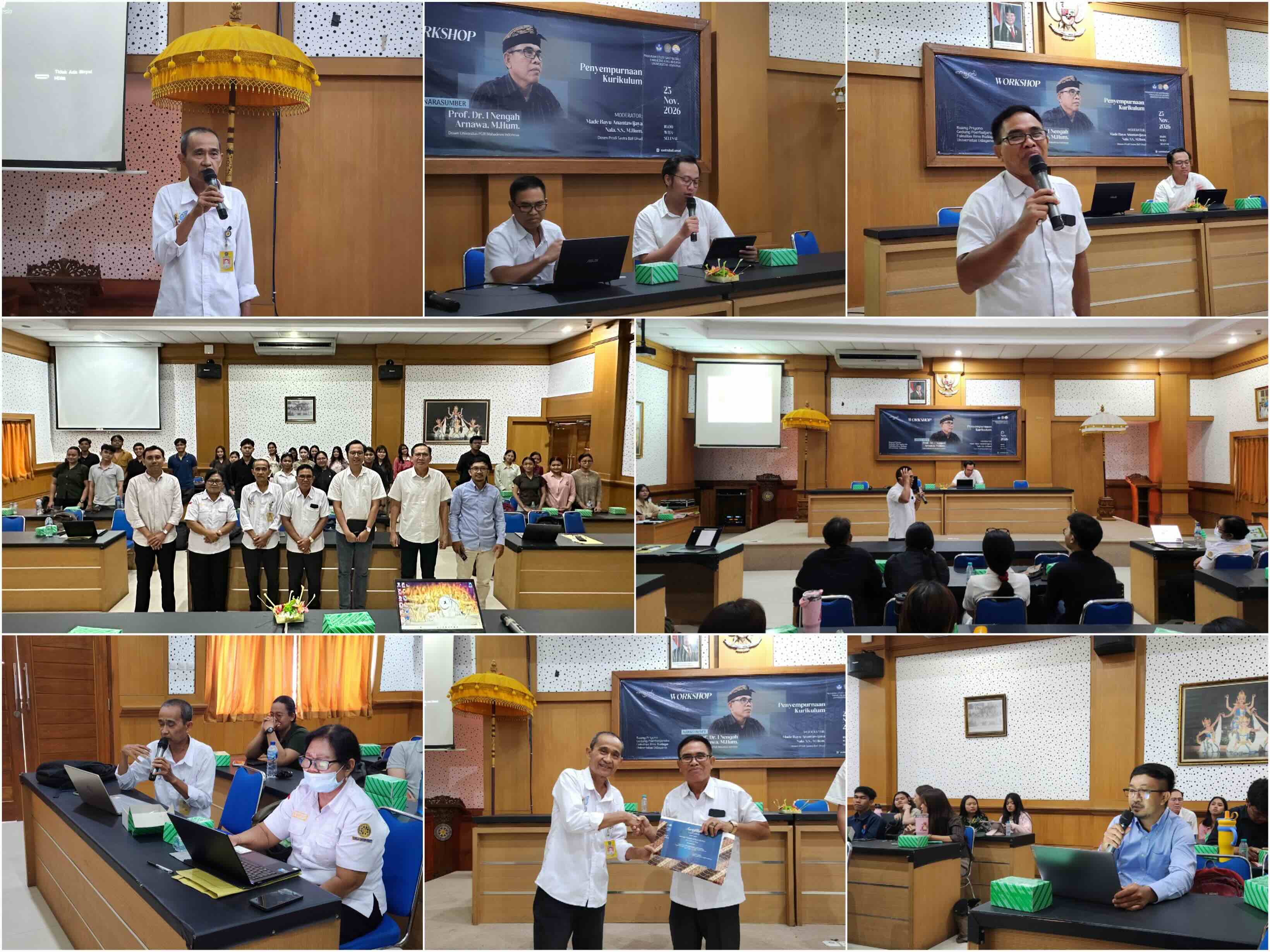
DENPASAR — The Balinese Literature Study Program, Faculty of Humanities (FIB), Udayana University held a Curriculum Refinement Workshop on Monday, November 23, 2026, at the Priyono Room, Poerbatjaraka Building, FIB Udayana University. Starting at 10:00 WITA, the event was attended by lecturers, students, and alumni of the Balinese Literature Study Program.
The event was officially opened with remarks from the Coordinator of the Balinese Literature Study Program, Drs. I Ketut Ngurah Sulibra, M.Hum. In his address, he expressed his appreciation and gratitude to the keynote speaker for attending to guide the curriculum renewal process. He noted that the Balinese Literature Study Program is currently supported by 13 lecturers. Furthermore, he likened this curriculum refinement to "making a new outfit" to ensure it remains relevant to the dynamics of higher education, while emphasizing that following this workshop, lecturers are required to develop Outcome-Based Education (OBE)-based Semester Learning Plans (RPS).
Moving into the first session, moderated by Balinese Literature lecturer Made Bayu Anantawijaya Nala, S.S., M.Hum., the workshop featured Prof. Dr. I Nengah Arnawa, M.Hum. from the Faculty of Language and Arts, Universitas PGRI Mahadewa Indonesia, as the keynote speaker. In his presentation on the policies, principles, and framework for developing OBE-based higher education curricula, Prof. Arnawa explained that the OBE approach focuses on tangible competencies that students can demonstrate in every learning experience—not merely learning about "what," but learning "to do and/or for what purpose".
Prof. Arnawa emphasized that the OBE-based curriculum development flow must be systematically structured, beginning with establishing graduate profiles, formulating Program Learning Outcomes (CPL), designing courses, and compiling RPS. Specifically, he highlighted the opportunity to add Balinese language teacher to the graduate profile of the Balinese Literature Study Program, as permitted under existing regulations, complementing other graduate profiles such as Balinese language extension officers, researchers, language and culture practitioners, writers and editors, translators, and entrepreneurs in the field of language and culture. He also outlined the three main pillars of OBE: Outcome-Based Curriculum (OBC), Student-Centered Learning, and measurable outcome-based assessment and evaluation.
Following the discussion and Q&A session, the event continued into the second session with an overview of the current Balinese Literature Study Program curriculum delivered by the Study Program Coordinator. The agenda then proceeded with a feedback and input session from alumni representatives and the academic community regarding curriculum evaluation and needs. On this occasion, alumni provided constructive input on strengthening graduate profiles to better align with the needs of society and the workforce. Afterward, the speaker provided direct guidance and mentoring on curriculum formulation through the preparation of OBE-based RPS.
As a concrete outcome of the workshop, the Balinese Literature Study Program successfully mapped out the direction for its curriculum renewal. As an initial implementation target, the lecturers of the Balinese Literature Study Program drafted 31 OBE-based RPS during the event. The entire series of activities concluded with the presentation of a certificate to the keynote speaker.
UDAYANA UNIVERSITY