 ENG
 INA
Examining Cross-Cultural Gender Constructions and Relations, Doctoral Program in Cultural Studies of FIB Unud Holds the 13th Cultural Narrative Series with UNS and AKBI
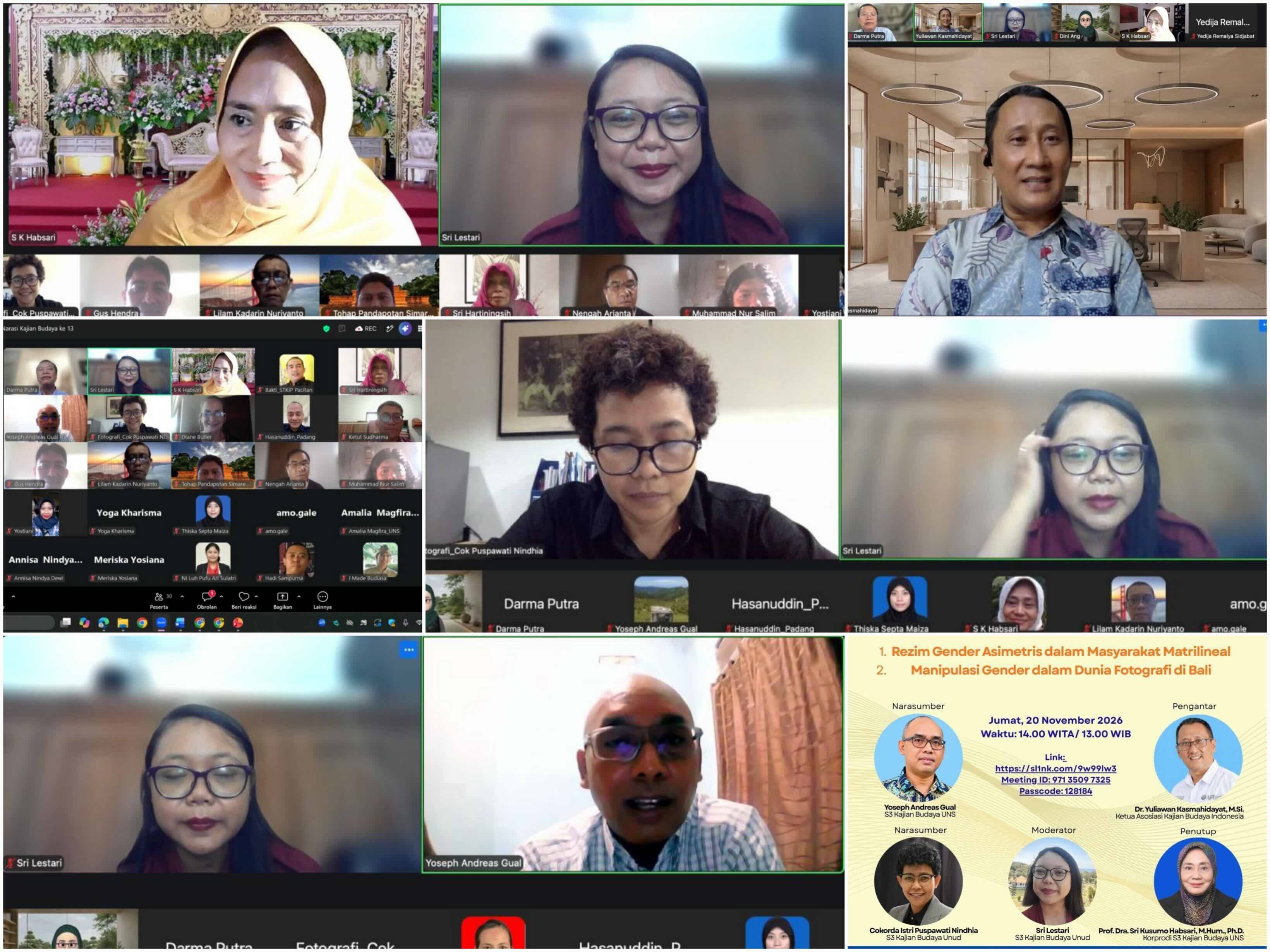
DENPASAR – Issues of gender construction and relations across two contrasting cultural contexts, ranging from the aesthetic space of contemporary photography in Bali to matrilineal customary systems in East Nusa Tenggara, took center stage at the National Seminar for Cultural Studies Students themed Narasi Budaya Seri ke-13 (13th Cultural Narrative Series) on Friday (20/11/2026). Held online by the Doctoral Study Program in Cultural Studies, Faculty of Humanity, Udayana University (FIB Unud), in collaboration with the Doctoral Study Program in Cultural Studies, Faculty of Cultural Sciences, Sebelas Maret University (UNS), and the Indonesian Cultural Studies Association (AKBI), this academic forum was attended by approximately 43 participants consisting of lecturers, students, and Cultural Studies alumni from various universities across Indonesia.
One of the main highlights of the discussion moderated by FIB Unud Doctoral Program in Cultural Studies student Sri Lestari came from a presentation by FIB Unud doctoral student, photographer, and photography lecturer at ISI Bali, Cokorda Istri Puspawati Nindhia. Carrying the title “Manipulation of Gender Identity in Contemporary Photography in Bali” (“Manipulasi Identitas Gender dalam Dunia Fotografi Kontemporer di Bali”), she examined photography practice as an arena for both the formation and deconstruction of gender identity.
By combining theories of gender performativity, semiotics, queer theory, and hegemony, her research demonstrated how visual elements such as attire, body posture, lighting, and photographic composition are utilized to blur the normative boundaries between masculinity and femininity.
“Photography, in this context, is not merely a medium to record reality, but also a space to produce and negotiate gender identity,” she stated.
The presentation sparked critical responses from participants, including Dini Ang from UNS, who questioned the impact of visual manipulation, such as men appearing in feminine or genderless styles as well as shifts in photographic settings in shaping new habitus in society. Responding to this, Cokorda Istri emphasized that contemporary photography also engages in social construction by representing desired gender identities, which must be distinguished from gender constructions based solely on biological aspects.
This issue of cross-gender representation also received special emphasis from the Coordinator of the Doctoral Study Program in Cultural Studies at UNS, Prof. Dra. Sri Kusumo Habsari, M.Hum., Ph.D., during her closing remarks. She highlighted the persistence of double standards in society: men who appear feminine are often appreciated as entertainment or aesthetic achievements, whereas women who display masculine styles are frequently judged as deviating from their nature.
Complementing the visual perspective from Bali, the seminar featured an ethnographic viewpoint from UNS Doctoral Program in Cultural Studies student Yoseph Andreas Gual, with his presentation titled “Asymmetrical Gender Regime in a Matrilineal Society: An Ethnographic Study of the Bunaq Community in Dirun Village” (“Rezim Gender Asimetris dalam Masyarakat Matrilineal: Studi Etnografis pada Komunitas Bunaq di Desa Dirun”), Belu Regency, East Nusa Tenggara. Using a critical ethnographic approach, he unpacked common assumptions regarding female power dominance in matrilineal societies.
Yoseph explained that although women in the Bunaq community hold vital positions regarding land ownership, property, and the continuity of lineage, this does not always correspond with control over decision-making and resource utilization. Leadership authority and public representation in certain domains remain exercised by men. Because these relations cannot be simplified into a dichotomy of patriarchy and matriarchy, he formulated the concept of the “Bunaq Asymmetrical Gender Regime” (“Rezim Gender Asimetris Bunaq”) to describe a gender order shaped by custom and reproduced through social institutions. During the discussion session, the use of the term “regime” in this study drew critical notes from Dr. Diane Butler, given the strong political connotations and historical memories attached to the terminology.
Beyond its strong, interdisciplinary scholarly substance, the implementation of the 13th Cultural Narrative Series marked a distinct institutional milestone. The Chair of AKBI and an alumnus of the Cultural Studies Study Program at FIB Unud, Dr. Yuliawan Kasmahidayat, M.Si., stated in his opening remarks that this collaborative forum between FIB Unud and FIB UNS has now been officially adopted as one of AKBI’s work programs.
“This is a good program both academically and in terms of networking, not only because it discusses interesting Cultural Studies topics, but also because it has proven to be sustainable up to its 13th series,” said the Universitas Pendidikan Indonesia (UPI) Bandung lecturer, who is also known as an artist and dance educator, while inviting all AKBI members across Indonesia to participate actively.
Similar appreciation was expressed by Prof. Dra. Sri Kusumo Habsari, M.Hum., Ph.D., who noted that the convergence of two distinct cultural landscapes in the 13th Cultural Narrative Series demonstrates the tangible contribution of Cultural Studies in reading social issues critically, while simultaneously strengthening academic networks among Cultural Studies centers across the country.
UDAYANA UNIVERSITY