 ENG
 INA
Celebrating Language Month, Indonesian Literature Study Program of FIB Unud Holds Webinar Discussing Opportunities and Challenges of the Indonesian Language in the Digital Space
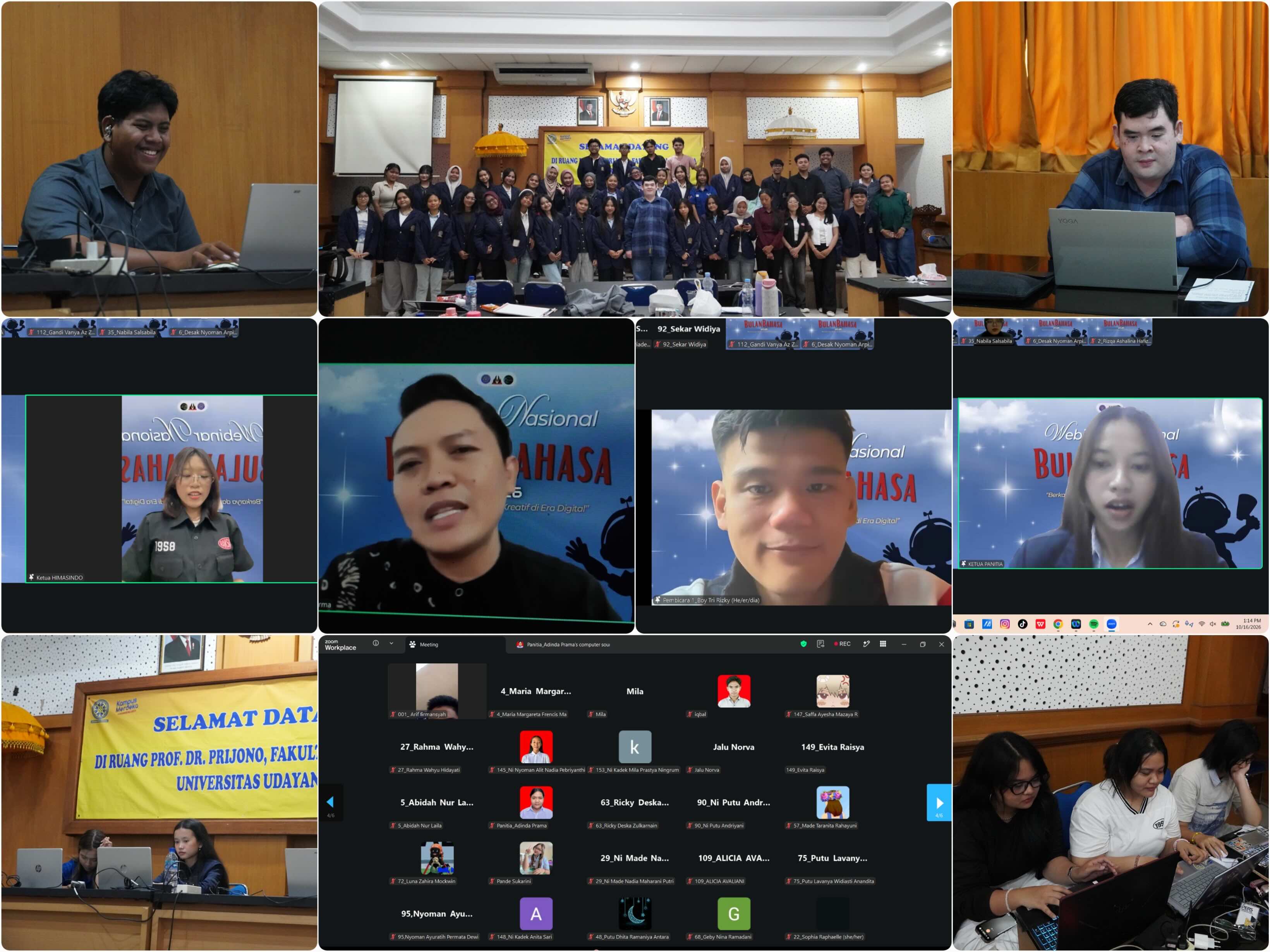
DENPASAR – In celebration of Language Month (Bulan Bahasa), the Indonesian Literature Study Program, Faculty of Humanities, Udayana University (FIB Unud), organized an online webinar themed "Digital Space, Creative Space, Language Space" ("Ruang Digital, Ruang Berkarya, Ruang Bahasa") via Zoom on Friday, October 16, 2026. Moderated by Komang Ade, the event attracted 143 participants from across Indonesia, ranging from school and university students, teachers, and lecturers to language and literature enthusiasts.
The webinar featured two speakers: Boy Tri Rizky, an Indonesian for Foreign Speakers (BIPA) instructor based in Berlin, Germany, and Dr. Irma Setiawan, M.Pd., a lecturer at the University of Mataram. The forum served as a strategic discussion space on how the digital world can be utilized both as a platform for creative expression and as a medium to preserve the Indonesian language, particularly among younger generations closely connected to social media.
Opening the presentation session with a topic titled "Opportunities for the Indonesian Language", Boy Tri Rizky shared his journey in the BIPA sphere—beginning with his studies in Göttingen, participating in the Ministry of Education and Culture’s BIPA program, completing an internship at the University of Vienna, and teaching at the Haus der Indonesischen Kulturen in Berlin since April 2024. Currently, he is also pursuing his doctoral studies in linguistics at Freie Universität Berlin.
According to Boy, BIPA is now present in numerous countries, positioning the Indonesian language as a vital intercultural bridge. Furthermore, he highlighted the growing opportunities for the Indonesian language within the international academic sphere.
“The Indonesian language is now studied and researched as an academic discipline at several European universities. Examples include research projects and doctoral fellowship openings in descriptive linguistics focusing on languages in Indonesia. Therefore, the Indonesian language deserves to be viewed not merely as a tool for communication, but also as a field of science. A language can change the way a person sees the world. The Indonesian language can even change the course of someone’s life,” said Boy during the webinar.
In the subsequent section, Boy highlighted the shifting spaces of language use. Whereas the Indonesian language was previously present through books, newspapers, radio, television, and classrooms, it now thrives dynamically on Instagram, TikTok, YouTube, podcasts, blogs, artificial intelligence (AI), and even in comment sections and memes. He also demonstrated how he personally utilizes social media to introduce the Indonesian language to international audiences, emphasizing that the digital space is an open creative arena for anyone.
In the second session, Dr. Irma Setiawan, M.Pd., delivered a presentation titled "Measuring Language in Digital Algorithms: Creating and Voicing Creativity in the Digital Era". He emphasized that language today has two distinct readers: humans who interpret meaning and algorithms that sort data.
“Indonesia has 229.4 million internet users (80.66% penetration, APJII 2025) and approximately 180 million active social media user identities. Under these conditions, language is now written, filtered, and learned by machines on a massive scale,” said Dr. Irma.
Furthermore, he invited participants to observe linguistic creativity in cyberspace as users navigate automated content moderation systems.
“An example is the term ‘war takjil’ (hunting for Ramadan snacks), which went viral during Ramadan 2024 and was used across religious communities as a symbol of togetherness. Another example is MSME (UMKM) sellers replacing trigger words with numbers or symbols during TikTok live streams. This represents the phenomenon of algospeak, which refers to words intentionally modified to bypass algorithmic moderation,” Dr. Irma explained.
Concluding his presentation, Dr. Irma underscored the importance of speaker sovereignty amidst technological dominance. “Language must not merely become raw material for algorithms; its speakers must remain the authors of its script,” he asserted.
The webinar concluded with an interactive question-and-answer session, reaffirming that the digital realm is an open creative space for speakers of both the Indonesian language and regional languages. Consequently, language speakers need to understand how algorithms work so they can remain in control as the true authors of their own linguistic narratives.
UDAYANA UNIVERSITY