 ENG
ENG
 INA
INA
Commemorating National Revival Day: Udayana University Lontar Unit Conserves Ancient Manuscripts Donated by the Netherlands
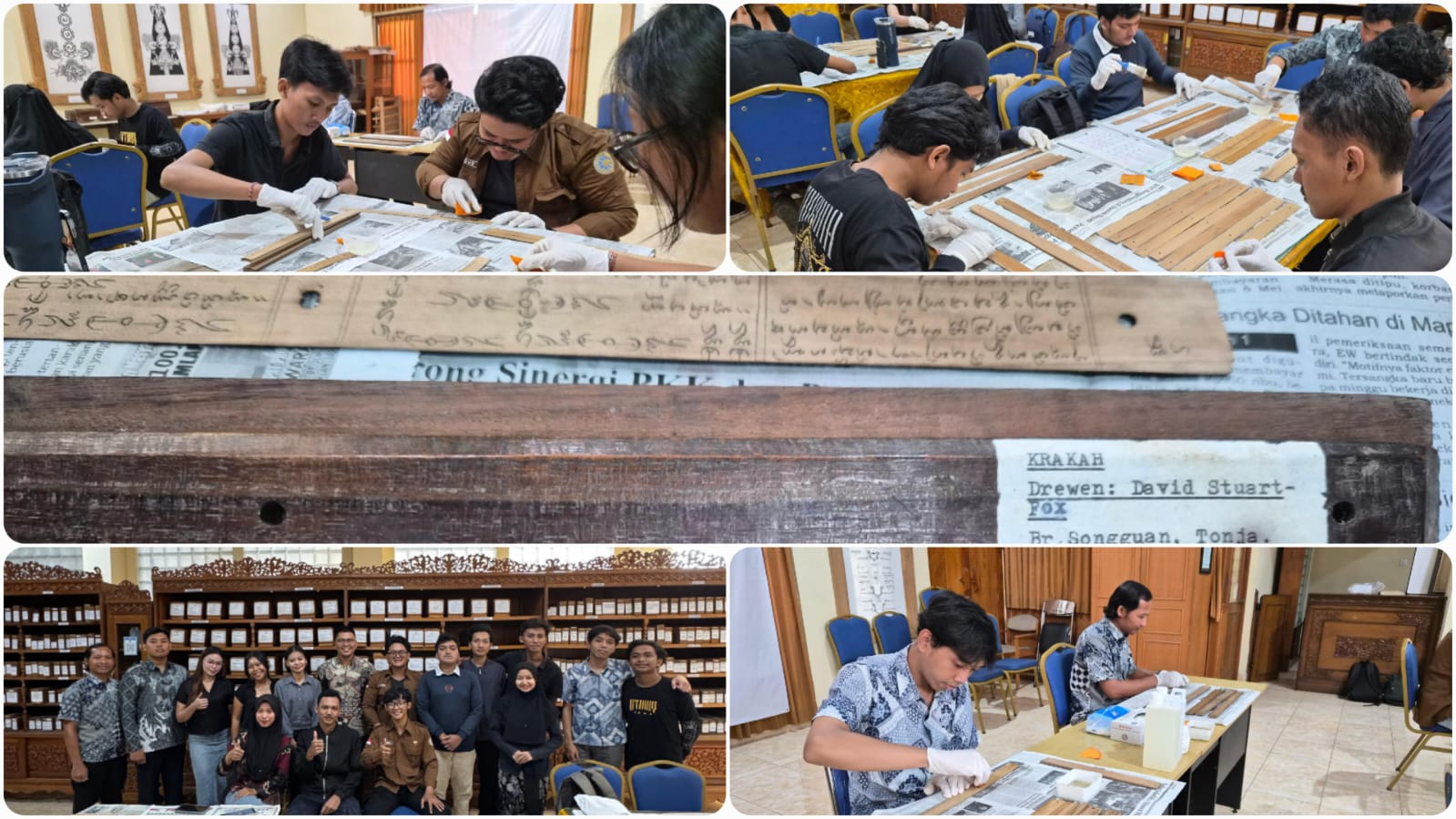
In commemorating National Revival Day, the Lontar Unit of Udayana University (ULU) took a concrete step that served not merely as a ceremonial event but also as a milestone for cultural awakening. This concrete step involved the conservation of ancient lontar manuscripts recently repatriated from the Netherlands. The conservation of these ancient manuscripts took place in the Lontar Storage Room, Prof. Dr. I Gusti Ngurah Bagus Building, Faculty of Humanities, Udayana University. This conservation effort was not solely carried out by experts but also directly involved students from the Old Javanese Literature Study Program, Faculty of Humanities, Udayana University.
Commencing the conservation activities, Dr. Putu Ari Suprapta Pratama, M.Hum., as the Secretary of the Udayana University Lontar Unit, emphasized that this conservation is a manifestation of preserving the repatriated Balinese lontar manuscripts, where the celebration of National Awakening Day is closely intertwined with the actual act of saving these manuscripts. Although the physical condition of these donated manuscripts is generally good and well-maintained, periodic conservation measures remain mandatory to clean destructive materials and prolong the physical lifespan of the lontars so they can be passed down to future generations.
The primary focus of this ancient lontar conservation is the lontars donated by David Stuart Fox, a former librarian from the Rijksmuseum voor Volkenkunde (National Museum of Ethnology) in Leiden, the Netherlands. Out of a total of 30 donated lontars, the Udayana University Lontar Unit Team acted swiftly to prioritize the conservation of four bundles (cakep) of lontars in this initial stage. The four lontar bundles containing highly valuable traditional Balinese knowledge include the following:
62 Pages of Lontar Krakah: Contains guidelines for reading the sacred Modre script, complete with pronunciation rules and the sacred symbols of the Balinese script.
48 Pages of Lontar Wariga Gemet: Contains traditional Balinese astronomy related to the calculation of auspicious and inauspicious days (dewasa).
15 Pages of Lontar Geguritan Dewasa: Serves as a crucial reference for the community to determine the auspiciousness of a day prior to conducting religious ceremonies.
28 Pages of Lontar Anggelar Puja Parikrama: An important part of the manuscript collection, successfully preserved in this stage.
The direct involvement of students in this lontar conservation activity have given them the opportunity to practically apply knowledge of conservation and philology while simultaneously fostering an emotional connection with their ancestral heritage that had previously traveled to the country of windmills. The repatriation of these dozens of lontar manuscripts ultimately strengthens Udayana University's commitment as a reliable center for archipelago manuscript studies and a bastion of cultural defense.
.jpg)
UDAYANA UNIVERSITY