 ENG
ENG
 INA
INA
Critical Reflections at 68: Faculty of Humanities Hosts Scientific Orations and Launches Nine Academic Works
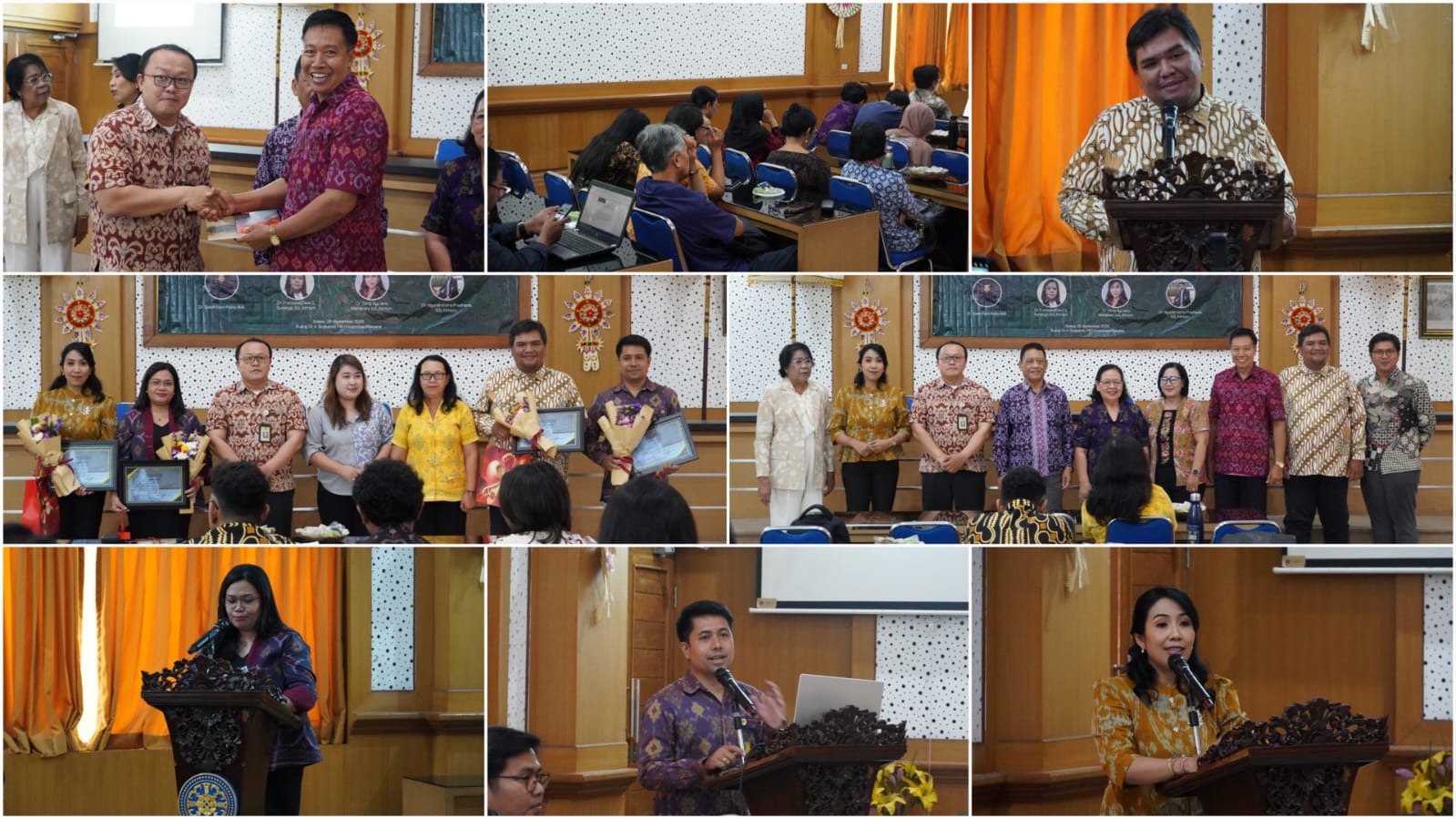
The Scientific Oration and Book Launch became one of the main agendas in the 45th Alumni Association (BK) and 68th Anniversary commemoration series of the Faculty of Humanities (FIB), Udayana University, on Tuesday, September 29, 2026. Held in the Dr. Ir. Soekarno Meeting Room, 4th Floor of the Poerbatjaraka Building, the event featured orations delivered by four FIB Unud lecturers. Additionally, this momentum was marked by the launch of several books authored by lecturers and professors within FIB Unud.
In his opening remarks officially inaugurating the event, the First Vice Dean of FIB Unud, Dr. I Gede Oeinada, S.S., M.Hum., emphasized that at the age of 68, FIB Unud remains committed to upholding academic traditions, fostering critical thinking, and dedicating itself to cultural advancement. He stated that the book launch and scientific oration have always been maintained as routine agendas in every FIB Unud BK commemoration. Furthermore, he hoped the material presented by the four orators would spark productive discussions, inspire new ideas, and enrich the scientific insights of all attendees.
The book launch momentum in this anniversary series was marked by the introduction of nine new academic works from the ranks of FIB Unud lecturers and professors. These works include "English Grammar for the Users of Balish Tenses in English" compiled by Prof. Dr. Ni Luh Sutjiati Beratha, M.A., et al., which formulates comparative English grammar for local speakers, as well as two Balinese classical manuscript transliteration works by Prof. Dr. I Nyoman Weda Kusuma, M.S. titled "Geguritan Dharma Sesana" and "Kakawin Usana Bali Mayantaka Carita". Also launched was "Buku Ajar Sociolinguistics" by Prof. Dr. Ni Luh Nyoman Seri Malini, S.S., M.Hum., et al., which examines contemporary sociolinguistic dynamics, followed by two history literature books by Prof. Dr. Phil. I Ketut Ardhana, M.A. titled "Pengantar Ilmu Sejarah Historiografi Kritis" and "Bahasa Belanda Untuk Ilmu Budaya". Moreover, this publication treasure was enriched by the book "Sastra Anglofon: Bahasa, Kuasa, dan Negosiasi Identitas" by Dr. Galuh Febri Putra, M.A. and colleagues, which dissects postcolonial literature; a linguistic study "Model Analisis Pola Metaforis dan Pemetaan Metafora Konseptual" compiled by Dr. Ni Made Ayu Widiastuti, S.S., M.Hum., et al.; and concluded with the anthology "Cerita Anak Melayu Loloan" by I Gusti Ayu Gde Sosiowati, et al. as a concrete step in preserving the regional language in Jembrana.
Entering the scientific oration session, Dr. Galuh Febri Putra, M.A., as the first orator, delivered an oration titled "Anglophone Literature: Language, Power, Identity, and Empathy". He asserted that English Literature is no longer a monopoly of British or American traditions but has become a medium of expression for the global community. The language, once a colonial instrument, has now been reclaimed by writers from various parts of the world to voice identities, local histories, injustices, and even climate crises. Although this narrative space is expanding, he reminded the audience that global literature is still shadowed by distribution inequality and cultural commodification. Therefore, he urged the academic community of FIB Unud to read Anglophone literature with political awareness and humility to foster empathy without losing local cultural identity.
Continuing to the second session, Dr. Fransiska Dewi Setiowati Sunaryo, S.S., M.Hum. delivered an oration titled "Sumba Diaspora: Between Diversity and Inclusivity in Bali". She highlighted that the presence of the Sumba diaspora in Bali is not merely economic migration but a cultural encounter space colored by both integration and contestation. Through the concept of "Moderate Marapu," Sumba ancestral values have proven adaptable into a work ethic and social capital to survive in urban environments, while simultaneously dispelling negative stigmas in society. The oration concluded with a reflective hope that the sociological recognition in Bali, which began with the general term for migrants, 'Nak Jawa', progressing to the specific 'Nak Sumba', can continue to evolve into 'Nyama Sumba' (Sumba sibling), as a concrete manifestation of harmonious coexistence.
Proceeding to the linguistics session, Dr. Sang Ayu Isnu Maharani, S.S., M.Hum. dissected the linguistic landscape of Bali tourism through the lenses of language, power relations, and cultural identity. She emphasized that information signboards in public spaces are not neutral mediums, but rather arenas for symbolic power negotiations between government authorities and societal actors. Regarding the practice of translating tourist information into foreign languages, she highlighted the importance of communication justice; local cultural terms should not be forced into English translations to prevent identity erasure. As a form of cultural resilience, she offered the principle of "Global in communication, local in identity," which encourages the use of foreign languages as global bridges without having to strip away the visibility, language existence, and unique identity of the Balinese people.
Concluding the scientific oration series, Dr. Ngurah Indra Pradhana, S.S., M.Hum. dissected the population crisis through his presentation titled "Demographic Transition and Sociocultural Changes in Japanese Society". He highlighted the phenomenon of a declining birth rate (shoshika) and the explosion of the elderly population (koreika shakai), primarily triggered by high living costs, a workaholic culture, and the younger generation's reluctance to marry. This sociocultural shift has also sparked female independence, contrasting with the "parasite single" male trend, leading to issues such as empty villages, labor crises, and the tragic phenomenon of dying alone (kodokushi). To mitigate this crisis, the Japanese government is now taking proactive steps through the implementation of paternity leave, equal pay for female workers, and family campaigns to restore their demographic structure.
UDAYANA UNIVERSITY