 ENG
ENG
 INA
INA
Curriculum Review and Improvement Year 2026 Bachelor of English Literature
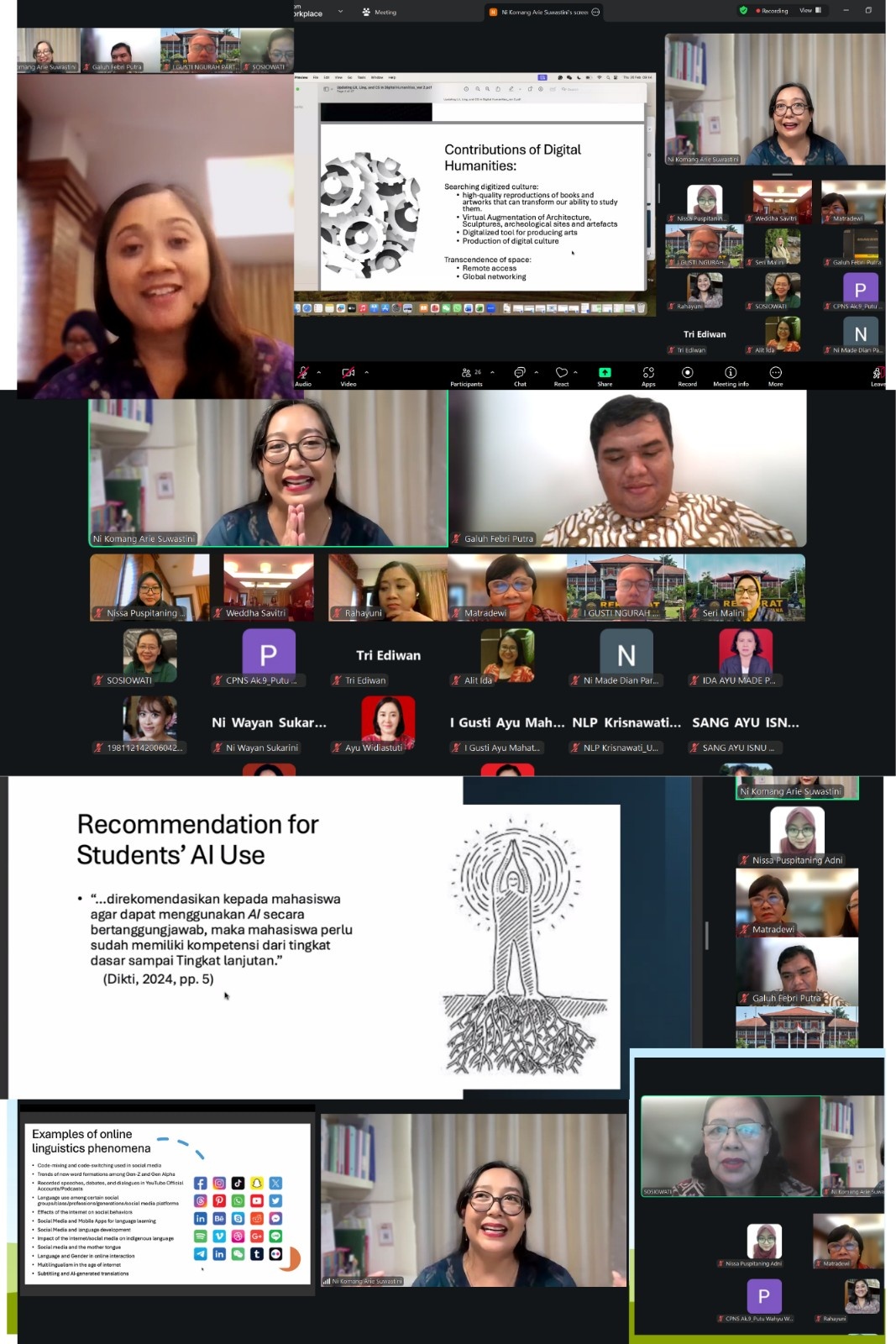
The 2026 Curriculum Review and Improvement Activity for the Bachelor of English Literature was held on February 26, 2026, as an effort to ensure that the curriculum remains relevant, adaptive, and in line with developments in science, industry needs, and applicable accreditation standards. The activity involved the committee, expert speakers, and all lecturers in the English Literature Study Program, conducted online and guided by Dr. Ni Ketut Sri Rahayuni, S.S., M.Hum. The Chair of the Committee, Dr. Putu Weddha Savitri, S.S., M.Hum., delivered an activity report, followed by a speech from the Coordinator of the Bachelor of English Literature, Dr. I Gusti Ngurah Parthama, S.S., M.Hum. The event was officially opened by the Chair of UP3M, Dr. Ni Ketut Widhiarcani Matradewi, S.S., M.Hum., who spoke on behalf of the Dean of the Faculty of Humanities and officially opened the event.
The event continued with a material presentation by Prof. Dr. Ni Komang Arie Suwastini, S.Pd., M.Hum. from the Ganesha University of Education, moderated by Dr. Galuh Febri Putra, M.A. The material presented discussed the development of Digital Humanities as a field that integrates digital technology with humanities studies, as well as its implications in linguistic, literary, and cultural studies. The presentation explained that digital media allows writers to express themselves in new ways, and digital tools help researchers identify intrinsic elements using more practical methods. Reader participation has also increased because various forms of digital text, such as webtoons, web novels, app-based short films, TikTok videos, memes, and social media captions, are now part of literary and cultural research. The speakers also discussed the birth of electronic literature, which includes hypertext, kinetic poetry, interactive fiction, and generative works that can only exist in a digital environment. The emergence of AI raises questions about the limits of its use, which is still considered a tool and which constitutes academic cheating. The government, through the Ministry of Education, Science, and Technology, has begun regulating the use of AI by creating blacklists and whitelists. AI may be used to search for learning resources, create slides based on material provided by students, for independent study, and as a learning companion. However, students are required to have AI literacy and competence from basic to advanced levels.
Then, the activity continued with discussion and curriculum review involving all participants to review the course structure, learning outcomes, and their relevance to academic and professional needs. The discussion continued actively until the afternoon and resulted in a number of curriculum improvement points that will form the basis for finalizing the 2026 curriculum document. The event was closed by the Coordinator of the Bachelor of English Literature, Dr. I Gusti Ngurah Parthama, S.S., M.Hum. He expressed his hope that the results of the discussion would strengthen the quality of the curriculum and improve lecturers' understanding of curriculum development that is responsive to technological developments and community needs.
UDAYANA UNIVERSITY