 ENG
ENG
 INA
INA
Faculty of Humanities Strengthens Steps Toward Final Project Diversification
.jpg)
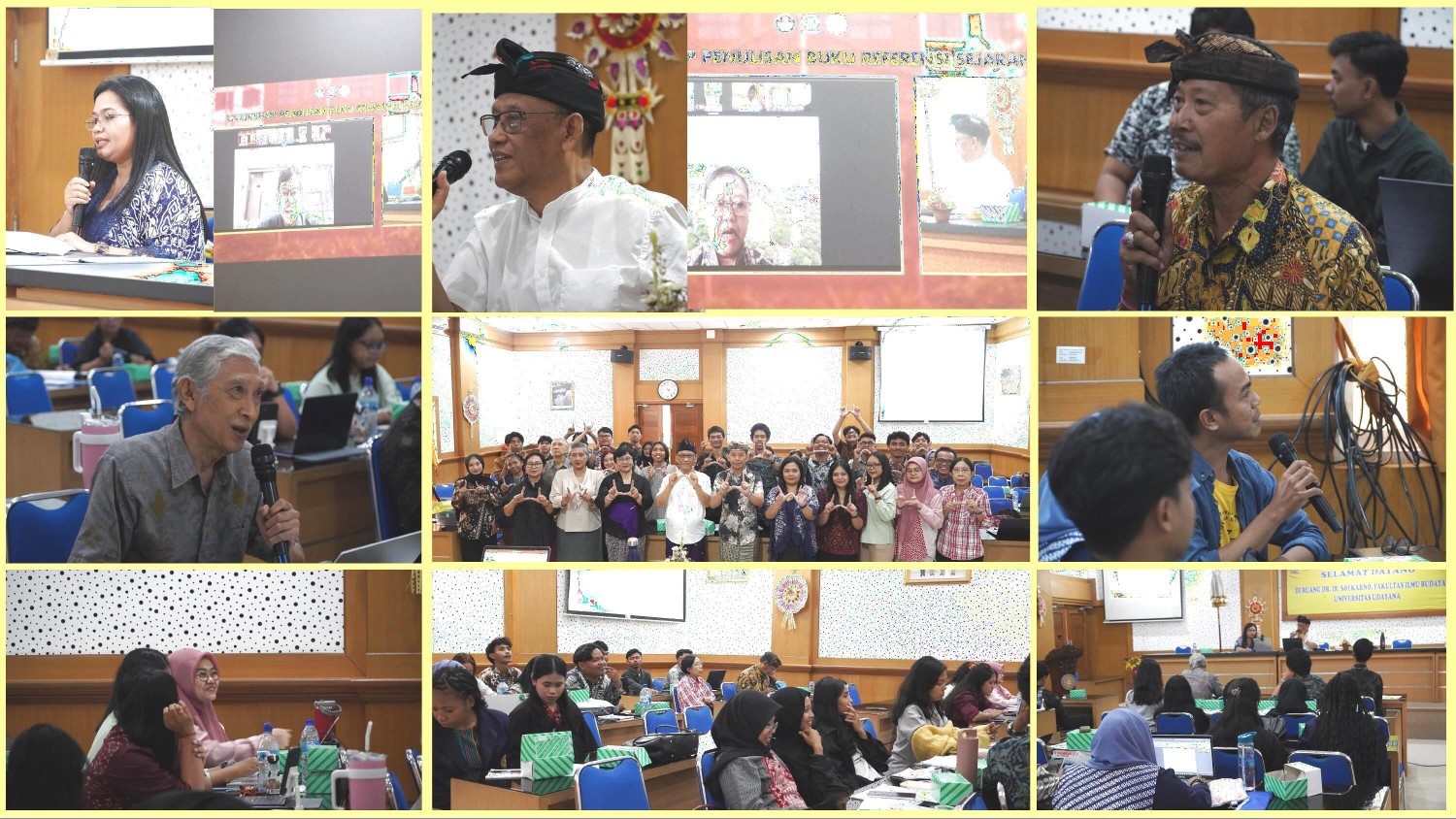
On Tuesday, September 22, 2026 the Faculty of Humanities of Udayana University is getting more serious in implementing various forms of final projects for its students. This commitment was clearly seen in the Curriculum Review Activity themed "Student Final Projects for Strengthening Graduate Competency Achievements" held in the Soekarno Room, 4th Floor, Poerbatjaraka Building, Faculty of Humanities. This activity was organized by Dr. Ni Ketut Widiarcani Matradewi, S.S., M.Hum., as the Head of UP3M FIB. The event was also attended by the leadership ranks and the academic community, including the Dean, Vice Dean I, the Heads of Study Programs from each study program, the ranks of Professors within the scope of Faculty of Humanities, students, and other invited guests.
The event was opened with remarks by Prof. I Nyoman Aryawibawa, S.S., M.A., Ph.D., as the Dean of Faculty of Humanities of Udayana University. The Dean emphasized that in 2026, Faculty of Humanities of Udayana University will facilitate students with various choices of final project formats besides the conventional thesis. This step is in line with efforts to address the challenges and anxieties of students who often experience stress and procrastination due to high credit (SKS) burdens, individualized work, and the lengthy thesis writing process.
Presenting 2 expert resources from the P-PK Team of LP3MUdayana University, namely Dr. Ni Made Swasti Wulanyani, S.Psi, M.Erg., and Dr. Ni Gusti Ayu Dyah Satyawati, S.H., M.Kn., LLM, this activity emphasized the importance of the Output Based Education (OBE) approach. The final project must be viewed as an instrument to demonstrate the Lesson Learning Outcomes comprehensively, not merely the final goal of learning.
Dr. Swasti Wulanyani highlighted the importance of considering psychological aspects, such as Self-Determination Theory, in designing the diversification of final projects. Providing broader autonomy to students is expected to increase their motivation and engagement, because the chosen final project can be tailored to their individual interests and potentials. She also gave an example of the Psychology Study Program of Udayana University's initiative, which has started utilizing final MBKM publications as an alternative to the final project while continuing to refine the Standard Operating Procedures.
In line with this view, Dr. Dyah Satyawati presented several proposals for alternative forms of final projects that are highly relevant to the field of humanities. These proposals include compiling studies, creating creative works, undertaking translation and editing (edition) projects, creating documentation, organizing curations and exhibitions, up to developing cultural education programs. She asserted that differentiating the format of the final project does not mean lowering academic standards or quality at all. However, implementing this idea certainly faces challenges in the field.
However, the implementation of these diverse final project formats is still faced with technical challenges. One of the main challenges in implementing various forms of final projects is the concern over a disparity in weight between thesis and non-thesis projects. To overcome this, Dr. Swasti Wulanyani emphasized the importance of ensuring that non-thesis final projects have a workload equivalent to a thesis. This must be accompanied by providing a commensurate challenge, establishing clear assessment criteria, and providing constructive feedback.
In order to support the equalization of quality and workload, clear regulations are highly needed to ensure the achievement of the CPL and the guarantee of academic quality. The process of designing these alternative forms of final projects is recommended to go through discussion stages with relevant professional associations. If there is already a Decree (SK) or an agreement with an association, the educational institution (Udayana University) can follow it more easily. A trial or testing phase is also considered crucial before a new form of final project is implemented widely.
As tangible proof of its commitment to accommodating non-thesis final projects, Faculty of Humanities Udayana University has actually started implementing them. Based on the 2024 Undergraduate (S1) Program Faculty Guidebook, the non-thesis final project option in the form of scientific publication is accommodated through a series of strict stages and specific student requirements. To be eligible, students must have passed a minimum of 80 credits (SKS) and achieved a minimum GPA of 3.5 in semester 4, or have won 1st, 2nd, or 3rd place in a scientific article writing competition at the local, national, or international level. Students who meet these criteria have the right to choose the publication-based final project in semester 5 by attaching the approval of their academic advisor (using a form determined by the study program) and programming it into their study plan card (KRS).
The process then proceeds with the preparation of a draft proposal, submission to the Head of the Study Program, and appointment of the supervisory team, as well as the opportunity to convert grades for the Seminar course. Students are required to ensure a maximum Turnitin similarity rate of 20% before submitting to at least a Sinta 3 indexed journal no later than the end of semester 6, listing their supervisors as the 2nd and 3rd authors. The final project examination is then held in semester 8 after the article is published and the student has passed a minimum of 138 credits (SKS), with the assessment weight divided into journal criteria (65%) and presentation (35%). If the publication is not completed by semester 8, students are given the opportunity to revert to writing a conventional thesis in semester 9.
This spirit of renewal has also received positive responses at the operational level. The discussion session among study programs showed enthusiasm and readiness to innovate. Representatives of lecturers from the Bachelor of English Literature conveyed that they already have practical courses, such as performing arts which includes speech, MC, and news reading, which have great potential to be developed into non-thesis final project formats. Not only English Literature, but representatives from various other study programs within Faculty of Humanities Udayana University also presented their respective strengths, specifically in applying skill-based courses that can be directed into final project products.
This activity affirms that the determination and implementation of final project formats other than a thesis are the authority of the Study Program Coordinator and the team in each study program in order to ensure relevance and alignment with the specific scientific discipline of each study program.
UDAYANA UNIVERSITY