 ENG
ENG
 INA
INA
Faculty of Humanities Udayana University Hosts Inaugural KELIR: Weaving the Future of Balinese Language and Culture in the Digital Era
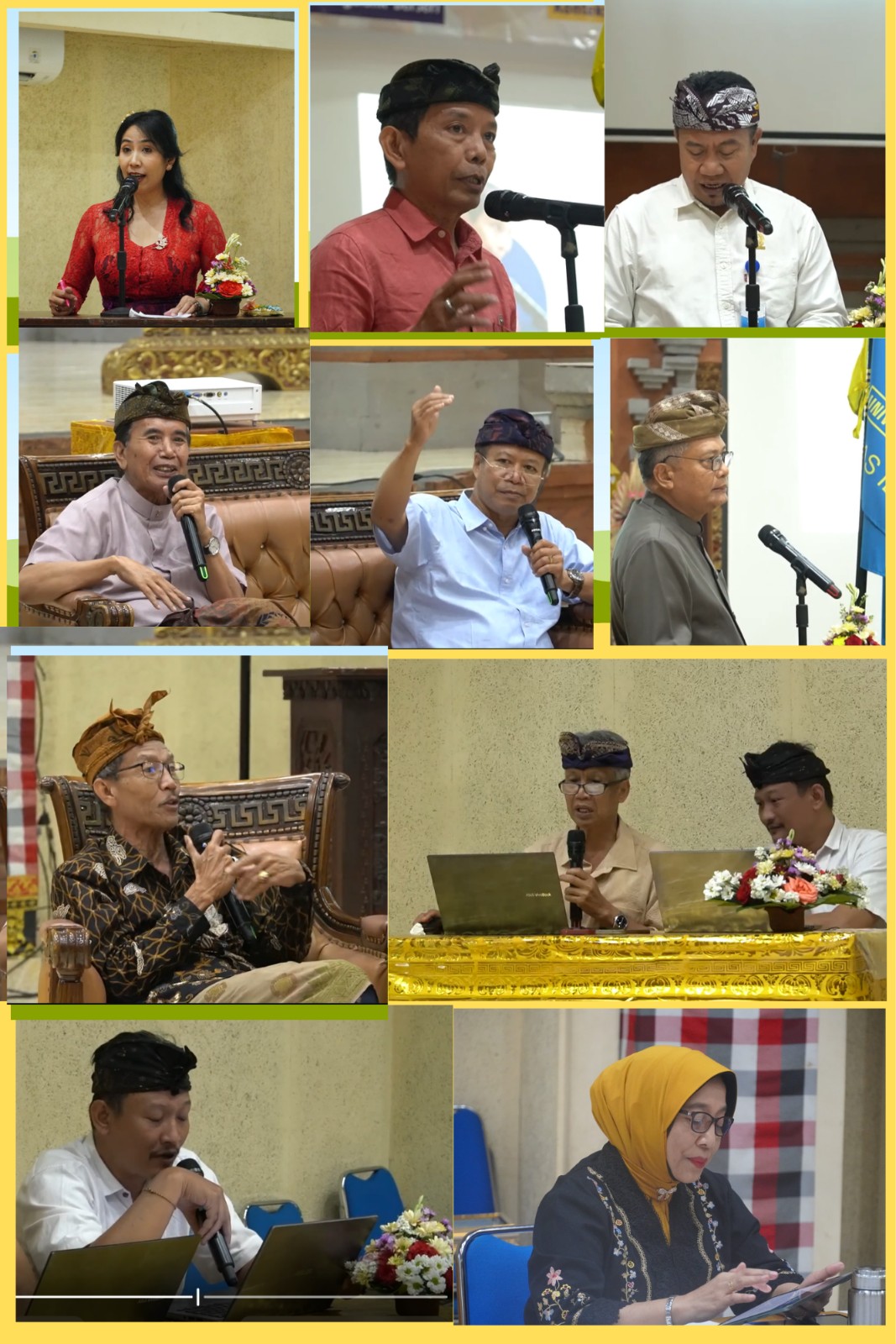
The Doctoral Linguistics Program of the Faculty of Humanities, Universitas Udayana, officially held the inaugural edition of the Serial Linguistics Exploration Colloquium (KELIR) on Thursday (September 17, 2026) at the Widya Sabha Mandala Hall, Faculty of Humanities. As a newly initiated event, KELIR Series 1 highlighted the main topic "The Dynamics of the Balinese Language in Local, Global, and Power Contexts" under the grand theme "Cultivating Balinese: Weaving A Future of Balinese Language and Culture." The event, which highlighted the paradigm shift in viewing the existence of the Balinese language from a mere grammatical system to a relational and cultural foundation that must be continuously enlivened, was attended by the executive board, professors, study program study coordinators, and structural officials within Faculty of Humanities Udayana University; representatives from other faculties, the Bali Provincial Culture Office and the Bali Provincial Language Center; leadership delegations from various partner universities (such as Undiksha, UHN, Universitas PGRI Mahadewa, and STKIP/Faculty of Dharma Acarya); and all event contributors, academics, researchers, and students.
In her report, the Chairperson of the KELIR Committee, Dr. Sang Ayu Isnu Maharani, S.S., M.Hum., emphasized that this forum is a meeting space for various academic ideas and experiences. She also highlighted the essence of regional languages for the community. "Balinese is not just words, Balinese is not just grammar, Balinese is how we position ourselves among others," she stated. She noted that this inaugural colloquium was attended by 150 invited guests and participants, ranging from students and academics to language policymakers in Bali, proving that academic spaces are never enclosed by institutional boundaries.
The Dean of the Faculty of Humanities, Universitas Udayana, Prof. I Nyoman Aryawibawa, S.S., M.A., Ph.D., in his remarks, explained the dynamics of linguistic and anthropological theories regarding how language influences ways of thinking. He asserted that studying the Balinese language is not enough merely through its semantic sentence structure; it must transcend pragmatic and sociocultural aspects. He appreciated the initiative of the Doctoral Linguistics Program for organizing this inaugural activity and presenting outstanding speakers whom he referred to as "the sharpest and finest minds of FIB."
The event was then officially opened by the Rector of Universitas Udayana, Prof. Ir. I Ketut Sudarsana, S.T., Ph.D. In his opening speech, the Rector highlighted the challenges to the existence of the Balinese language amid technological disruption and the digital communication era, which have accustomed the younger generation to a multilingual lifestyle. For the Rector, higher education institutions play a crucial role not only in testing assumptions and producing publications but also in ensuring that these outputs have a tangible social, economic, and environmental impact.
"Therefore, I always say that there is a tagline 'rooting in culture, competing globally.' We are rooted in our culture, the culture of the Archipelago, and Balinese culture, and we compete globally," asserted Prof. Sudarsana.
Following the official opening, the colloquium proceeded with material presentations from the curator, lead speakers, and discussants before finally concluding with the reading of the formulation results. The entire flow of the discussion dissecting the dynamics of Balinese language and culture was guided directly by Prof. Dr. Ni Luh Nyoman Seri Malini, S.S., M.Hum., as the moderator.
The colloquium was opened by Prof. Dr. Ketut Artawa, M.A., as the curator, who emphasized the importance of the Linguistic Landscape (LL) as a reflection of cultural identity in public spaces during the globalization era. The use of the Balinese language on signboards or public signs is not merely a means of information but a symbol of existence, social interaction, and a tangible manifestation of the success of language preservation policies amidst the strong currents of modernity.
This idea was expanded upon by Prof. Dr. I Nyoman Darma Putra, M.Litt. as a lead speaker, who highlighted the shift of the Balinese language's public space into the digital realm through the literary landscape. He dismissed the pessimism surrounding the discourse on the extinction of the Balinese language by proving the high enthusiasm of the younger generation, who adaptively utilize social media, television, and digital platforms to continuously express modern Balinese literature and culture.
From a Linguistic perspective, Prof. Dr. I Wayan Pastika, M.S., explained that the existence of the Balinese language is currently at an endangered level (level 2) due to the narrowing of its domains of use, pressured by national and foreign languages. Facing this challenge, he encouraged the strengthening of cultural linguistic approaches—which view language as a repository of memory and cultural imagery of its society—to serve as a foundation in research, documentation, and the compilation of Balinese language dictionaries.
Concluding the discussion from a cultural perspective, Prof. Dr. Drs. A.A. Ngurah Anom Kumbara, M.A. asserted that the preservation of the Balinese language must not stop at mere ceremonial activities. Culture must be continuously cultivated and woven to become a real, everyday living space, including the need to reinterpret the etiquette of anggah-ungguhing basa (Balinese language levels) to be more egalitarian and inclusive so that the younger generation is not afraid to practice their language.
As the culmination of the entire discussion series, the colloquium formulation team, consisting of Dr. Nanang Sutrisno, S.Ag., M.Si., and Dr. Drs. I Wayan Suardiana, M.Hum., established several strategic points as a blueprint for the preservation of Balinese language and culture. The existence of the Balinese language was emphasized to have its living space continuously expanded adaptively, both through the strengthening of the linguistic landscape in public facilities and the exploration of the literary landscape in the virtual realm to accommodate literary creativity in the digital era. Responding to the position of the Balinese language, which is linguistically at an endangered level, this formulation also urges further research, comprehensive documentation, and the compilation of dictionaries based on cultural linguistics to safeguard the mental imagery and memory of the society. Ultimately, the preservation movement must absolutely shift from mere ceremonial formalities to cultivation practices in real living spaces, prioritizing a more egalitarian and inclusive etiquette of anggah-ungguhing basa so that the younger generation has a safe space to practice their mother tongue once again.

UDAYANA UNIVERSITY