 ENG
ENG
 INA
INA
Faculty of Humanities Udayana University Socializes Fast Track Program: Encouraging Students to Achieve Two Degrees in Five Years
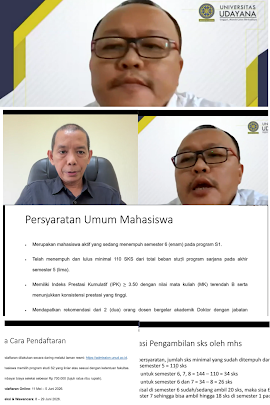
The Faculty of Humanities of Udayana University held a socialization event discussing the introduction of the Bachelor's to Master's Fast Track program, conducted online via Zoom Meeting. The event was attended by the decanate ranks, undergraduate study program coordinators, and lecturers within the Faculty of Humanities, along with 2nd, 4th, and 6th-semester students.
Opening the socialization, the Dean of the Faculty of Humanities, Prof. I Nyoman Aryawibawa, S.S., M.A., Ph.D., explained that the inception of this program is not merely an offer to shorten the study period. Institutionally, the Fast Track is a mandate from the Rector's Regulation (Pertor) to boost the achievement of Udayana University's Key Performance Indicator (IKU) 1, namely the percentage of undergraduate alumni who immediately continue their studies. Furthermore, he emphasized that students joining the Fast Track program must work extra hard, considering they will undergo parallel studies by completing their remaining credits in the 7th and 8th semesters while simultaneously attending master's courses.
Continuing the socialization, Dr. I Gede Oeinada, S.S., M.Hum., elaborated on the details of this Fast Track program. To participate in this acceleration program, students are required to meet a series of highly stringent requirements. An absolute, non-negotiable requirement is the principle of academic linearity; students from literature study programs are obligated to proceed to the Master's Program in Linguistics, while non-literature students are directed to the Master's Program in Cultural Studies.
Specifically, the registration will open from May 11 to June 5, 2026. It is targeted at active sixth-semester students who have taken and passed a minimum of 110 credits (SKS) with at least a 'B' grade by the end of their fifth semester. Applicants are also required to have a minimum Grade Point Average (GPA) of 3.25, obtain an English proficiency score from the Udayana University Language Center of at least 475, and attach recommendation letters from two lecturers holding Doctoral degrees. Administratively, students must include a letter of financial consent from a parent or guardian, sign a pact of commitment to complete the program on time, and pay the selection fee upon registration.
Adding to the Dean's directives, he also emphasized that after students officially pass their thesis defense and obtain their bachelor's degree, they will enter the ninth and tenth semesters to fully focus on their master's thesis writing. During this phase, they are obligated to pay 100 percent of the Master Program's tuition fee (UKT S2), whereas previously they paid the full Bachelor's tuition fee alongside 50 percent of the Master's tuition fee during their parallel studies (7th and 8th semesters). To support the acceleration of this study, the faculty strongly recommends that the undergraduate thesis topic be drawn from a research foundation that can be further developed into a master's thesis.
The Q&A session highlighted three main polemics. First, the decanate firmly rejected the idea of cross-faculty enrollment because the linearity principle is an absolute requirement; graduates from the literature cluster must proceed to the master's in linguistics, and non-literature graduates to cultural studies. Second, regarding complaints about the difficulty of meeting the minimum 110-credit requirement due to certain study programs' curricula, the faculty stated that the rule rigidly refers to the rectorate's draft. Thus, students are advised to strategize by taking 24 credits starting from their early semesters. Lastly, regarding the certainty of potential scholarships and the IPI (Institutional Development Fee) billing, the faculty could not provide a definitive answer, as they are still awaiting the ratification of the Rector's Regulation.
.jpg)
.jpg)
UDAYANA UNIVERSITY