 ENG
 INA
Faculty of Humanities Unud Hosts Guest Lecture by Chinese Consul General, Exploring the History of the Long March and China’s Path of Progress
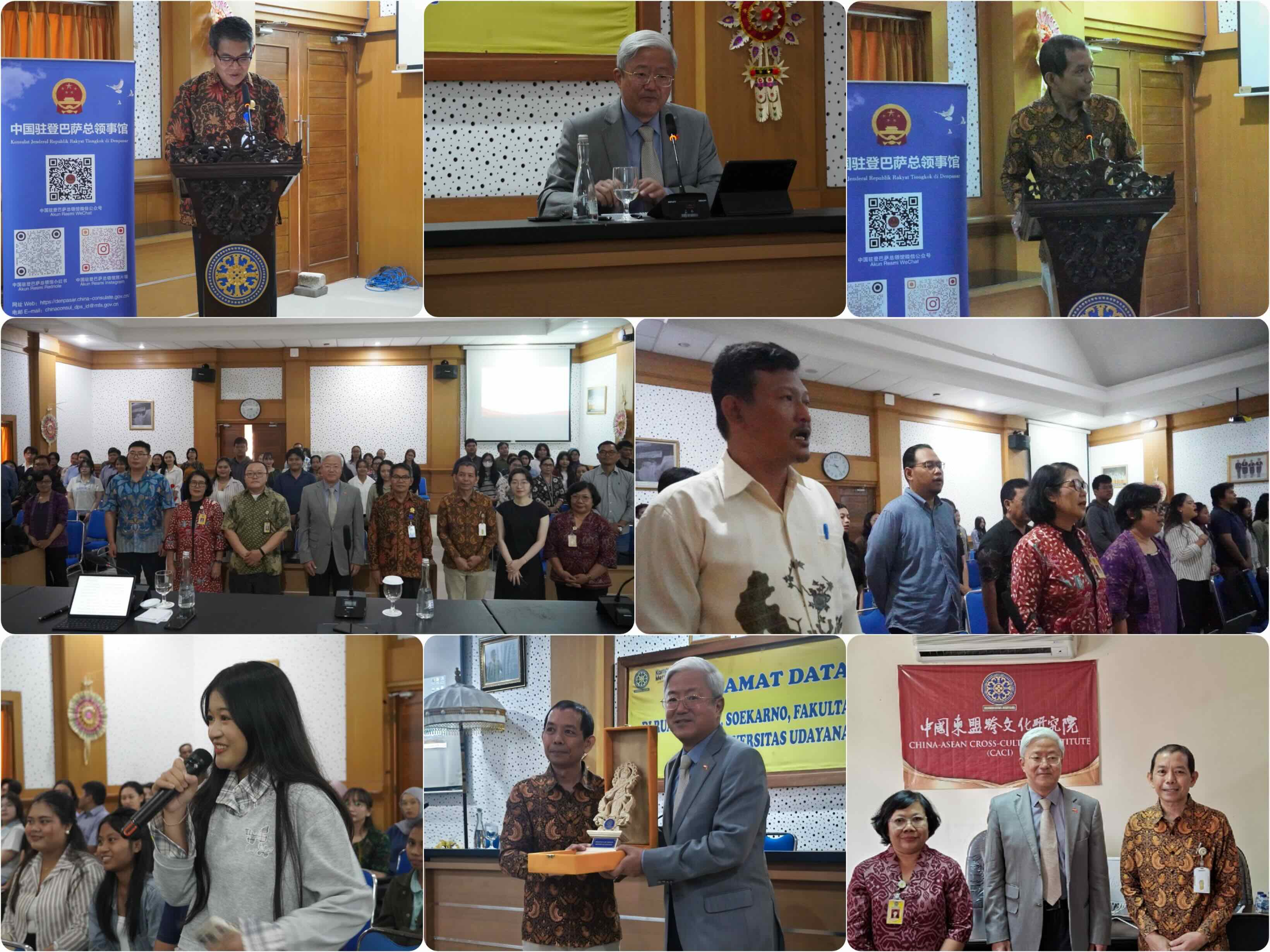
DENPASAR – The Faculty of Humanities, Udayana University (Unud), held a Guest Lecture titled "From the Long March of the Chinese Red Army to the Fifth Plenary Session of the 20th Central Committee of the CPC: China’s Spiritual Core and Path of Progress in the New Era" on Wednesday, November 11, 2026. Starting at 09:00 WITA in the Soekarno Room, Poerbatjaraka Building, Faculty of Humanities, Unud, the event was attended by students and academic members from the Faculty of Humanities, the Faculty of Law, and the Faculty of Social and Political Sciences of Udayana University.
The program began with the singing of the national anthem, Indonesia Raya, and a joint prayer, followed by welcoming remarks from the Dean of the Faculty of Humanities, Unud, Prof. I Nyoman Aryawibawa, S.S., M.A., Ph.D. He expressed his respect to the Vice Rector for Academic and Student Affairs as well as the speaker, while warmly welcoming the Consul General on this inaugural visit as a valuable opportunity for the academic community to learn about Chinese history.
The event was then officially opened by the Vice Rector for Academic and Student Affairs of Unud, Prof. Ir. I Nengah Sujaya, M.Agr.Sc., Ph.D. He expressed gratitude for the presence of the Consul General of the People's Republic of China (PRC) in Denpasar, Mr. Zhang Zhisheng, emphasizing that a nation is shaped by its history and encouraging students to build a comprehensive, critical, and objective understanding.
"The ability to understand is crucial for the younger generation. Listen actively, learn actively, and do not hesitate to raise your hand to ask questions. Open-mindedness and critical thinking are essential," said Prof. Sujaya, expressing hope that historical and cultural ties between Indonesia and China would serve as a foundation for future research collaborations and academic exchanges.
Entering the main session, Mr. Zhang Zhisheng highlighted two major events separated by 90 years yet closely interconnected: the Long March and the Fifth Plenary Session of the 20th Central Committee of the Communist Party of China (CPC). According to him, understanding the CPC, which now has over 100 million members and has governed for 77 years since the founding of the PRC in 1949, is key to understanding modern China's progress.
Mr. Zhang reviewed China's historical journey from the decline of the Qing Dynasty, the defeat in the 1840 Opium War, to the suffering caused by colonialism, noting historical parallels with Indonesia. Efforts to save the nation included the 1911 Xinhai Revolution, which established the Republic of China era (1912–1949), and the May Fourth Movement of 1919, which introduced Marxist thought. Following the founding of the CPC in July 1921 in Shanghai and brief cooperation with Dr. Sun Yat-sen in 1924, conflict led to the Chinese Civil War (1946–1949) and the establishment of the PRC in 1949.
In depth, he examined the Long March (October 1934–October 1936), during which core Red Army troops, mostly aged 18 to 19, executed a strategic shift spanning roughly 13,000 kilometers from southeastern to northwestern China. Enduring over 600 battles and extreme terrain, the force of around 86,000 soldiers was reduced to approximately 7,000 survivors. This event marked a turning point for the CPC's leadership independence through the 1935 Zunyi Conference and strengthened national unity against the Japanese invasion until Japan's surrender in 1945.
According to Mr. Zhang, the Long March, named by Life magazine in 1998 as one of the 100 most important world events of the past millennium, bequeathed three core spiritual values: prioritizing national interests through people's unity, self-reliance and seeking truth from facts without foreign dictation, and sincere devotion to the people. He cited the story of the "Half a Quilt" in November 1934, when three female soldiers cut their only quilt in half to give to a poor elderly woman named Xu Jiexiu, alongside accounts of soldiers digging wells and helping villagers harvest crops.
This spiritual legacy continues in China's development direction toward the PRC's centenary goal in 2049 through strict party governance and anti-corruption efforts serving the public interest. He also encouraged students in Bali to study China's development and seize opportunities in economic cooperation, trade, and cultural exchanges between Indonesia and China.
During the interactive Q&A session, three Faculty of Humanities students posed critical questions: Rama Dean (History), San (Archaeology), and Dayu (Balinese Literature). Responding to Rama Dean on whether the Long March marked the birth of military strategy or a strategic retreat, Mr. Zhang explained that the shift saved the revolutionary "flame" from destruction and became a turning point for revival. Answering San on how to educate ordinary people amidst widespread illiteracy and poverty, he emphasized that the approach relied not merely on theory, but on tangible actions such as agrarian reform and strict military discipline. Meanwhile, addressing Dayu on shifting the revolutionary base from cities to rural areas, he noted that China's predominantly agrarian population made winning peasant support the most realistic path.
Closing the lecture, Mr. Zhang appreciated the enthusiasm of Udayana University's academic community and invited students to keep strengthening Indonesia–China friendship. The event concluded with the presentation of a memento by the Dean of the Faculty of Humanities, Unud, to the Consul General of the PRC, followed by a group photo session.
UDAYANA UNIVERSITY