 ENG
ENG
 INA
INA
Fostering Buduk Village: Faculty of Humanities Conducted Lontar Conservation Program with the Mengwi District Socialialization Team
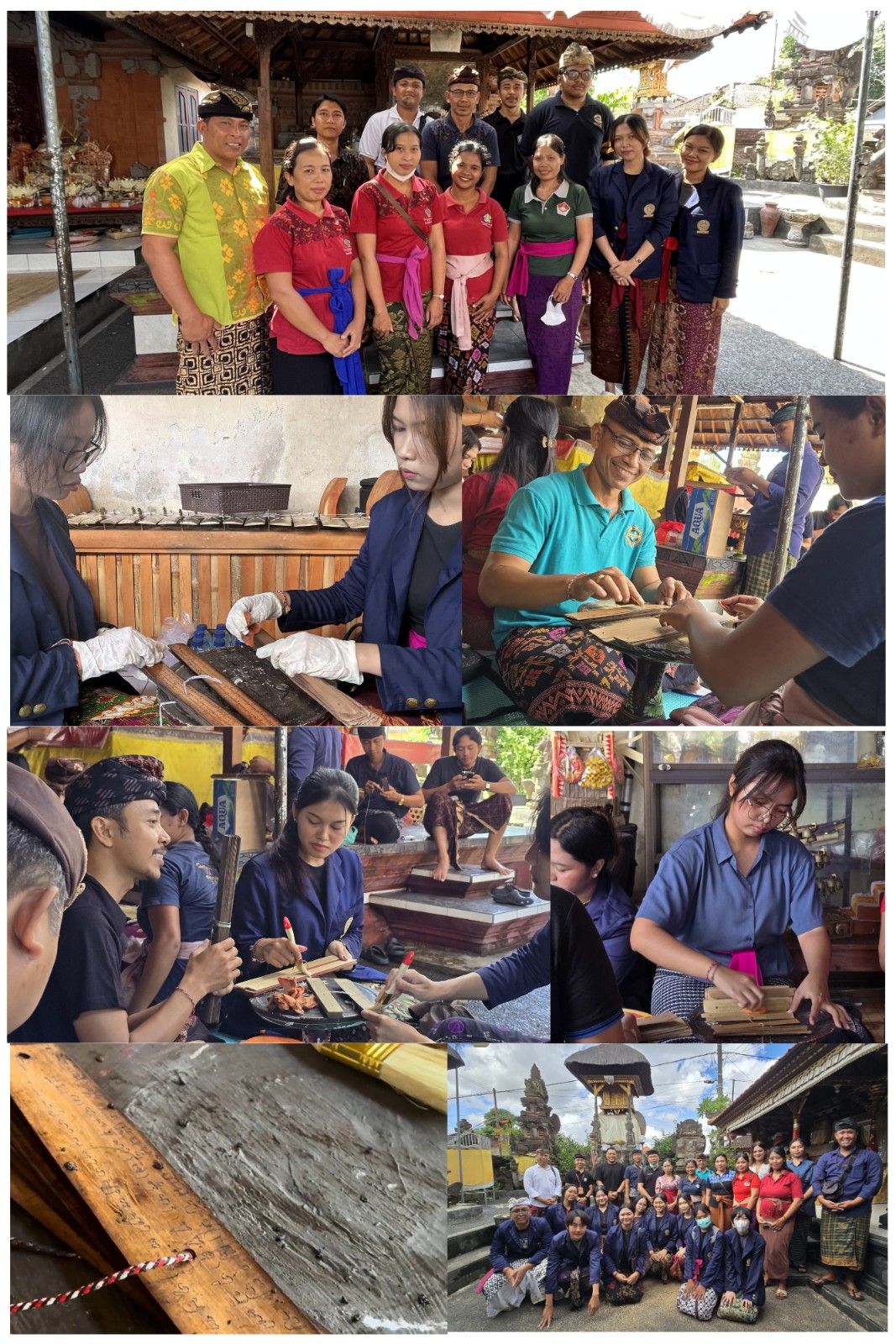
Buduk, Badung – In an effort to preserve one of the legacies of past civilizations, the Buduk Village Socialization Team of the Faculty of Humanities is conducting a palm-leaf manuscript conservation program in collaboration with the Mengwi District Balinese Language Socialization Team (now renamed the Operational Service Manager). This activity has been carried out at Griya Gede Simpangan, Buduk Village since May 19, 2026, and has entered the stage of data collection on the contents of the palm-leaf manuscripts as part of compiling a catalog of the palm-leaf manuscripts stored there.
Ida Bagus Adi Santika as Chairman of the Lontar Baga (Red Section) of Mengwi District, who is also part of the Socialization Team, said that lontar conservation activities are a preservation step to maintain the continuity of the intellectual and cultural heritage contained in the lontar manuscripts left by ancient elders. "Bali is very rich in manuscripts, especially ancient manuscripts are inherited from ancestors or previous ancestors. The contents of which are very important for the actual existence of Bali itself. These contain cultural values, local wisdom values and knowledge values," explained Adi Santika when met at a conservation activity on June 2 2026.
Meanwhile, the Chairman of the Buduk Village Fostering Team, Gusti Ayu Putu Dian Oktamaharani, explained the reason behind selecting Griya Gede Simpangan as the location for this conservation program. "Griya Gede Simpangan Manuaba has a variety of lontar manuscripts. The lontar manuscripts found at Griya Gede Simpangan Manuaba are tetamian, or inherited, and most of them were written by the Griya family. The lack of any attempt to catalog the lontar manuscripts at Griya Simpangan Manuaba is the main reason we are carrying out conservation and cataloging at Griya Simpangan Manuaba," said Dian.
Then Adi Santika, part of the Socialization Team, who frequently participates directly in conservation activities, explained the series of stages involved in the lontar conservation process. Adi Santika explained that the conservation process begins with identifying the condition of the manuscript to determine the appropriate treatment. After that, the lontar is cleaned with a brush to remove dust and dirt, then treated with citronella oil to maintain its suppleness and protect it from destructive insects. Afterward, the palm leaf, consisting of several pages, is left open so that each side, which has been treated with citronella oil, can be properly absorbed and prevent moisture from forming if immediately covered. Adi Santika also added that after being oiled, the palm leaf should not be exposed to direct sunlight. "Don't dry it in the sun. Just let it dry naturally," he added.
After the conservation process completed, the catalogue phase carried out to record the manuscript's identity, including the number, title, type of manuscript, first and last sentences, author, and ownership information. "Now, cataloging isn't about reading the entire manuscript but rather determining the first step, and assigning a numbering, just like in a library," said Ida Bagus Adi Santika.
Moreover, after the identification process, the socialization team determined that there are 71 lontar manuscripts stored in the Griya Gede Simpangan merajan. These manuscripts vary in size and number of pages. Furthermore, the manuscripts were in various condition. Some are intact and arranged sequentially according to page number. Others found disorganized, damaged, or even illegible conditions. These dozens of lontar manuscripts are written using Balinese script in Old Javanese (Kawi). The lontar manuscripts cover various fields of knowledge, including natural sciences or usada, tattwa (psychology/philosophy), Babad (history and geography), suastra (literature), and various other categories of knowledge.
This lontar conservation activity is not only an effort to preserve ancient manuscripts but also expected to raise awareness among the younger generation about the importance of preserving cultural heritage. Ida Bagus Adi Santika, Head of the Mengwi District Lontar Association, hopes that the involvement of the younger generation in lontar preservation will continue to increase in the future. "As the younger generation, it is also important to care for and preserve the lontar heritage in all aspects," said Ida Bagus Adi Santika.
The Chairman of the Buduk Village Fostering Team, Gusti Ayu Putu Dian Oktamaharani, expressed her hopes for the conservation activities. "We hope that this conservation activity can protect, save, and care for these ancient manuscripts and their contents. We also hope that the next generation will take a closer look at and develop an interest in preserving and researching the contents of these manuscripts."
.jpg)
UDAYANA UNIVERSITY