 ENG
ENG
 INA
INA
Indonesian Literature Guest Lecture at Faculty of Humanities Udayana University Discusses Child Language Acquisition in Multilingual Contexts
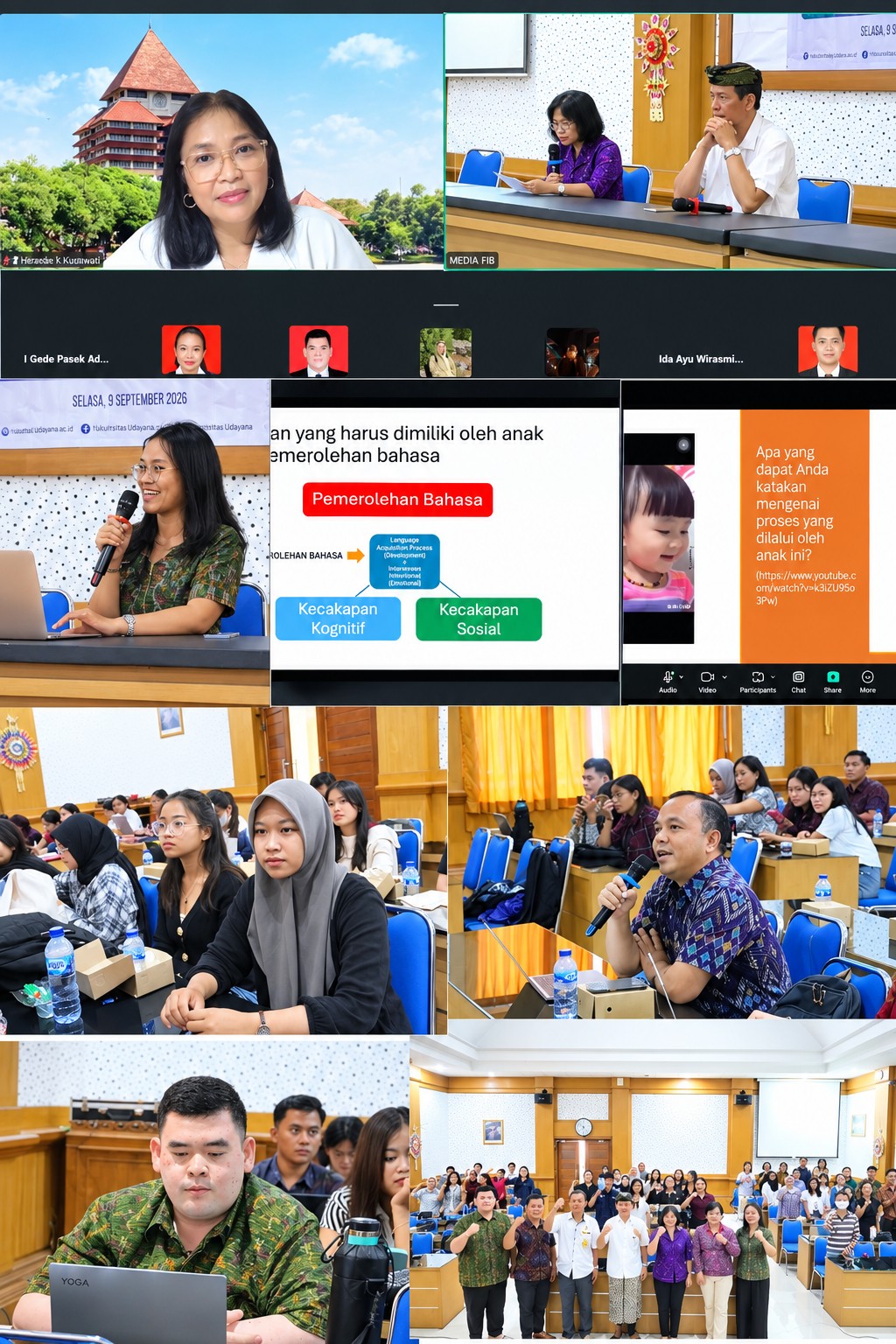
Denpasar — On Tuesday (09/08/2026), the Bachelor of Indonesian Literature, Faculty of Humanities, Udayana University held a guest lecture discussing the topic of child language acquisition in multilingual contexts. The guest lecture was attended by students from the Bachelor of Indonesian Literature. The event was held at the Poerbatjaraka Building, Soekarno Room. Dr. Bernadette Kushartanti, M.Hum., lecturer and Head of the Bachelor of Indonesian Literature at the University of Indonesia was invited as the speaker and accompanied by Ni Komang Diah Restu Swari, S.Pd., M.A. as the moderator from Bachelor of Indonesian Literature, Faculty of Humanities, Udayana University.
In her presentation, Bernadette raised the issue of child language acquisition from both psycholinguistic and sociolinguistic perspectives. She began her material by explaining the fundamental differences between three terms often confused in language studies: language, dialect, and variation. "Language is a broad communication system with its own grammar, vocabulary, and pronunciation. A form of speech is usually recognized as a distinct language if it cannot be mutually understood with another language, although political and cultural factors also influence that status. Dialect, on the other hand, is a regional or social form of language that differs in pronunciation, vocabulary, and sometimes grammar, but remains rooted in the same language. Meanwhile, variation is the broadest term, encompassing all linguistic forms, including languages, dialects, accents, sociolects, and formal as well as informal speech registers. These three concepts are central topics in sociolinguistic studies," said Bu Kiki, as Bernadette is often called.
She also discussed the concept of hierarchy in language acquisition. According to her, the assumption that language acquisition is purely hierarchical needs to be corrected. A child learning language, she explained, is not only required to master communicative competence or the ability to distinguish correct from incorrect speech, but must also possess knowledge and skill regarding when a particular language is appropriate to use.
Bernadette emphasized that the social environment plays an important role in children's language acquisition, because the way an utterance is spoken or shortened is influenced by social factors. Therefore, the study of language acquisition cannot rely solely on psycholinguistics, but also requires sociolinguistic and anthropolinguistic approaches. For example, children's pronunciation is usually good for a single syllable, but becomes irregular when combining two syllables. Even so, the child feels their pronunciation is correct, which often leads parents to repeat it in order to correct them. According to Bernadette, this shows that children's speech does not solely reflect the perfection of their speech organs.
Bernadette explained that language acquisition does not always occur in a single variety as her second topic. Referring to the view of a psycholinguistics expert, she outlined three conditions of first language acquisition: Monolingual First Language Acquisition (MFLA), Early Second Language Acquisition (ESLA), and Bilingual First Language Acquisition (BFLA), which occurs within the home environment. "There are times when a child acquires their first language before being followed by a subsequent language, but there are also children who receive more than one language from the very beginning," Bernadette explained.
She also described three forms of language differentiation that children undergo when exposed to more than one language. First, the child creates a single combined system from the two languages they hear. Second, the child is able to distinguish between the two languages and acquires them without mutual influence. Third, the child distinguishes between the two languages, but their development continues to influence one another.
Bernadette also discussed the effects of bilingualism on children's language development, including its influence on the direction and pace of language development. She noted that bilingual development can have different impacts on each child: some children are able to develop competence in both languages with ease, while others experience difficulty learning both languages. This condition, she said, greatly depends on prevailing social and cultural values, including the values instilled within the family.
At the end, she highlighted the influence of culture on the development of children's bilingualism. According to her, if bi- or multilingualism is considered important within a culture, children who grow up bilingual tend to acquire more language abilities compared to monolingual children. This guest lecture provided an opportunity for Indonesian Literature students at Udayana University to deepen their understanding of child language acquisition, particularly within multilingual societies such as Indonesia, while also enriching their academic perspectives in examining linguistic phenomena around them.

UDAYANA UNIVERSITY