 ENG
ENG
 INA
INA
International Collaboration: Faculty of Humanities, Udayana University and Monash University, Australia Hold Semiotics and Multimodality Workshop
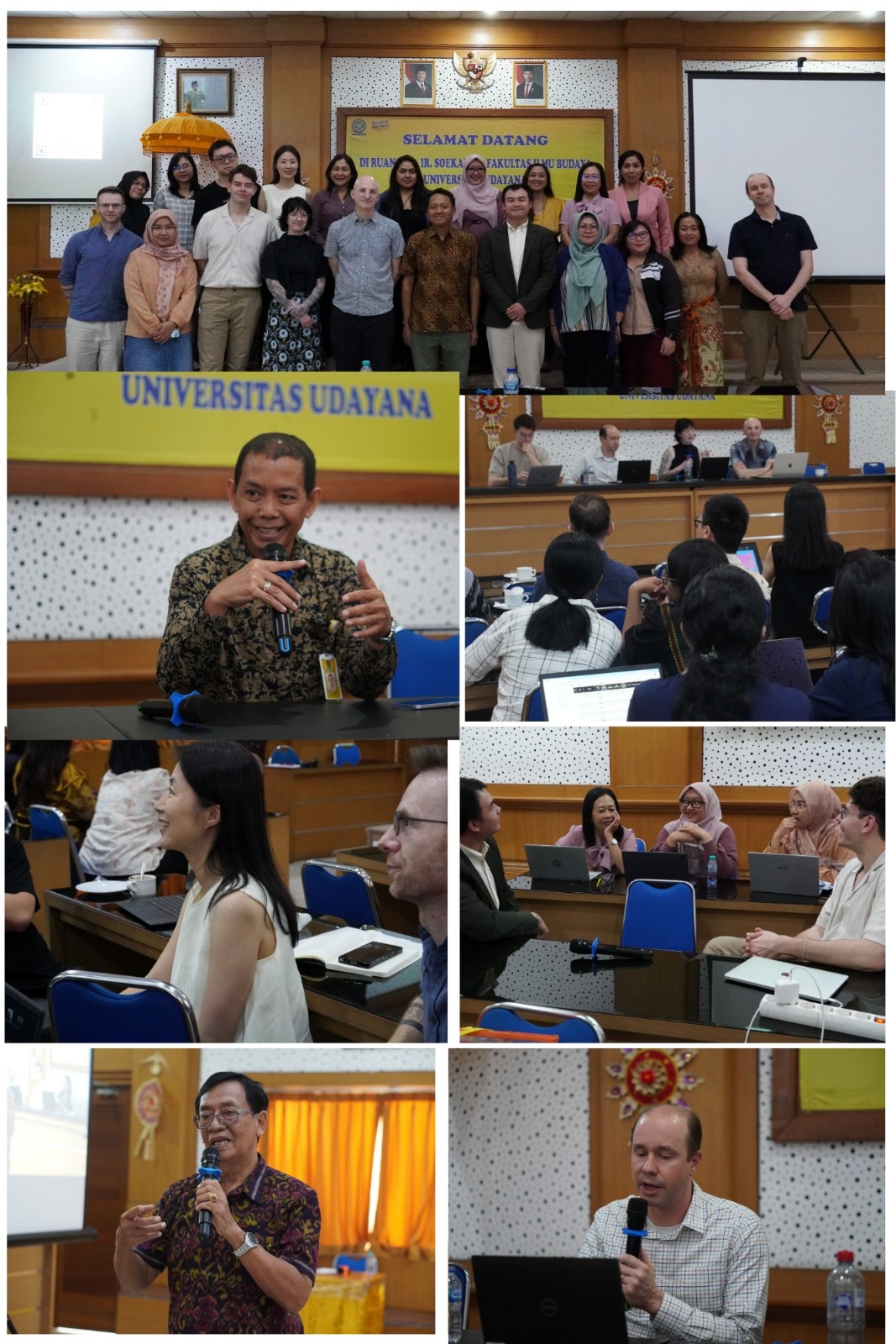
Denpasar, June 3, 2026 - The Bachelor
of English Literature (BoEL) Study Program, Faculty of Humanities, Udayana
University, in collaboration with Monash University Australia,
organized a workshop entitled the "Monash/Udayana Semiotics and
Multimodality Workshop," held from June 3-4, 2026. The workshop was fully
funded by Monash University, Australia via the Academy of Korean Studies
Laboratory Grant. Conducted in the Dr. Ir. Soekarno Meeting Room on the 4th
Floor of the Poerbatjaraka Building, Faculty of Humanities, Udayana University, and in a hybrid format via Zoom,
the workshop brought together linguists from Indonesia and Australia to unpack
how humans create and interpret messages. It highlighted how language, cultural
habits, and chosen communication channels intertwine to construct meaning. The workshop
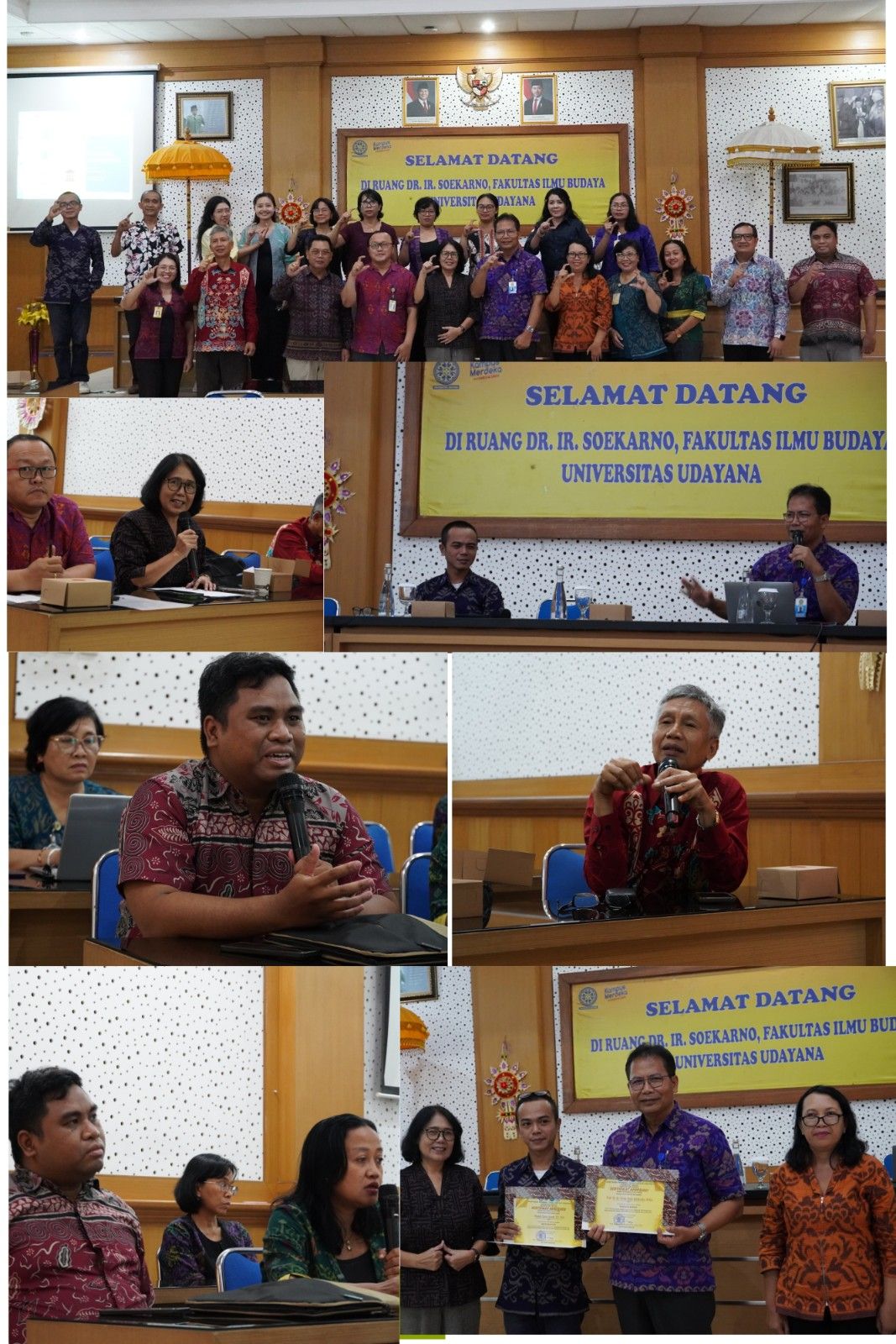
was also attended by the Dean of Faculty of Humanities, Udayana University, the Coordinator and lecturers of the
BoEL Study Program, as well as Doctoral students in Linguistics.
Commencing the event, Assoc.
Prof. Lucien Brown, representing the Australian team, expressed his gratitude
for the hospitality and professional readiness of Faculty of Humanities, Udayana University. He expressed hope
that the workshop, which featured a team from diverse international
backgrounds, would pave the way for strengthening inter-institutional
collaboration in the future.
Meanwhile, Prof. I Nyoman
Aryawibawa, S.S., M.A., Ph.D., as the Dean of Faculty of Humanities, Udayana University, warmly welcomed the
linguistics experts from Australia and officially opened the event. He
underlined the importance of understanding communication holistically, not
merely through verbal language but through various complementary modes
(multimodal), and emphasized that the workshop is a tangible manifestation of
the faculty's commitment to building and developing the academic capacity of
students and lecturers within the Faculty.
The keynote speakers for this workshop
were Assoc. Prof. Lucien Brown and Dr. Daniel Pieper from Monash University,
Dr. Eldin Milak from Curtin University, and Dr. Jessica Kruk from The
University of Western Australia. During the main panel session, the core of the
discussion focused directly on the expansion of South Korean language and pop
culture across the Asia-Pacific through the lens of transnational semiotics.
Assoc. Prof. Lucien Brown
highlighted the shift in meaning (resemiotization) of the word
"Oppa." He dissected how the term, which originally denoted kinship,
has now been commodified into a standard of idealized masculinity, and is even
frequently intertwined with practices of exploitation and online romance scams
outside Korea. Aligning with these findings, Dr. Jessica Kruk explored the
finger heart gesture, which is prevalent in Indonesian mass media. The
recontextualization of this gesture proves that the finger heart has evolved
from a mere pop culture trend into a symbol of modern identity for
transnational youth.
The discussion continued with a
focus on linguistic structures and orthography, presented by Dr. Daniel Pieper.
Through a case study on the application of the Han'gŭl script to the language
of the Cia-Cia tribe in Southeast Sulawesi, he unpacked the complexities
between Korean linguistic nationalism and its adaptation by communities outside
the country's territorial borders. Complementing this exploration of global
"Koreanness," Dr. Eldin Milak concluded the main session by
dissecting the phenomenon of prefixation, highlighting how the use of prefixes
such as "K-" (as in K-Pop or K-Drama) and "Han-" dictates
the formation of new meanings in global society.
Following the presentations from
the keynote speakers, the workshop proceeded with a presentation session
highlighting the application of semiotics from traditional physical spaces to
digital landscapes. The exploration of eastern Indonesian locality was
presented by Polce Aryanto Bessie, who analyzed the cognitive meaning of
billboards in Kupang City, alongside research by Agnes Odiyanti Manek regarding
"malak noni" as a semiotic representation of animal ownership and the
cultural identity of the Dawan ethnic group. Shifting to the digital realm,
Rabiatul Adawiah presented a multimodal analysis of the studio layout of the
YouTube podcast "LOGIN," which visually constructs authority in
interfaith dialogue, while the study by Matthew Skidmore and Levi Dubridge
deconstructed the affective construction of Korean-Australian cultural identity
through visual narratives on Instagram. Completing this diverse discourse, Marc
Yeo presented the polemics of Jawi-scripted signboards in Malaysia through the
lens of ethnic identity politics and religiosity.
Entering the second day, 4th
June 2026, the workshop shifted its focus to strengthening the participants'
research skills through two interactive practical sessions. In the first
session entitled "Linguistic Landscapes," guided by Dr. Jessica Kruk
and Dr. Eldin Milak, participants were equipped with methodological frameworks
to analyze how meaning is produced through visual texts in public spaces. This
theory was immediately applied in group discussions, where participants were
challenged to guess the country of origin of a café purely by analyzing spatial
semiotic elements, such as paint colors and object arrangements within it.
This reinforcement of research
skills continued in the session on "Pragmatic and Social meanings of
gesture and multimodality" with Assoc. Prof. Lucien Brown and Dr. Daniel
Pieper. In this session, which trained the ability to identify and code bodily
visual practices, participants were invited to dissect the layered meanings
behind various interaction clips, ranging from the tactics of hand movements in
presidential debates to emphasize crucial points, to the analysis of body
gestures in Korean dramas that implicitly demonstrate superiority and
relationship disparities among the characters.
The organization of this workshop is expected to be a solid stepping stone in cementing Faculty of Humanities, Udayana University's international collaborations. Moving forward, it is hoped that the research skills acquired by the participants can be actualized into critical, innovative linguistic research works that are relevant to contemporary challenges.
.jpeg)
UDAYANA UNIVERSITY