 ENG
ENG
 INA
INA
Made Narawati Receives Doctoral for the Research on “A Model to Counter Stigma Against Former Female Inmates in Social Life in Denpasar”
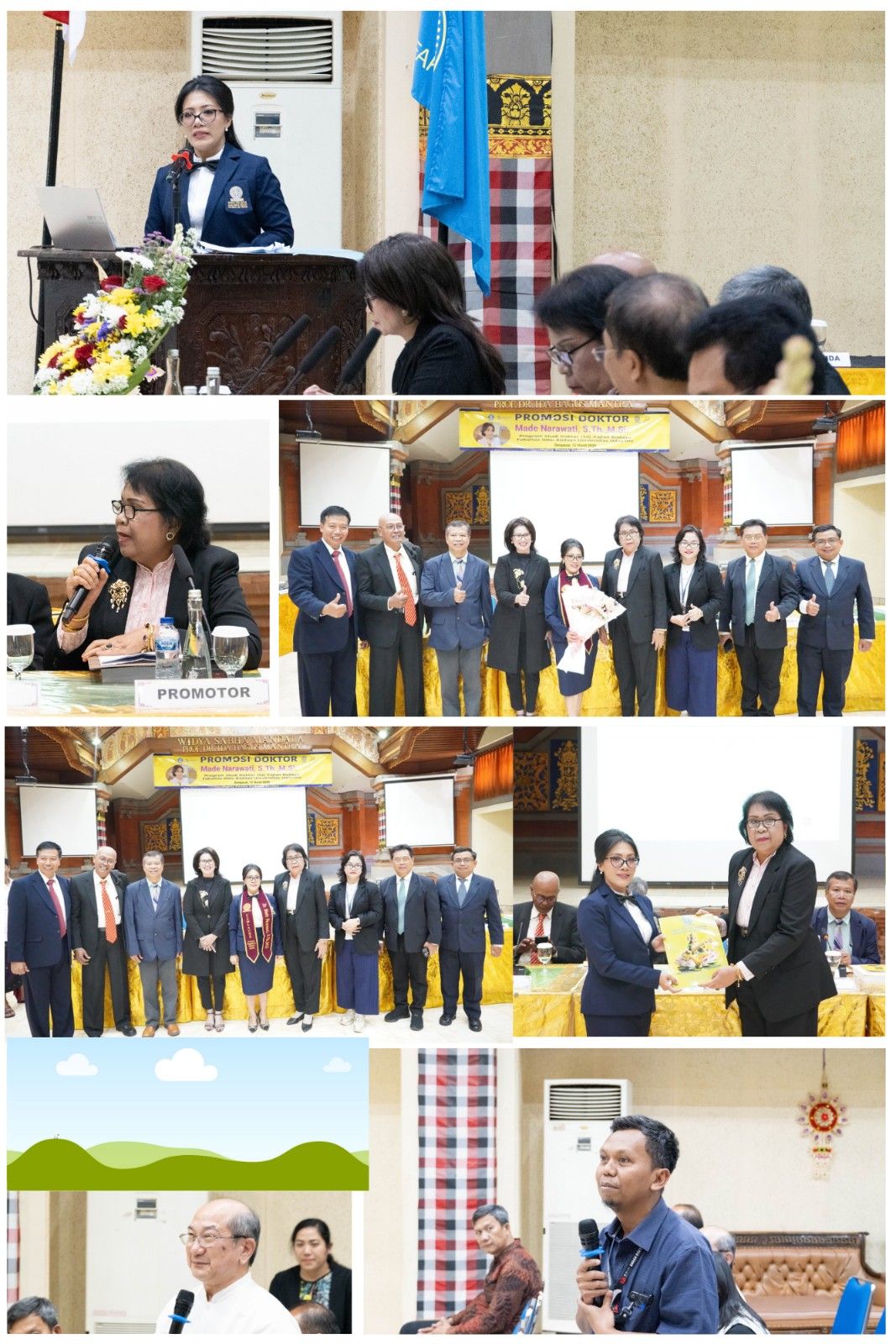
On Thursday, March 12, 2026, the Faculty of Humanities Udayana University once again held an Open Doctoral Defense for the Doctoral Program in Cultural Studies. The defense took place in the Widya Sabha Mandala Auditorium, 3rd Floor of the Ida Bagus Mantra Building, Faculty of Humanities Udayana University. The doctoral candidate, Made Narawati, S.Th., M.Si.., presented her dissertation titled “A Model for Counter-Stigma Among Former Female Inmates in Social Life in Denpasar City.” During the defense, the candidate successfully defended her dissertation and was declared to have passed with the grade “cumlaude”. With this graduation, she is recorded as the 277th Doctoral graduate in the Faculty of Humanities and the 303rd Doctoral graduate in the Doctoral Program in Cultural Studies, Doctoral Program, Faculty of Humanities, Udayana University.
At this doctoral defense, the Chairman of the Dissertation Examination, Prof. Dr. I Nyoman Darma Putra, M.Litt., accompanied by Committee Members Prof. Dr. Ni Luh Sutjiati Beratha, M.A., Prof. Dr. I Nyoman Suarka, M.Hum., Prof. Dr. I Nyoman Weda Kusuma, M.S., Dr. Ida Bagus Gde Pujaastawa, M.A., Dr. I Wayan Suardiana, M.Hum., Dr. A.A.A. Ngr. Tini Rusmini Gorda, SH., MM., MH., Dr. I Made Anom Wiranata, SIP., M.A., and Dr. Nuning Indah Pratiwi, S.Sos., M.I.Kom., C.Med.
This dissertation is motivated by the author’s observations of female former inmates who have served their period of incarceration and are now reintegrating into society. Social stigma causes these women to face difficulties in socializing and interacting with their social environment. However, for female former inmates, this stigma actually drives them to rise up and fight to establish an image of strong, independent women within society. Self-acceptance and family support for female former inmates, as well as the roles of various stakeholders, are crucial to the success of social reintegration. Therefore, the focus of this study is to design a counter-stigma model for female former inmates. Through a critical and emancipatory cultural analysis, this study examines the forms of counter-stigma, its underlying causes, and the counter-stigma model for female former inmates in Denpasar City.
The main findings of the dissertation are empirical and theoretical. Empirically, this study highlights counter-stigma practices toward female former inmates, in contrast to previous studies that generally only addressed stigmatization in social life. This study demonstrates that female former WBP are capable of restoring their self-image through social practices rooted in the Balinese local wisdom value of “jengah,” which functions as a habitus in social life. This image restoration process is reinforced through the active role of female former WBP as subjects, with the support of seven stakeholders formulated in the “PELITA MAS” Heptahelix Model, namely a collaboration between the government, educators, NGOs, industry, community leaders, families, and the mass media.
Theoretically, this study develops the concept of transformation from agent to agency through a synthesis of the theories of Pierre Bourdieu and Anthony Giddens. This concept explains that agents can build agency through the process of habitus structuring, by utilizing various forms of capital—such as social, educational, skill-based, economic, and symbolic capital—rooted in the value of “shame.” Collaboration among actors in the “interactive forceful agent” model demonstrates that agents are not always hegemonic but can play a supportive role in empowering former female inmates as agents of change. These findings also indicate that stigma, typically perceived as negative, can be transformed into constructive motivation for former female inmates to build more independent and resilient lives within the social structure of society.
Closing the Open Examination Session, Prof. Dr. Ni Luh Sutjiati Beratha, M.A., as the Promotor, stated that throughout her studies, the doctoral candidate demonstrated a high level of dedication through hard work, sincerity, and discipline in refining her academic work, as evidenced by the increasingly improved and significant progress of her dissertation over time. She emphasized that achieving a Doctoral degree is not the end of an academic journey, but rather the beginning of a greater responsibility in the world of academia. On the same occasion, she also extended her congratulations to the doctoral candidate and her family, while expressing her hope that the candidate would continue to produce work, continue to develop herself and learn, uphold academic ethics, and make meaningful contributions to the advancement of science, the institution, and society.
UDAYANA UNIVERSITY