 ENG
 INA
Doctoral Program in Linguistics at FIB Udayana University Holds Guest Lecture with Undip Professor, Exploring CORTEX Dictionary Lab in Corpus-Based Lexicography
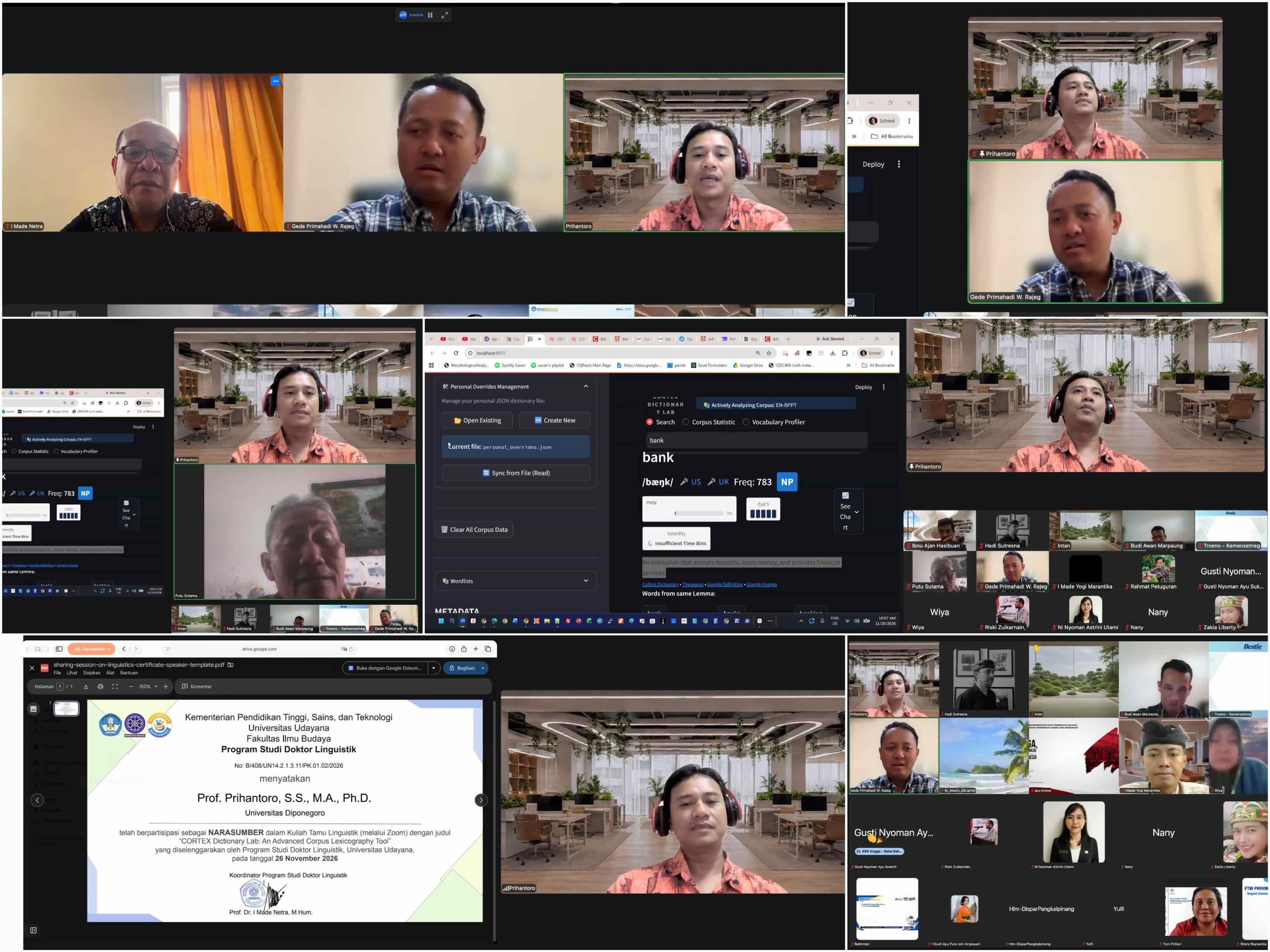
DENPASAR – The Doctoral Program in Linguistics, Faculty of Humanities (FIB), Udayana University hosted a Linguistics Guest Lecture titled "CORTEX Dictionary Lab: An Advanced Corpus Lexicography Tool" online via Zoom on Thursday (November 26, 2026) at 10:00 WITA. The event was organized in collaboration with the Computer-assisted Lexicology and Lexicography (CompLexico) research group, the Digital Humanities Landscape at the Faculty of Humanities (DUMILAH) initiative, and the Centre for Interdisciplinary Research on the Humanities and Social Sciences (CIRHSS).
Attended by approximately 79 participants from various academic and research backgrounds, the guest lecture featured Professor of Corpus Linguistics from Universitas Diponegoro, Prof. Prihantoro, S.S., M.A., Ph.D., as the speaker. The event was officially opened by the Coordinator of the Doctoral Program in Linguistics at FIB Udayana University, Prof. Dr. I Made Netra, M.Hum., and moderated by lecturer and corpus linguistics researcher Gede Primahadi Wijaya Rajeg, Ph.D.
In his opening remarks, Prof. I Made Netra noted that the guest lecture is part of the program's regular annual academic agenda aimed at broadening insights, deepening scholarly perspectives, and strengthening inter-university collaboration—particularly with Universitas Diponegoro. He highlighted that lexicography has evolved into an increasingly complex discipline alongside advances in digital technology and artificial intelligence (AI), transforming how language is documented, analyzed, and represented.
"For those of us in a doctoral academic environment, we must not only understand the theories and concepts of lexicography, but also recognize, evaluate, and utilize technological advancements to produce innovative research that makes a tangible contribution to the development of linguistics," he stated.
Opening the presentation session, Gede Primahadi Wijaya Rajeg introduced Prof. Prihantoro’s academic background as Coordinator of the Master’s Program in Linguistics at Universitas Diponegoro, Director of the Corpus Approaches to Digital Humanities and Social Science (CARDHISS) Research Group, Chair of the Indonesian Lexicographers Association (Persaudaraan Pekamus Seluruh Indonesia/Perkamusi), and a Ph.D. alumnus of Lancaster University, United Kingdom.
In his lecture, Prof. Prihantoro discussed the evolving role of modern dictionaries, which have expanded beyond mere meaning-lookup references into corpus-based resources that also serve as writing guides. After walking participants through semi-automatic dictionary compilation workflows using established platforms such as Sketch Engine linked with Lexonomy, he introduced CORTEX Dictionary Lab, a free web-based corpus lexicography tool he developed.
Unlike several paid tools that require cross-platform integration, CORTEX Dictionary Lab is designed as an integrated, theory-neutral ecosystem. The tool supports both monolingual and parallel corpora—whether uploaded from personal files such as ELAN transcriptions, scraped from online sources, or accessed via built-in corpora—and offers analytical features including classified wordlists (CEFR, GSL, AWL), Zipf-scaled frequency bands, temporal volatility charts, N-grams, pattern-grams, and collocations.
One notable innovation demonstrated during the session was the integration of CORTEX Dictionary Lab with artificial intelligence (AI) models, such as local Ollama and Google Gemini, via the Edit Sense feature. This allows dictionary compilers to rapidly generate draft definitions while keeping final editorial curation firmly in the hands of the lexicographer. Nevertheless, Prof. Prihantoro candidly noted current development challenges, including computational constraints on the cloud community server and the absence of persistent storage, with future plans aimed at migrating to a private server.
The discussion session proceeded interactively, with participants raising questions ranging from building parallel corpora from subtitles and language documentation archives, to software recommendations for documenting traditional ecolexicons—such as ELAN, FLEx, and Lexique Pro—as well as opportunities to develop a Part-of-Speech (POS) tagger for the Balinese language.
Responding to a question from Prof. Dr. Drs. Putu Sutama, M.S. regarding the extent to which CORTEX can assist younger generations in writing local languages that feature speech levels and dialectal variations bound to cultural contexts, Prof. Prihantoro explained that the key lies not merely in the tool itself, but in the richness of pragmatic and sociolinguistic annotations and metadata within the corpus. Once a corpus is equipped with markers for speaker relationships and pragmatic functions, corpus-based tools can effectively help users identify contextually appropriate lexical choices.
The guest lecture concluded with the symbolic presentation of a speaker certificate by the moderator as a token of appreciation from the Doctoral Program in Linguistics at FIB Udayana University, accompanied by an invitation for future research collaboration and shared utilization of corpus tools.
UDAYANA UNIVERSITY