 ENG
ENG
 INA
INA
The Bachelor of Archaeology Udayana University held a webinar of “Stone Age and Genomic Analysis”
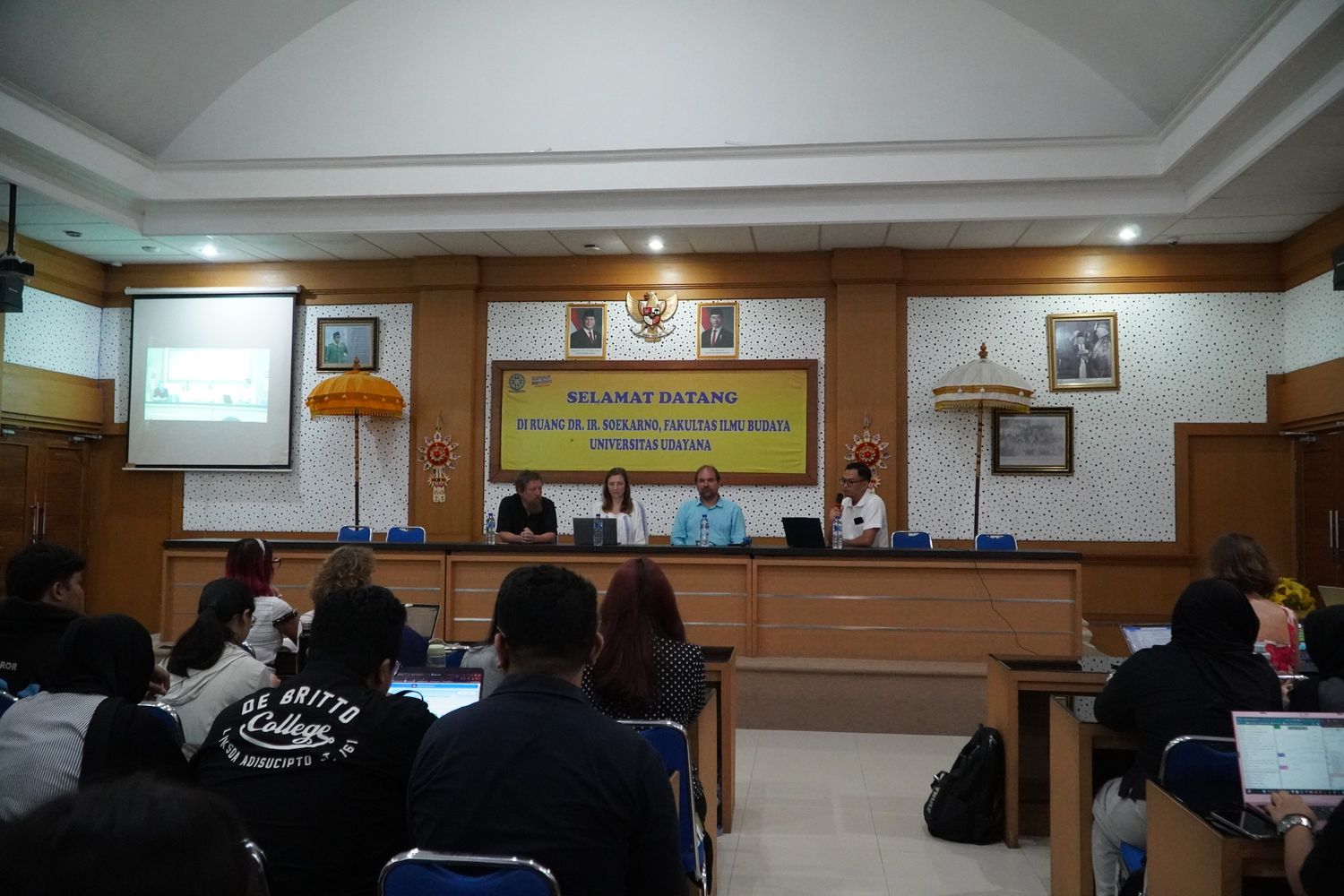
A webinar entitled “Stone Age and Genomic Analysis” held on Monday, November 25, 2025, by the Bachelor of Archaeology. It took place in the Soekarno Room, Faculty of Humanities, and open to the public via the Zoom platform. This event served as an important scientific forum for researchers, academics, and students interested in prehistoric archaeology and the development of genetic research in understanding human history. The activity was hosted by moderator I Made Agus Julianto, S.S., M.Sc., a lecturer from the Bachelor of Archaeology Udayana University, who guided the discussion to ensure it was interactive and comprehensive.
This webinar featured several speakers from the University of Tartu, Estonia. The first panel featured two speakers, Kerkko Nordqvist, Ph.D., and Aija Macane, Ph.D. presented a topic entitled “Stone Age of Northeastern Europe: An Introduction.” In their presentation, they explained the cultural developments during the Stone Age in Northeastern Europe, including settlement patterns, subsistence systems, and artifactual findings that provide insight into the lives of prehistoric communities in the region. The second session was led by Prof. Mait Metspalu presented a topic entitled “What Can We Learn from the Past from Genes? And How?” He explained how genomic analysis has become an important method in tracing the origins of populations, migration routes, and genetic relationships between prehistoric human groups. This webinar was also supported by Drs. Marsis Sutopo, M.Si, Chairman of the Indonesian Archaeologists Association (IAAI), who was represented by Sektiadi, S.S., M.Hum., Secretary General of the Indonesian Archaeologists Association (IAAI), and Prof. I Nyoman Aryawibawa, S.S, MA, Ph.D., Dean of the Faculty of Humanities, whose presence provided opening remarks for the webinar.
Participants were given opportunity to engage in direct dialogue with the speakers, such as asking questions about the material that had been presented. The discussion session was very active, demonstrating the enthusiasm of the webinar participants and their eagerness to ask questions to the speakers. One of them was a participant named Arief Catur, who asked a question related to the migration patterns of early humans. He asked, "Why did humans choose to migrate to Northern Europe? Why didn't they settle on the Balkan coast, for example? Was there a specific area in that region that was particularly suitable?" The questions asked by the participants prompted the speakers to provide more in-depth and focused explanations. The discussion at this webinar grew even more lively with the emergence of new perspectives, attracting other participants to continue the question and answer session.
The webinar ended with a closing statement that the collaboration between archaeology and genomics is an innovative step in understanding the dynamics of humans in the past. Scientific webinars such as this are expected to become a space for sharing knowledge that brings together archaeological studies and genomic analysis more broadly. Furthermore, interdisciplinary research will open new windows for understanding the past and tracing the migration, culture, and evolution of humans.
UDAYANA UNIVERSITY