 ENG
ENG
 INA
INA
Faculty of Humanities Udayana University Conducted ELO Assessment Workshop to Strengthen OBE Quality and Accreditation Preparation
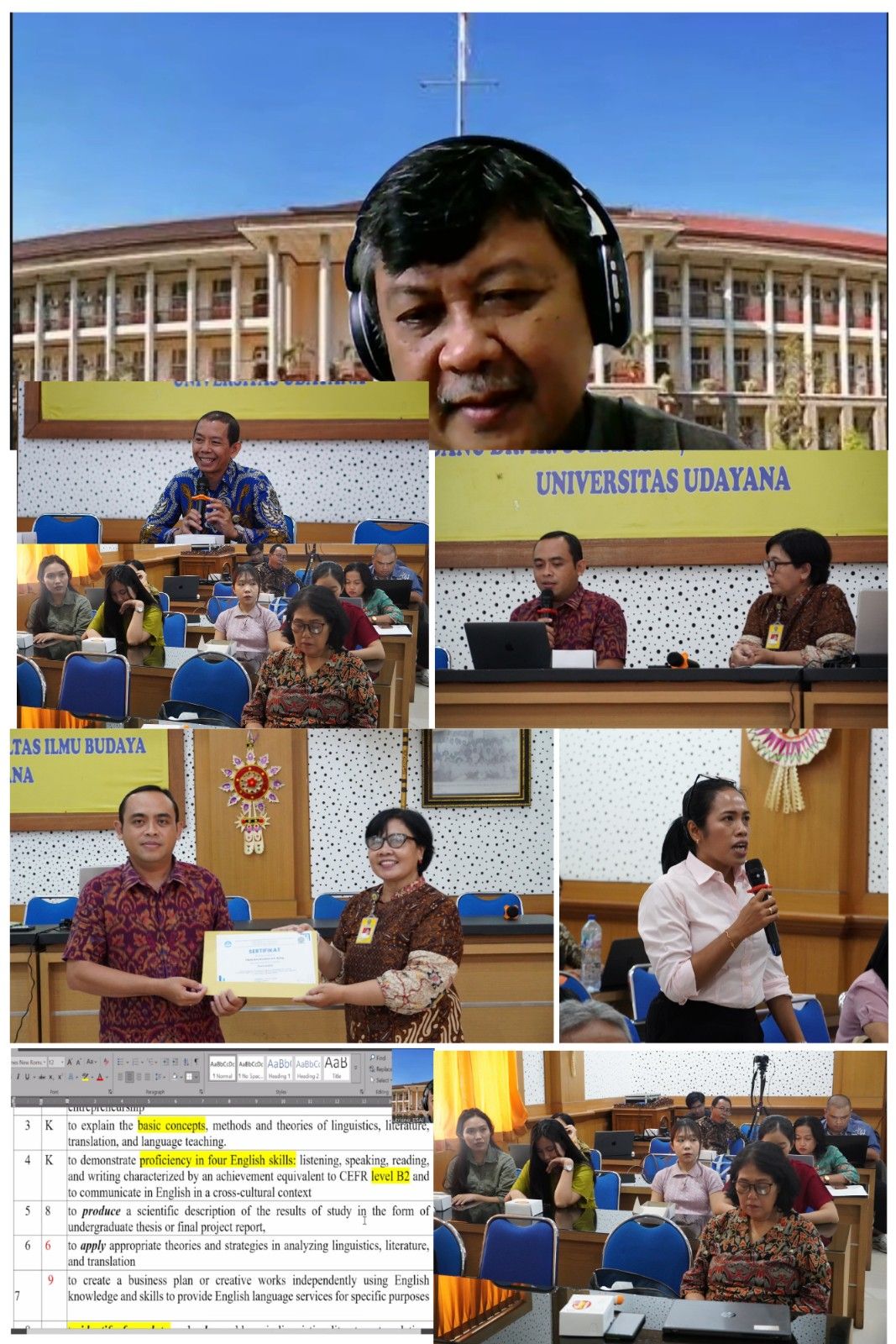
Denpasar, April 29, 2026 - The Learning
Development and Quality Assurance Unit of the Faculty of Humanities, Udayana
University held a hybrid Workshop on the ELO Assessment Workshop. It was
conducted at the Soekarno Room, 4th Floor of the Poerbatjaraka Building,
Faculty of Humanities, Udayana University. The activity was attended by all
leaders within Faculty of Humanities, Udayana University, Learning Development
and Quality Assurance Unit of the Faculty of Humanities, Udayana University
team, Coordinator of Unit of Information and Cooperation Services Faculty of
Humanities Udayana University, Quality Assurance teams for Bachelor's,
Master's, and Doctoral study programs; the task force teams for Bachelor of
English Literature, Bachelor of Japanese Literature, and Linguistics
Doctoral Program; as well as faculty and student representatives.
Opening the workshop, Prof. I Nyoman Aryawibawa,
S.S., M.A., Ph.D., as the Dean of FIB Unud, emphasized that this activity aims
to ensure that students' competencies are optimally achieved through the
implementation of the Outcome-Based Education (OBE) curriculum. An
understanding of this measurement is considered highly crucial and urgent,
particularly for the Bachelor of Japanese Literature and Bachelor of English
literature study programs, which will be conducting re-accreditation this year,
as well as the doctoral program next year. Nevertheless, the Dean asserted that
the optimization of this reporting system must be utilized by all study
programs within the faculty to meet the Key Performance Indicators targets,
serving simultaneously as the faculty's long-term commitment to establishing an
accountable standard of measurement.
The workshop featured two main speakers: Dr. Adi
Sutrisno, M.A., who attended online from Universitas Gadjah Mada and serves as
the President of ESAI (English Studies Association in Indonesia), and Dr. I
Made Arsa Suyadnya, S.T., M.Eng. from the Information Resources Unit of Udayana
University. The session was moderated by Dr. Ni Ketut Widhiarcani Matradewi,
S.S., M.Hum., the Coordinator of Learning Development and Quality Assurance
Unit, Faculty of Humanities, Udayana University.
In his evaluation, Dr. Adi Sutrisno, M.A.
provided an in-depth review of the implementation of the Expected Learning
Outcomes (ELO) within the Bachelor of English Literature Udayana University. He
highlighted inconsistencies in the Lesson Plan documents, where the content
often misaligned with the listed course titles. As a corrective, Dr. Adi
recommended restructuring the ELOs hierarchy to be organized
sequentially—ranging from attitudes and knowledge to general and specific
skills—to ensure a solid academic foundation for students.
Regarding the methods, he emphasized the
application of outcome-based assessment used by setting a minimum attainment
threshold of 70 percent for each course to guarantee the quality standards of
graduates. Furthermore, he encouraged the use of concrete programmatic
assessment instruments, such as conducting independent language proficiency
tests equivalent to TOEFL ITP standards, and utilizing thesis evaluations as a
comprehensive means to assess students' linguistic and literary competencies.
The discussion session following the first
presentation highlighted the technical dynamics and administrative challenges
in implementing the Outcome-Based Education (OBE) curriculum on the ground.
Participants' main attention was directed toward finding efficiency strategies
to reduce the administrative burden on lecturers when compiling evaluation
matrices. Additionally, the forum specifically discussed guidelines regarding
the ideal proportion of Course Learning Outcomes derived from each ELO formulation.
It was also deliberated on the best practices for exam question
weighting—whether it should be measured based on ELO or Course Learning
Outcomes—to ensure the assessment process remains valid, proportional, and
practical for educators.
Proceeding to the second session, Dr. I Made Arsa
Suyadnya, S.T., M.Eng. as the Head of USDI Udayana University presented the
technical guidelines for managing Outcome-Based Education (OBE) assessments.
The implementation of this curriculum requires structured mapping, from
Expected Learning Outcomes (ELO), Course Learning Outcomes (CLO), to the
sub-CLOs, which are linked to specific performance indicators in the RPS. With
this scheme, the weighting of assessment instruments such as assignments,
quizzes, midterms, and finals no longer relies on static percentages but is
dynamically mapped to evaluate the attainment of each indicator.
Responding to concerns regarding the high
administrative burden of inputting grades, he asserted that the SIMAK system
has been equipped with an Excel-based mass grade import feature to simplify
lecturers' workloads. If the assessment matrix is filled consistently, the
system will automatically accumulate the passing percentage according to the
threshold set by the study program. This automation ultimately facilitates the
compilation of centralized assessment portfolios and the printing of students’
ELO transcriptions which are crucial for fulfilling accreditation form
requirements.
The enthusiasm as well as the caution of the
educators in adapting to the SIMAK system were clearly reflected in the
discussion session. The Q&A forum highlighted various technical aspects of
operating the system, ranging from clarification on the mandatory input of all
Expected Learning Outcomes (ELO) into the database to the hierarchical rules
for selecting Course Learning Outcome (CLO) indicators, which must
systematically align with the ELO indicators. Furthermore, this discussion
directly facilitated the solution of technical problems, such as: system
incompatibility anomalies that frequently occur when lecturers input a higher
number of CLOs than the formulated ELOs for a course.
UDAYANA UNIVERSITY